
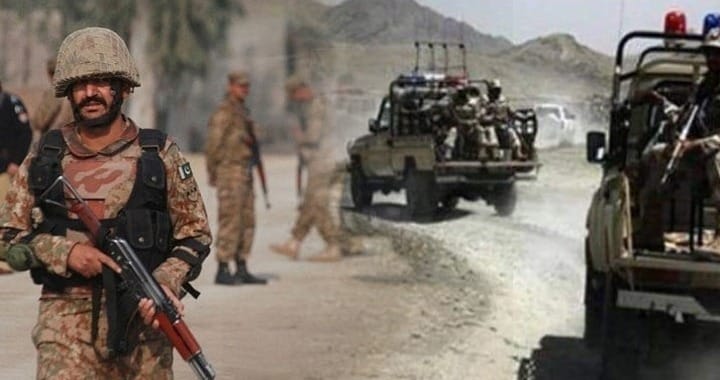
Over the past seven days, Pakistan’s security forces have unleashed an unrelenting wave of intelligence-based and coordinated counterterrorism operations across Khyber Pakhtunkhwa and Balochistan, neutralizing at least 84 terrorists, dismantling facilitation networks, recovering large caches of explosives, and preventing multiple planned attacks, in what appears to be a significant intensification of the state’s zero-tolerance policy against terrorism.
The string of operations, carried out under the broader framework of Azm-e-Istehkam and reinforced by operational campaigns such as Ghazab Lil Haq, signals a clear shift from reactive counterterror responses to proactive, intelligence-led domination of the battlefield.
The week began with revelations exposing the Afghan nexus in cross-border terrorism. In Bajaur, security sources recovered multiple bodies of Afghan terrorists linked to the banned Tehreek-e-Taliban Pakistan (TTP) months after they were killed during a failed cross-border movement amid heavy snowfall in January. A condolence gathering held in Afghanistan’s Paktia province for one of the slain terrorists further reinforced allegations that Afghan nationals continue to operate within TTP structures targeting Pakistan.
Even as the Afghan link resurfaced, terrorists attempted to strike inside Pakistan. In Bannu, a suicide attack targeted a security forces vehicle, martyring three personnel, including a captain, while injuring civilians. Yet the response was immediate. Within hours and in subsequent days, security forces launched repeated intelligence-based operations in Baka Khel, Jani Khel, and surrounding areas, neutralizing multiple terrorists, including notorious figures such as Waheedullah alias Muktiar, an alleged mastermind of the February 21 suicide attack that martyred Lieutenant Colonel Gul Faraz, and Naeem Wazir alias Grenade.
In another major breakthrough in the region, a highly wanted terrorist commander, Amir Sohail alias Akabi alias Umar Khattab, was eliminated in the forested belt between Lakki Marwat and Bannu, dealing a serious blow to operational networks active in southern districts of Khyber Pakhtunkhwa.
The biggest breakthroughs, however, came in Khyber district, where security forces launched consecutive major operations. On April 22, a large-scale intelligence-led raid in Kanduri, Bara, neutralized 18 Fitna-al-Khawarij terrorists and led to multiple arrests. Just two days later, another joint operation in the district eliminated 22 more Khawarij, underscoring sustained operational pressure and intelligence penetration into militant hideouts.
Together, the two operations in Khyber alone accounted for 40 terrorists neutralized in less than 72 hours, one of the most significant tactical successes in recent months.
Meanwhile, in Balochistan, security forces kept up simultaneous pressure on India-backed terrorist outfits identified by the state as Fitna-al-Hindustan. In separate operations and engagements across Dashtuk–Turbat Highway, Awaran, Dalbandin, Nushki, and Kech, dozens of terrorists linked to the banned Balochistan Liberation Army (BLA) and Balochistan Liberation Front (BLF) were neutralized. One notable incident, rather a tale of sacrifice that history will always remember, is the martyrdom of Balochistan’s first lady constable during police raid in the Bojal area of Khizdar, Malik Naz Baloch.
A swift response near Dalbandin foiled an attempt to impose an illegal roadblock along the strategic N-40 highway, where seven terrorists were eliminated. In Nushki, five BLA terrorists were killed in an intelligence-based operation, followed by another four eliminated in Kech’s Shapak area, in what appeared to be follow-up action against fleeing elements.
Security forces also moved beyond kinetic operations. In Gwadar’s Jiwani, authorities arrested a key facilitator allegedly linked to a recent attack on Coast Guard personnel, highlighting a strategic focus on dismantling logistical and support networks behind terrorism.
In Loralai, police foiled a major terrorist plot by recovering explosives, improvised explosive devices, detonators, and ammunition intended for attacks across Balochistan. The seizure likely prevented mass-casualty attacks on civilians and state infrastructure.
What stands out most in the past week is not just the number of terrorists neutralized, but the breadth, coordination, and tempo of operations. From border belts and forests to highways and urban facilitation cells, Pakistan’s security apparatus appears to be operating with enhanced intelligence coordination and increasing operational confidence.
The repeated operations in Bannu, Khyber, and Balochistan suggest that security agencies are not merely reacting to attacks, but sustaining pressure through follow-up strikes, sanitization sweeps, and the dismantling of residual networks.
The message emerging from the battlefield is clear: Pakistan’s zero-tolerance policy on terrorism is no longer confined to statements and press briefings. It is being enforced through action, operation after operation, district after district.
If the past seven days are any indication, Pakistan’s counterterror campaign may be entering a more aggressive and decisive phase, one in which the state is not waiting for terrorists to strike first.



