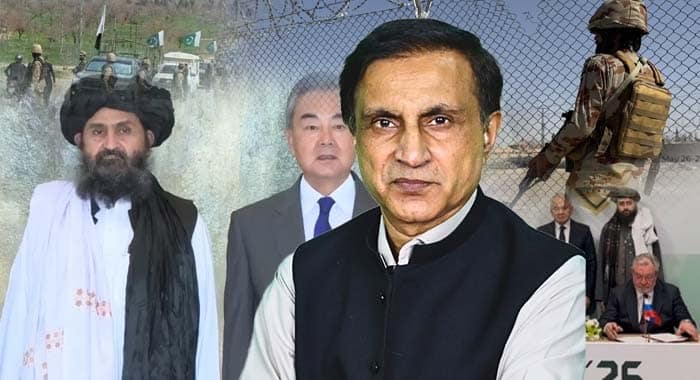
(Arshad Aziz Malik)
Pakistan today stands at a critical security crossroads. The country faces a complex and evolving threat environment that extends far beyond isolated terrorist incidents. From the rugged mountains of Khyber Pakhtunkhwa and Balochistan to the diplomatic corridors of Moscow, Kabul, Beijing, and Washington, the security equation has become deeply interconnected. Recent successful counterterrorism operations in Panjgur, Balicha, and North Waziristan demonstrate the professionalism and vigilance of Pakistan’s security forces. Yet they also highlight a troubling reality: the threat itself remains persistent, adaptive, and increasingly linked to developments across the Afghan border.
The security landscape cannot be examined in isolation. Pakistan’s internal security challenges, Afghanistan’s political trajectory under the Taliban, Russia’s growing engagement with Kabul, China’s strategic interests, and the possibility of renewed American involvement in the region all form part of the same geopolitical puzzle. Understanding these connections is essential if Pakistan is to formulate an effective and sustainable national security strategy.
The successful interception of a vehicle packed with explosives in Panjgur represents far more than a routine counterterrorism success. Available information suggests that the vehicle was intended for a high-value target, potentially causing extensive casualties and infrastructure damage. Preventing such an attack is not merely a tactical victory; it is a strategic achievement that demonstrates the effectiveness of intelligence gathering and preemptive security operations.
Similarly, recent intelligence-based operations in North Waziristan that resulted in the elimination of multiple terrorists indicate that Pakistan’s security institutions remain operationally active and capable. These operations show that the state retains the capacity to disrupt terrorist networks before they can execute their plans.
However, success should not breed complacency. The frequency of attempted attacks reveals that terrorist organizations continue to possess operational capabilities. They are still able to recruit, plan, move personnel, and arrange logistics. This means that while individual attacks may be thwarted, the broader ecosystem supporting terrorism remains intact.
The challenge for Pakistan is therefore not merely defeating terrorists in individual encounters but dismantling the networks that sustain them.
One reality has become increasingly difficult to ignore. Many of the security challenges confronting Pakistan today have a cross-border dimension linked to Afghanistan.
For years, Pakistan has repeatedly expressed concerns regarding the use of Afghan territory by militant organizations targeting Pakistan. Whether these groups operate under different names or organizational structures, the central issue remains unchanged: militants continue to exploit ungoverned spaces and weak enforcement mechanisms to plan and launch attacks.
The problem is not simply geographical. It is political, institutional, and strategic.
Since the Taliban returned to power in 2021, the international community has struggled to determine how to engage with Afghanistan. While the Taliban succeeded in consolidating political control, governing a modern state requires more than military victory. It requires professional institutions, economic stability, technical expertise, and international legitimacy.
Afghanistan today faces significant challenges in all these areas. Its military infrastructure remains underdeveloped, its technological capabilities are limited, and its economic difficulties continue to constrain governance. These realities create vulnerabilities that regional and global powers seek to influence according to their respective interests.
For Pakistan, the concern is straightforward. Any instability within Afghanistan inevitably affects Pakistan’s security environment. The border is too extensive, the historical connections too deep, and the security challenges too interconnected for developments in Afghanistan to remain confined within Afghan territory.
One of the most important geopolitical developments in recent months has been the gradual strengthening of contacts between Russia and the Taliban administration.
Many observers interpret this engagement purely through a diplomatic lens. However, the reality appears more complex.
Russia’s primary concern is strategic. Moscow understands that Afghanistan occupies a crucial position in regional power politics. The withdrawal of American forces did not eliminate great-power competition; it merely changed its form.
Russia, like China, appears determined to prevent the re-emergence of significant American influence in Afghanistan. From Moscow’s perspective, a renewed American military or strategic foothold in the country would alter the balance of power across Central and South Asia.
Consequently, Russia has shown interest in supporting Afghanistan’s institutional and military development. Discussions reportedly focus on the maintenance and repair of military equipment, professional training programs, organizational reforms, and limited technological assistance.
These initiatives should not be misunderstood as an effort to transform Afghanistan into a major military power. Russia itself faces significant constraints and remains heavily engaged in other strategic theaters. Nevertheless, Moscow clearly wishes to ensure that Afghanistan does not become a vacuum that external rivals can exploit.
This calculation reflects classic geopolitical thinking. States often provide support not solely to strengthen partners but also to prevent competitors from gaining influence.
Unlike Russia, China has adopted a comparatively low-profile approach toward Afghanistan. Beijing’s strategy appears focused less on military engagement and more on economic stabilization and infrastructure development.
China understands that instability in Afghanistan carries risks for regional connectivity projects and broader economic ambitions. Consequently, Beijing has demonstrated interest in investment opportunities, infrastructure initiatives, and economic cooperation.
However, China’s involvement is not unconditional.
Beijing shares Moscow’s concern regarding potential American re-entry into Afghanistan. From a Chinese perspective, long-term stability in Afghanistan serves both economic and strategic objectives. Therefore, Chinese engagement is likely to continue, though primarily through economic instruments rather than overt military commitments.
This creates an emerging pattern in regional politics: Russia emphasizing security cooperation, China focusing on economic engagement, and both powers seeking to limit opportunities for renewed American influence.
Although the United States withdrew its military forces from Afghanistan in 2021, it would be premature to assume that Afghanistan has disappeared from Washington’s strategic calculations.
Afghanistan remains relevant for several reasons. First, concerns related to terrorism continue to attract international attention. Second, issues involving human rights, women’s rights, governance, and narcotics trafficking remain unresolved. Third, Afghanistan occupies a critical geographic location connecting multiple regions of strategic importance.
It is therefore reasonable to expect that global attention may once again shift toward Afghanistan in the coming years.
Should that occur, competition among major powers could intensify. Russia, China, Iran, and the United States each possess distinct interests and objectives. The resulting strategic contest would have implications not only for Afghanistan but for the broader region as well.
For Pakistan, this means that developments in Afghanistan cannot be viewed merely through a bilateral lens. They must also be analyzed within the wider framework of great-power competition.
A recurring misconception in some international discussions is the suggestion that Pakistan is unwilling to engage diplomatically with Afghanistan. The historical record suggests otherwise. Over the years, Pakistan has participated in numerous rounds of dialogue through multiple platforms and host countries. Discussions have occurred in Qatar, Turkey, Saudi Arabia, the United Arab Emirates, China, and various regional forums.
Pakistan’s position has consistently emphasized dialogue, cooperation, and mutually beneficial economic relations. The challenge has been the gap between diplomatic commitments and realities on the ground. Constructive statements are valuable, but they must be accompanied by tangible actions. When terrorist incidents continue despite repeated assurances, trust inevitably suffers. Sustainable peace requires more than declarations. It requires verifiable mechanisms, effective enforcement, and measurable progress in addressing security concerns. Pakistan has repeatedly demonstrated its willingness to negotiate. The question is whether all parties are equally committed to implementing the outcomes of those negotiations.
No discussion of Pakistan’s security environment can overlook the critical role of Khyber Pakhtunkhwa. The province remains on the frontline of the country’s counterterrorism efforts. Security personnel, police officers, intelligence officials, and ordinary citizens continue to bear the burden of this reality. Recent incidents in Bannu, Dera Ismail Khan, Peshawar, and other districts illustrate the persistence of the threat. Terrorist tactics have evolved over time, incorporating complex attacks, suicide bombings, vehicle-borne explosives, and secondary explosions designed to target rescue efforts.
These methods reflect a deliberate attempt to maximize casualties and create psychological fear. Responding effectively requires a combination of military, intelligence, technological, and administrative measures. The first priority must be prevention. Once attackers reach urban centers, the cost of stopping them increases dramatically. Therefore, intelligence capabilities become the decisive factor. Successful security operations typically begin long before the first shot is fired. They depend upon surveillance, information sharing, human intelligence networks, data analysis, and proactive monitoring.
This is where investment becomes crucial.
Pakistan’s police forces, Counter Terrorism Departments (CTDs), and Special Branch units constitute the first line of defense against many security threats. Their effectiveness directly influences public safety. Funding allocations are important, but funding alone is insufficient. Resources must be translated into operational capability. This means modern surveillance systems, forensic technologies, secure communication networks, advanced training programs, and professional intelligence analysis. Equally important is accountability. Whenever security failures occur, there should be systematic reviews to identify weaknesses and improve future performance. Accountability should not be punitive alone; it should also be corrective. Institutions improve when lessons are learned and implemented.
The provincial governments have a particularly important role in this regard. Security investments must be monitored carefully to ensure transparency, efficiency, and quality. Public funds are a national trust and must be utilized effectively. Citizens have every right to expect both security and accountability.
Pakistan’s security challenges cannot be solved through military means alone. A comprehensive approach is required.
Such a strategy should include:
- Enhanced border management and surveillance.
- Greater intelligence integration between federal and provincial agencies.
- Expanded technological capabilities for law enforcement.
- Improved coordination between civilian and military institutions.
- Continued diplomatic engagement with Afghanistan.
- Stronger regional cooperation on counterterrorism.
- Economic development in vulnerable regions.
- Institutional accountability and performance monitoring.
These elements are interconnected. Weakness in one area undermines progress in others.
Pakistan’s security environment today reflects the convergence of local, regional, and global dynamics. The successful operations in Panjgur, Balicha, and North Waziristan demonstrate the courage and effectiveness of the country’s security forces. Yet they also remind us that the threat remains active and determined. At the regional level, Afghanistan’s future continues to shape Pakistan’s security calculations. Russia’s growing engagement with Kabul, China’s economic interests, and the possibility of renewed international focus on Afghanistan all point toward a changing geopolitical landscape.
For Pakistan, the path forward requires vigilance, realism, and strategic patience. Security operations must continue, intelligence capabilities must expand, institutions must be strengthened, and diplomacy must remain active. Peace cannot be achieved through wishful thinking. It requires sustained effort, professional institutions, regional cooperation, and an unwavering commitment to national security.
The challenges are significant, but so too are Pakistan’s capabilities. With the right policies, effective governance, and a comprehensive national strategy, the country can meet these challenges and move toward a more secure and stable future.