
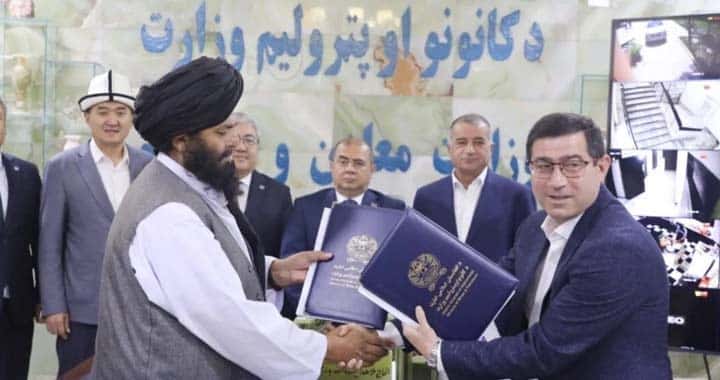
The Taliban leadership is reportedly tightening its control over Afghanistan’s vast mineral resources, using the mining sector not only as an important source of revenue but also as a mechanism for consolidating political authority, rewarding loyal networks, and strengthening control over strategically important provinces.
According to an assessment by the U.S. think tank Jamestown Foundation, the Taliban leadership deployed approximately 1,000 special forces personnel to Badakhshan in late June in an effort to reinforce control over the province’s mining operations and bring mineral extraction more directly under the authority of the Taliban leadership.
The deployment, according to the assessment, represents another stage in the Taliban’s broader effort to centralize control over Afghanistan’s mineral resources since returning to power in August 2021.
Rather than developing the country’s mining sector through transparent institutions and accountable governance, the assessment argues that the Taliban’s approach increasingly resembles the resource-extraction and revenue-generation practices that characterized the group’s insurgency before it seized power.
Afghanistan possesses some of the world’s most significant largely untapped mineral resources. The U.S. Geological Survey has estimated that Afghanistan’s mineral wealth could exceed $1 trillion, while more than 1,400 mineral deposits have reportedly been identified across the country’s 34 provinces. These deposits include strategically important resources such as lithium, copper, cobalt, rare earth elements, zinc, lead, antimony, and other critical minerals. The scale and strategic value of these resources have attracted interest from regional and global powers, including China, India, Pakistan, and the United States.
For Afghanistan, effective development of these resources could potentially provide significant revenue, employment, infrastructure investment, and opportunities for long-term economic development. However, the manner in which the Taliban are managing the sector has generated growing concerns regarding transparency, accountability, environmental protection, and equitable distribution of mineral wealth.
Since taking control of Afghanistan in 2021, the Taliban have increasingly placed the mining sector at the centre of their revenue-generation strategy. According to the Jamestown Foundation assessment, the Taliban have awarded at least 205 mining contracts to more than 150 companies, while announcing major mining agreements worth billions of dollars. In September 2023, the Taliban announced new mining agreements reportedly valued at more than $6.5 billion.
In May 2024, the Taliban-controlled Ministry of Mines and Petroleum claimed that it had secured more than $7 billion in investments from countries including China, Qatar, Türkiye, Iran, and the United Kingdom. However, the details and terms of many of these agreements have not been publicly disclosed, raising questions over how Afghanistan’s mineral wealth is being allocated and who ultimately benefits from the revenues generated by extraction.
The Jamestown Foundation assessment draws a direct connection between the Taliban’s current mining practices and the group’s methods of financing its insurgency prior to 2021. During the insurgency, the Taliban generated revenue by taxing mining operations, controlling transportation routes, collecting fees from traders, and imposing payments on businesses operating in areas under their influence. The assessment argues that many of these practices have subsequently been incorporated into the Taliban’s post-2021 governing structure.
Mining licenses and contracts are reportedly issued through opaque mechanisms, while access to valuable concessions may be influenced by connections to Taliban leadership, loyalist networks, and foreign intermediaries. This has raised concerns that Afghanistan’s mineral economy is becoming increasingly centralized around political and economic networks associated with the Taliban leadership.
Concerns over transparency intensified following Afghanistan’s suspension from the Extractive Industries Transparency Initiative (EITI) in June 2024. The suspension highlighted concerns surrounding the country’s ability to maintain credible mechanisms for monitoring the extraction and distribution of natural-resource revenues. The issue became even more prominent following the appointment of Hedayatullah Badri, a UN-sanctioned Taliban member, as Minister of Mines and Petroleum in July 2024. According to figures cited in the assessment, publicly reported mining revenues dropped sharply during the latter part of 2024.
More than 95 percent of reported mining revenue for 2024 was disclosed during the first seven months of the year, while only approximately $1 million was publicly reported during the subsequent five months. The dramatic decline in publicly reported revenue has prompted questions over whether Afghanistan’s mineral income is being systematically recorded and transferred through state institutions or whether a growing portion is being controlled through informal and elite networks.
Afghan observers have reportedly described the emergence of what has been termed a “mineral mafia” within the Taliban’s wider economic structure. According to these accounts, individuals and networks linked to the Taliban allegedly collect taxes, royalties, licensing fees, and direct payments from miners, transporters, exporters, and local traders. Operators in some mining areas have reportedly faced pressure to comply with Taliban financial demands in order to maintain access to their operations.
Such practices could undermine the development of a legitimate mining industry and discourage transparent domestic and foreign investment. They could also reinforce a system in which economic opportunities depend heavily on political loyalty and connections rather than competitive and accountable commercial processes.
Nangarhar province has reportedly received the highest number of mining contracts issued by the Taliban. The province is rich in resources including chromite, talc, and nephrite, making it one of Afghanistan’s most important areas within the emerging extractive economy. Talc mining in Nangarhar has previously attracted international scrutiny. A 2018 Global Witness report found that much of Afghanistan’s talc production was generating revenue for the Taliban while the group was still operating as an insurgent organization.
More recent open-source assessments suggest that the Taliban’s post-2021 contract system has further reinforced Nangarhar’s position as a major centre of mineral extraction. The province therefore provides an example of how an industry once used to finance insurgent activity could increasingly become integrated into the Taliban’s governing and revenue structures.
The reported deployment of approximately 1,000 Taliban special forces personnel to Badakhshan carries particular significance because of the province’s mineral wealth. Badakhshan is known for deposits of gold and other valuable minerals, and mining has expanded in several areas under Taliban-linked local authorities. The increased security presence reportedly aims to bring mining activity under tighter central control.
The move also illustrates the broader relationship between natural resources and political power in Afghanistan. Control over mineral-rich territory can provide access to substantial revenue while simultaneously allowing the authorities to strengthen their influence over local communities, businesses, and regional power structures.
The expansion of Afghanistan’s mining sector has also generated concerns beyond financial transparency. Mining operations can place substantial pressure on scarce natural resources, particularly water, while inadequate safety standards can expose workers to serious risks. Reports have documented the involvement of children as young as eight years old in coal mining, with workers reportedly operating without adequate machinery, protective equipment, or basic safety safeguards.
Such conditions raise serious concerns regarding labour rights, child protection, and occupational safety. The absence of effective regulatory institutions could further increase the risk of environmental degradation and unsafe extraction practices as mining activity expands.
The mining economy has also reportedly generated disputes involving local communities, land ownership, and access to mineral sites. In provinces including Badakhshan and Takhar, local communities have raised concerns over gold extraction, displacement, and exclusion from the economic benefits generated by mining. Competition over valuable deposits has reportedly contributed to clashes and disputes, including incidents connected to Chinese-backed mining interests.
The deployment of additional Taliban security personnel to Badakhshan therefore carries implications beyond the protection of mining sites. It could also represent an effort to consolidate political authority over mineral-rich territory and regulate who is permitted to participate in the extraction and distribution of its resources
Afghanistan’s mineral wealth has the potential to become one of the country’s most important foundations for economic recovery. With appropriate governance, transparent contracts, environmental safeguards, fair taxation, and investment in local communities, mineral resources could generate significant employment and public revenue while supporting infrastructure and national development. However, the Jamestown Foundation assessment raises concerns that Afghanistan’s current trajectory is moving in a different direction.
Instead of being developed as a transparent, nationally accountable economic sector, mining risks becoming increasingly integrated into a system of centralized political control, patronage, and revenue extraction. Such a model could generate short-term income while weakening the institutions required for sustainable economic development.
Afghanistan’s mineral resources are also becoming increasingly significant from a geopolitical perspective. The presence of critical minerals including lithium, rare earth elements, copper, cobalt, and other strategically valuable resources has attracted international attention at a time when major economies are competing to secure reliable supplies of critical raw materials. The manner in which the Taliban manage these resources could therefore have implications extending well beyond Afghanistan’s borders.
Foreign investment may provide the Taliban with additional financial resources and international economic relationships, while the absence of transparency could complicate efforts to determine the ultimate beneficiaries of major mining agreements. The Taliban’s growing control over Afghanistan’s mining sector represents a development with potentially profound economic, political, and security consequences.
The reported deployment of approximately 1,000 special forces personnel to Badakhshan illustrates the strategic importance the Taliban increasingly attach to controlling mineral-rich territories. According to the Jamestown Foundation, the Taliban’s approach to resource extraction increasingly resembles the revenue-generating practices developed during their insurgency, now incorporated into a centralized governing structure. Afghanistan possesses mineral resources potentially worth more than $1 trillion, yet the country’s ability to transform that wealth into broad-based prosperity will depend heavily on governance, transparency, accountability, environmental protection, and the fair distribution of revenues.
If mineral extraction remains dominated by opaque contracts, political patronage, coercive practices, and limited public accountability, Afghanistan risks turning one of its greatest economic opportunities into another source of institutional weakness and elite capture. The central challenge facing Afghanistan is therefore not simply how much mineral wealth lies beneath its soil, but who controls it, who profits from it, and whether it will ultimately serve the Afghan people or reinforce an increasingly centralized system of power.



