
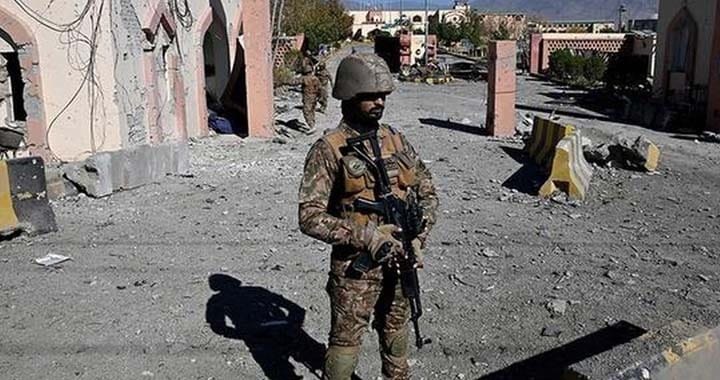
A renewed and increasingly dangerous wave of terrorism is once again visible in Khyber Pakhtunkhwa, raising serious concerns over security, governance, and the absence of a coherent and unified counterterrorism narrative in the province.
Security analysts and political observers note that the current wave of militancy differs in its targeting pattern and intensity. Earlier phases of terrorism primarily focused on security institutions; however, recent attacks indicate a shift toward police forces, civil administration, and public institutions, significantly widening the scope of insecurity.
The province has recently witnessed major losses, including reports of approximately 30 police personnel martyred in Bannu, underscoring the growing intensity of militant attacks and the heavy burden being carried by law enforcement agencies on the frontline.
Despite the severity of the situation, questions are being raised regarding the provincial government’s public engagement and political response. Critics point out that there has been limited visible participation from the Chief Minister in mourning ceremonies of martyrs or visits to bereaved families, fueling public debate over governance priorities and institutional sensitivity in times of crisis.
Observers argue that Khyber Pakhtunkhwa is currently facing not only a surge in terrorism but also a deeper governance challenge marked by the absence of a strong counterterrorism narrative and weakened public messaging. They warn that this vacuum is contributing to confusion, anxiety, and a lack of unified societal response against extremist violence.
Security forces, police personnel, tribal elders, and civilians continue to remain direct targets of terrorist attacks, while concerns are being raised about the clarity of provincial political positioning in confronting terrorism as a unified national challenge.
Some analysts further argue that governance priorities appear divided, with insufficient focus on core issues such as counterterrorism strategy, institutional strengthening, and public service delivery. These include concerns over revenue generation, institutional performance, agricultural development, and broader administrative reforms, which critics say require stronger and more sustained attention.
At the same time, questions are being raised about political focus and leadership engagement, with critics alleging that attention is increasingly diverted toward political activities, party alignments, internal consultations, and external political engagements, rather than immediate crisis response and public reassurance in conflict-affected areas.
Security experts emphasize that terrorism in Khyber Pakhtunkhwa cannot be addressed through force alone. They underline that the conflict is being fought on two critical fronts: an operational battlefield where the army, police, and security agencies are sacrificing lives, and a parallel ideological and governance front where political leadership, religious scholars, media, and civil society must clearly define and uphold an unambiguous stance against terrorism.
According to analysts, the absence of a strong and consistent narrative allows extremist groups to exploit ambiguity. When terrorism is framed in terms of political rivalry, federal-provincial tensions, or external conspiracies, they argue, it inadvertently benefits terrorist organizations by obscuring accountability and weakening public resolve.
Observers further warn that terrorist groups do not only gain ground through violence but also through narrative dominance particularly when state messaging becomes inconsistent, politically divided, or ambiguous about identifying perpetrators and victims. They stress that confusion between state institutions and extremist actors weakens collective resistance and undermines sacrifices made by security personnel.
Concerns are also being raised regarding public expression of solidarity with victims of terrorism, with analysts noting that insufficient engagement at funerals, martyrdom ceremonies, and bereaved households can deepen public alienation and create space for extremist propaganda narratives.
Critics question whether leadership attention is adequately aligned with the province’s security priorities, pointing to competing political engagements, administrative restructuring efforts, and party-level mobilization, while communities affected by terrorism continue to demand immediate support and visible state presence.
At the governance level, experts emphasize that poor service delivery in conflict-affected and underdeveloped areas can create an environment where extremist narratives gain traction, particularly when citizens perceive the absence of the state in their daily lives. They argue that such governance gaps contribute to conditions that terrorist groups exploit to justify their presence and recruitment.
Security analysts reiterate that terrorism cannot be framed or addressed through selective narratives or political reinterpretations. They stress that every attack on police, civilians, teachers, workers, and security forces is an attack on the state itself and must be addressed with absolute clarity and unity.
The official position of Pakistan remains unequivocal: terrorism in any form, under any banner, or under any ideological or political justification, is unacceptable. Authorities maintain that individuals and groups involved in violence against civilians and security personnel will be pursued and held accountable under the full force of law.
The situation in Khyber Pakhtunkhwa highlights an urgent need for unified political messaging, strengthened counterterrorism institutions particularly Counter Terrorism Departments (CTDs) and full implementation of national frameworks such as the National Action Plan. Experts note that gaps in institutional capacity directly impact operational effectiveness against terrorism.
Comparisons are also drawn with other provinces affected by militancy, where observers claim greater policy clarity and institutional alignment with state counterterrorism objectives. In contrast, concerns persist that lack of coordination and clarity in Khyber Pakhtunkhwa is undermining broader national efforts against extremism.
Officials and analysts agree that Pakistan’s counterterrorism strategy requires both operational strength and narrative unity. Without coordinated efforts between federal and provincial governments, security institutions, political leadership, and civil society, the risk of continued instability remains high.
As violence persists, citizens in affected areas continue to demand peace, protection, and the restoration of normal life, alongside greater visibility of state institutions in crisis-hit regions. The growing public concern underscores an urgent expectation for decisive leadership, institutional accountability, and a unified stance against terrorism in all its forms.



