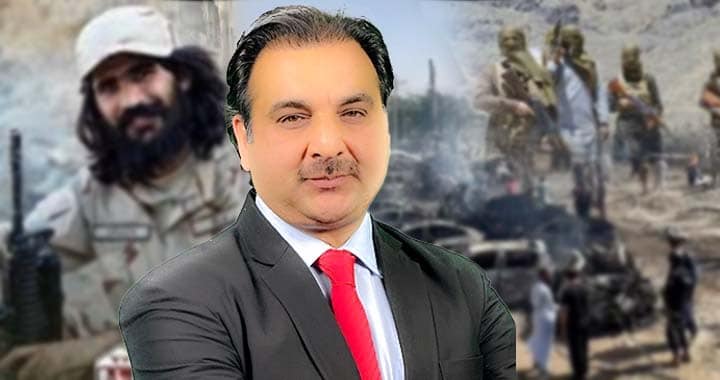
(Irfan Khan)
The aftermath of the Quetta blast has once again pushed Pakistan into a familiar but deeply unsettling cycle one where tragedy, political narratives, intelligence claims, and competing versions of truth collide in the public sphere. At the center of this latest storm is a name that has now become symbolic of broader questions: Bilal Shahwani.
Was he a missing person, as his family once publicly claimed? Or is he, as some official narratives now suggest, linked to militant networks operating in the region? And beyond this individual case, what does the controversy reveal about Pakistan’s evolving internal security challenges, its information environment, and the widening trust deficit between the state, civil society, and conflict-affected communities?
These are not simple questions. They sit at the intersection of counterterrorism, human rights discourse, and geopolitical suspicion. And it is precisely this intersection that makes clarity difficult and misinformation easy.
The case of Bilal Shahwani gained attention after his family reportedly held a press conference claiming he had been missing since January. This claim placed him within a broader and highly sensitive category in Pakistan: alleged enforced disappearances. Over the years, this issue has become one of the most contested human rights concerns in the country, particularly in Balochistan and Khyber Pakhtunkhwa.
However, a different narrative has also emerged from security-linked sources. According to these accounts, Shahwani is not merely a missing person but someone who allegedly became involved with a militant outfit, with claims suggesting links to groups such as the Baloch Liberation Army (BLA). Some narratives further assert that individuals are often recruited, trained, and operationalized through structured militant networks operating in remote regions.
It is important to underline here that these claims exist within an adversarial information environment. In conflict zones, competing narratives often emerge simultaneously families, activists, and the state may all present sharply different versions of the same case. Determining the full factual picture requires transparent investigation and credible evidence, not just assertions.
From a security perspective, the Shahwani case is not being viewed in isolation. It is being interpreted within a wider pattern of insurgency, counterinsurgency, and recurring attacks in Balochistan. Pakistan has long argued that militant groups operating in the region benefit from cross-border sanctuaries and external support networks. Some officials and commentators have even alleged involvement of foreign intelligence agencies in destabilization efforts. These claims frequently cite geopolitical rivalries and regional tensions.
However, such assertions remain politically sensitive and are often contested internationally. While Pakistan faces real and documented security threats from militant organizations, attributing operational control or direct sponsorship to specific foreign states is a claim that requires strong, independently verifiable evidence. In its absence, these narratives risk becoming part of the very information warfare they seek to describe.
What is clear, however, is that militant groups in Balochistan and adjoining regions have demonstrated the ability to conduct coordinated attacks, exploit local grievances, and adapt to changing security conditions. The Quetta blast is part of this ongoing pattern of violence that continues to challenge state capacity.
One of the recurring arguments in official discourse is the question of logistics: how do insurgent groups sustain themselves?
This is a legitimate analytical question. Any organized militant structure requires funding, supply chains, recruitment pipelines, and safe movement channels. In many global insurgencies, such systems are sustained through a combination of illicit trade, smuggling, local taxation, external patronage, and opportunistic criminal networks.
However, in Pakistan’s context, these discussions are often entangled with political blame narratives. Assertions about foreign intelligence funding or coordinated external sponsorship frequently surface in public debate, especially after major attacks. Yet without transparent investigative reporting or internationally validated intelligence disclosures, such claims remain contested.
What cannot be disputed is that insurgent logistics exist and they are sophisticated enough to sustain prolonged conflict. The precise sources, however, often remain opaque even to observers.
Perhaps the most striking aspect of the Quetta blast aftermath is not only what happened on the ground, but how the narrative unfolded online.
Social media platforms have become parallel battlegrounds where competing versions of events are rapidly circulated. In this environment, every attack generates an immediate struggle over interpretation:
- Was the individual a victim of enforced disappearance or a recruited militant?
- Was the attack purely domestic in planning or externally influenced?
- Were security forces responsive or negligent?
These questions are often answered not through verified evidence, but through narrative alignment. Different political and ideological groups interpret the same event in completely opposite ways.
There is also a growing tendency to link militant propaganda with mainstream media amplification, sometimes alleging that hostile foreign channels shape perception through selective coverage. While media bias and geopolitical framing do exist globally, the leap from coverage patterns to direct operational control is not always substantiated.
What is undeniable, however, is that information warfare has become a central component of modern conflict in Pakistan. Militants, state actors, activists, and digital influencers all participate intentionally or otherwise in shaping public perception.
Lost in many of these debates is a simple but devastating reality: civilians are dying. The Quetta blast, like many before it, reportedly claimed both security personnel and civilians, including women and children. Regardless of the political narratives attached to such incidents, the human cost remains the most important fact.
Yet even tragedy becomes contested territory. Competing groups often interpret condemnation itself as political alignment or silence as complicity. This deepening polarization erodes space for collective mourning and shared national grief.
If every incident is filtered through suspicion—who condemned, who didn’t, who was silent, who was vocal—then society risks losing the ability to respond to violence with unity.
One argument frequently raised in security discussions is the role of internal facilitation networks. The claim is that complex attacks are rarely possible without some level of local knowledge, logistical assistance, or intelligence leakage.
This is not an unreasonable security hypothesis. Globally, insurgent operations often depend on localized support structures, whether ideological sympathizers or coerced collaborators. However, translating this hypothesis into blanket accusations against communities or political activists can be dangerous. It risks further alienating populations already living under suspicion, particularly in regions with histories of grievances and distrust toward the state.
A sustainable counterinsurgency strategy requires precision targeting verified threats rather than broad generalizations.
The issue of missing persons allegations, including those surrounding individuals like Bilal Shahwani, reflects a deeper challenge: trust.
Even if state narratives in certain cases prove accurate, the absence of transparent legal processes and independent verification mechanisms fuels public skepticism. Conversely, unchecked militant propaganda exploits these gaps to build counter-narratives.
In conflict environments, trust is not a soft issue it is a security variable. Where trust collapses, misinformation fills the vacuum. Strengthening judicial transparency, improving accountability mechanisms, and ensuring credible inquiry processes are not merely human rights demands; they are also counterterrorism necessities.
Pakistan today operates within a fragmented information ecosystem:
- State institutions emphasize national security imperatives.
- Activist groups highlight enforced disappearance concerns.
- Digital platforms amplify emotionally charged interpretations.
- External geopolitical actors are often accused of shaping narratives.
In such an environment, truth becomes contested rather than clarified.
The Bilal Shahwani case sits precisely within this fragmentation. It reflects how individual identities can become symbolic battlegrounds in larger struggles over legitimacy, narrative control, and political authority.
The Quetta blast and the controversy surrounding Bilal Shahwani should force a broader reflection on how Pakistan engages with internal conflict. The country does face serious security threats. Militant organizations operate in complex terrains, and violence remains a persistent reality. At the same time, unresolved human rights concerns and lack of transparent investigative processes continue to generate mistrust.
Overlaying this already difficult landscape is an accelerating information war one where claims, counterclaims, and geopolitical interpretations often outpace verified facts. The challenge ahead is not simply military or intelligence-based. It is institutional and informational. Pakistan must strengthen not only its counterterrorism capacity but also its mechanisms for transparency, legal accountability, and narrative credibility.
Without that balance, every incident will remain what Quetta has once again become: not just a tragedy, but a contested story—where facts struggle to survive between competing certainties.