
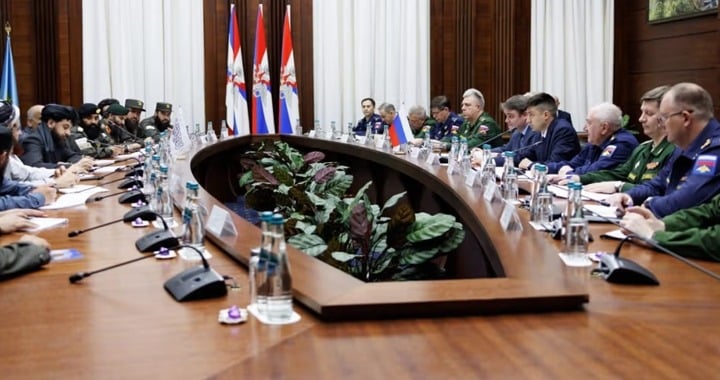
he signing of a military cooperation agreement between Russia and Afghanistan’s Taliban administration marks a significant geopolitical development that is likely to reshape regional security calculations and intensify strategic competition across South and Central Asia.
The agreement, signed during the visit of Afghanistan’s Defence Minister Mullah Mohammad Yaqoob to Moscow, comes at a time when Pakistan continues to grapple with persistent cross-border security challenges, including attacks attributed to militant organizations operating from Afghan territory. The development also coincides with Deputy Prime Minister and Foreign Minister Ishaq Dar’s diplomatic engagements in Washington, highlighting the increasingly complex diplomatic and security environment confronting the region.
Security analysts view the Russia-Taliban agreement as more than a bilateral arrangement. They argue that it reflects a broader realignment of regional interests at a time when Afghanistan remains a focal point of geopolitical competition, counterterrorism concerns, and great-power rivalry.
For Pakistan, the agreement raises critical questions regarding the future direction of regional security cooperation and the Taliban administration’s willingness and ability to address concerns repeatedly raised by neighboring countries.
Islamabad has consistently maintained that terrorist groups targeting Pakistan continue to exploit sanctuaries and operational space inside Afghanistan. Pakistani authorities have repeatedly called on the Taliban administration to take effective and verifiable action against organizations accused of launching attacks against Pakistan’s security forces, civilians, and economic infrastructure.
Despite repeated engagements and diplomatic exchanges, security concerns have remained a persistent source of tension between Islamabad and Kabul.
Pakistan’s counterterrorism campaign has come at an enormous cost. Over the past two decades, the country has sacrificed thousands of civilian and military lives while incurring significant economic losses in its efforts to combat terrorism and violent extremism. Consequently, any international security arrangement involving Afghanistan is inevitably viewed in Pakistan through the prism of counterterrorism accountability and regional stability.
Russia’s growing engagement with the Taliban administration reflects Moscow’s desire to safeguard its strategic interests in Central Asia and prevent instability from spilling into neighboring regions.
Russian officials have repeatedly expressed concerns regarding extremist threats emanating from Afghanistan and have emphasized their opposition to any renewed foreign military presence in the country. These concerns have become increasingly prominent amid evolving geopolitical tensions and debates surrounding the future security landscape of Eurasia.
While Moscow appears to view direct engagement with Kabul as a pragmatic approach to addressing regional security challenges, critics argue that security cooperation must be accompanied by tangible progress in addressing terrorism and militant activity.
Analysts warn that geopolitical considerations should not overshadow unresolved questions regarding Afghanistan’s role in regional security dynamics and the activities of armed groups operating within its borders.
One of the most significant implications of the Russia-Taliban agreement is the growing perception that security interests are increasingly taking precedence over questions of political legitimacy and governance.
Observers note that while many countries continue to engage with the Taliban administration for practical reasons, concerns persist regarding governance, inclusivity, human rights, and counterterrorism commitments.
The agreement highlights a broader trend in international relations whereby states may prioritize immediate security calculations over broader political considerations. However, security experts caution that sustainable stability cannot be achieved solely through strategic arrangements if underlying security concerns remain unresolved.
For Pakistan, the issue is not merely diplomatic recognition or political engagement. Rather, it is whether Afghanistan can effectively prevent its territory from being used by groups that threaten regional peace and security.
From the historic Torkham crossing to the remote Wakhjir Pass, Afghanistan remains one of the world’s most strategically important crossroads.
Its geography places it at the intersection of South Asia, Central Asia, China, Russia, and the broader Middle East, making it a critical arena for competing political, economic, and security interests.
Many analysts believe that the Russia-Taliban agreement may represent the early stages of a new phase of geopolitical competition involving regional and global powers seeking to shape Afghanistan’s future trajectory.
This competition extends beyond traditional military considerations and increasingly encompasses intelligence cooperation, counterterrorism frameworks, economic influence, technological capabilities, and strategic partnerships.
The agreement comes amid growing concerns regarding the activities of extremist organizations operating across the region.
Recent statements from senior Russian security officials have highlighted fears that transnational terrorist networks continue to exploit instability in Afghanistan and neighboring areas. Similar concerns have been repeatedly expressed by Pakistan, which has witnessed a resurgence of terrorist attacks targeting security personnel and civilians.
Security observers argue that any effort to strengthen regional stability must prioritize effective action against all militant organizations without distinction.
They caution that the failure to address these challenges could further destabilize an already fragile security environment and create opportunities for extremist actors to exploit geopolitical rivalries.
Pakistan has consistently advocated for a peaceful, stable, and economically connected region based on mutual respect, non-interference, and effective counterterrorism cooperation.
Islamabad maintains that lasting peace in Afghanistan is in the collective interest of the entire region. However, sustainable stability requires more than diplomatic engagement and security agreements. It demands practical action against terrorism, stronger border management, intelligence cooperation, and a commitment to preventing armed groups from threatening neighboring states.
Analysts note that Pakistan’s primary concern remains the protection of its citizens, territorial integrity, and economic development from the threat posed by terrorism and violent extremism.
As new regional alignments emerge, Islamabad is expected to continue engaging international partners to ensure that security cooperation in Afghanistan contributes to peace and stability rather than inadvertently creating new challenges.
The Russia-Taliban military cooperation agreement may prove to be a defining moment in the evolving geopolitics of Eurasia.
Whether it contributes to greater regional stability or introduces new strategic complexities will largely depend on future developments, the conduct of the Taliban administration, the response of regional stakeholders, and the extent to which counterterrorism concerns are addressed in a credible and verifiable manner.
For Pakistan, the central issue remains clear: regional peace cannot be secured unless terrorism is confronted comprehensively and consistently.
As geopolitical competition intensifies and new partnerships emerge, the international community faces a critical test ensuring that strategic interests do not come at the expense of long-term security and stability.
Pakistan’s sacrifices in the fight against terrorism have demonstrated that peace requires vigilance, cooperation, and accountability. The future of regional stability will ultimately depend not on agreements alone, but on actions that deliver genuine security for the people of the region.



