(Aqeel Yousafzai)
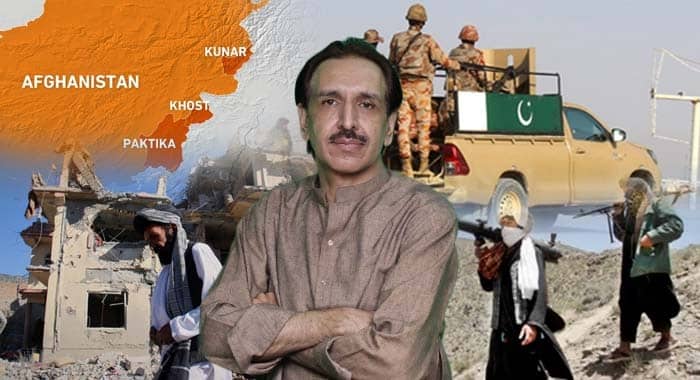
The reported launch of Operation Ghazab Lil Haq marks yet another intense moment in the long, turbulent history of Pakistan–Afghanistan security relations. According to emerging accounts, Pakistan conducted coordinated strikes across multiple eastern Afghan provinces, Paktika, Paktia, Kunar, and parts of Nangarhar targeting militant infrastructure allegedly linked to groups responsible for cross-border attacks inside Pakistan.
While official confirmations, independent battlefield verification, and casualty figures remain inconsistent across sources, the broader significance of the reported operation is not in dispute. It reflects a deepening phase of militarized counterterrorism, shaped by intelligence-led targeting, regional insecurity, and the persistent inability of state actors in South and Central Asia to neutralize entrenched militant ecosystems.
At its core, Operation Ghazab Lil Haq is not an isolated military action. It is a manifestation of a structural crisis that has defined the region for decades: the persistence of armed networks operating across borders that are politically contested, geographically porous, and institutionally fragmented. Eastern Afghanistan has long been central to this equation. Provinces such as Paktika, Paktia, Kunar, and Nangarhar have historically functioned as strategic depth zones for a range of militant formations. Their rugged terrain, tribal linkages, and limited state reach have made them ideal for concealment, recruitment, training, and cross-border movement.
Over the years, multiple armed actors have operated in this landscape. Among them are the Tehrik-i-Taliban Pakistan, Islamic State, Khorasan Province, and remnants or affiliates of al-Qaeda-linked networks. These groups have not remained static organizations. Instead, they have demonstrated a high degree of adaptability fragmenting under pressure, reconstituting under new names, and forming tactical alliances that often transcend ideological consistency.
This fluidity is what makes the region exceptionally difficult to stabilize. Military pressure does not simply eliminate these networks; it disperses them, forcing reconfiguration rather than collapse.
Within this context, the reported strikes under Operation Ghazab Lil Haq are being interpreted as an attempt to disrupt this adaptive ecosystem at multiple points simultaneously, rather than focusing on a single group or location. The operational narrative surrounding the strikes suggests a reliance on layered intelligence inputs, including interrogation of detained operatives, surveillance data, and satellite imagery analysis. According to accounts circulating in security discourse, actionable intelligence was derived from individuals allegedly involved in recent attacks inside Pakistan, who provided details about training sites, movement routes, and logistical arrangements across the Afghan border.
This kind of intelligence-driven warfare represents a significant evolution from earlier phases of counterinsurgency in the region. Instead of broad territorial operations, modern strikes increasingly depend on precision targeting, aiming to neutralize specific nodes within a network rather than engaging in prolonged ground campaigns.
However, this evolution also introduces new complexities. Intelligence in insurgent environments is rarely absolute. Militants often operate in dispersed cells, frequently shift locations, and deliberately embed themselves within civilian or semi-civilian spaces. As a result, even highly sophisticated surveillance systems face limitations in distinguishing between transient movement and operational presence.
The consequence is a persistent tension between tactical necessity and operational risk. A key dimension of the current situation is the emergence and evolution of Jamaat-ul-Ahrar, a significant splinter faction that broke away from larger militant structures during internal ideological and strategic disagreements within Pakistan-focused insurgent networks. Over time, this faction became associated with some of the most high-profile urban attacks inside Pakistan, including suicide bombings and coordinated strikes in major cities.
The broader militant ecosystem in which such groups operate is increasingly characterized by overlapping affiliations. Boundaries between factions have blurred, and cooperation between ideologically distinct groups has become more common, particularly under operational pressure. Reports of convergence between local insurgent factions and transnational entities such as ISIS-K reflect this trend. If accurate, such alignments signal a shift from ideologically coherent insurgencies to pragmatic survival-based coalitions. In such arrangements, shared tactical objectives such as attacking state institutions or securing logistical routes become more important than doctrinal purity.
This transformation significantly complicates counterterrorism strategy. Traditional approaches that rely on mapping fixed organizational hierarchies become less effective when networks behave like fluid ecosystems rather than rigid command structures. The geopolitical context surrounding Operation Ghazab Lil Haq is equally important. Pakistan’s security policy toward Afghanistan has historically oscillated between engagement, pressure, and limited cross-border action, depending on regional conditions and internal threat levels.
At various points, Islamabad has faced the challenge of managing simultaneous pressures on multiple fronts: internal militant attacks, diplomatic tensions with neighboring states, and broader regional instability involving major powers. These overlapping pressures have often influenced the timing and scale of military responses. The reported decision to conduct strikes after a period of restraint reflects this balancing act. Operational hesitation in earlier phases was shaped not only by bilateral considerations with Afghanistan but also by wider geopolitical uncertainties involving global power rivalries and regional alignments. In such an environment, military action becomes as much a political decision as a tactical one.
What is particularly notable in the current phase is the apparent shift toward preemptive disruption. Rather than waiting for attacks to materialize, the reported strategy emphasizes targeting suspected planning hubs and facilitators before operations are executed. This reflects a doctrine of deterrence through disruption. Yet it also raises questions about escalation dynamics, particularly in a region where retaliatory cycles are historically entrenched. Eastern Afghanistan’s security landscape cannot be understood without acknowledging its deep historical layering. Many of the regions reportedly affected by recent strikes have been associated with militant presence since the 1980s, when the Soviet–Afghan conflict transformed the area into a global theater of proxy warfare.
Since then, successive waves of armed groups have passed through the same geographic corridors. What began as Cold War-era insurgency infrastructure gradually evolved into post-9/11 jihadist networks, and later into fragmented insurgent ecosystems involving both local and transnational actors.
In provinces like Kunar and Nangarhar, the presence of entrenched militant infrastructure has persisted despite repeated military operations by multiple actors over several decades. Camps have been dismantled and re-established repeatedly, often in different configurations but within the same broader geographic zones.
This historical continuity underscores a critical reality: the problem is not simply one of specific organizations, but of geography, governance gaps, and long-standing conflict economies.
From Pakistan’s perspective, the central challenge remains the prevention of cross-border attacks originating from these regions. Urban centers such as Karachi, Lahore, Islamabad, and Rawalpindi have repeatedly been identified in militant planning narratives as strategic targets intended to maximize psychological and political impact.
This urban targeting logic reflects a broader strategic calculation by militant groups: striking densely populated and politically significant areas increases visibility, disrupts governance confidence, and forces disproportionate state response.
In response, Pakistan’s security establishment has increasingly prioritized intelligence-based disruption over reactive policing. However, this approach inevitably extends operational theaters beyond national borders, particularly when alleged planners are located in neighboring territory.
This is where the Pakistan–Afghanistan security dilemma becomes most acute. One state’s counterterrorism measure can be perceived by the other as a violation of sovereignty, even when driven by immediate security threats. The humanitarian and social dimension of this prolonged instability is often overshadowed by strategic narratives. Communities living along the border regions continue to experience cycles of disruption that blur the line between military operations and everyday life.
For many civilians, the presence of multiple armed actors, sporadic strikes, and shifting control zones creates a condition of permanent uncertainty. Infrastructure development remains inconsistent, economic opportunities are limited, and displacement is recurrent.
Over time, this environment produces a normalization of insecurity. Entire populations become accustomed to living within proximity to conflict dynamics that are neither fully war nor peace.
This is one of the most enduring consequences of the region’s unresolved security architecture: conflict becomes ambient rather than exceptional. Operation Ghazab Lil Haq, whether viewed as a tactical success, a strategic warning, or a contested narrative, ultimately reflects a deeper regional reality. The Pakistan–Afghanistan border is no longer merely a geographical boundary. It is an operational space where multiple conflicts intersect ideological, political, and strategic.
The persistence of militant networks, the fragmentation of insurgent groups, and the increasing reliance on intelligence-driven strikes suggest that the region is entering yet another phase of cyclical confrontation. Each operation may temporarily disrupt specific nodes, but the broader system continues to regenerate.
The critical question is whether this cycle can ever be broken through force alone, or whether it requires a fundamentally different regional framework—one that addresses governance deficits, cross-border coordination, and the political conditions that allow militant ecosystems to persist.
Until such a shift occurs, operations like Ghazab Lil Haq will likely remain a recurring feature of the region’s security landscape: decisive in intent, limited in resolution, and embedded in a conflict environment that shows little sign of structural closure.