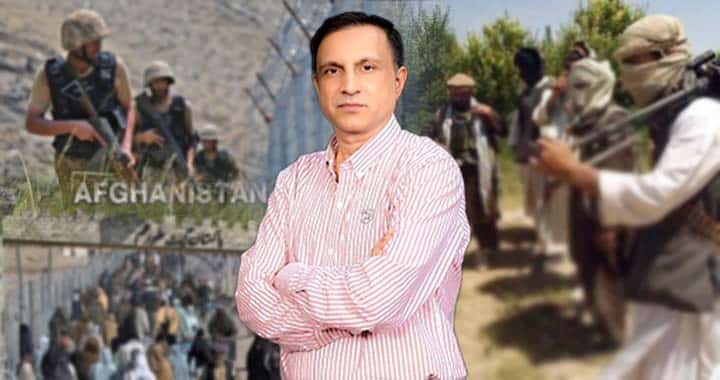
Five years after the Taliban returned to power in Kabul, Afghanistan is confronting a question that its rulers have repeatedly tried to postpone: can they actually control the armed groups operating from their territory, or will promises of action continue to substitute for action itself?
For Pakistan, this is not an abstract diplomatic debate. The TTP has repeatedly used Afghan territory as a sanctuary from which attacks against Pakistan are planned and launched. The issue therefore goes directly to Pakistan’s national security, border stability and the safety of its citizens.
Recent reports that TTP fighters and their families are being moved away from Afghanistan’s eastern border belt to locations including Ghazni deserve attention, but not automatic applause. Reports of such relocations are not entirely new. Earlier reporting also described the movement of TTP-linked families from Kunar and other border areas towards Ghazni and Zabul.
The real test is therefore not whether some families are moved from one Afghan province to another. The real test is whether the TTP’s operational infrastructure, freedom of movement, financing, recruitment and cross-border access are actually curtailed.
Relocation Is Not the Same as Resolution
If Kabul genuinely wants to address Pakistan’s concerns, the process must be transparent enough to be verified. Simply shifting people deeper into Afghanistan does not eliminate the threat if fighters retain access to weapons, communications, financing and logistical networks.
Pakistan has consistently demanded concrete action against groups attacking it from Afghan soil. What Islamabad needs now is not another verbal assurance, but evidence that the policy has changed.
There is also a credibility problem. Kabul has previously announced arrests of TTP figures, only for reports of their subsequent release to emerge. That history explains why Pakistan is understandably cautious about accepting every new announcement at face value.
The reported Ghazni relocation can therefore become meaningful only if it forms part of a wider, sustained policy. TTP members cannot be allowed to move freely from border districts to other Afghan provinces and then resume their activities when pressure subsides.
And the issue goes beyond geography. If a terrorist is moved 500 kilometres away but remains operationally free, the map has changed, but the threat has not.
Badakhshan Reveals Another Taliban Vulnerability
The second major development is unfolding in Badakhshan, where anti-Taliban resistance has become increasingly visible.
Reports surrounding a Taliban helicopter incident in Nusay district indicate that forces loyal to dissident Taliban commander Juma Khan Fateh claimed responsibility for bringing down the aircraft. The precise circumstances and casualty figures surrounding the incident require careful verification, but the broader picture is difficult to ignore: armed opposition to Taliban rule is becoming more visible in parts of northern Afghanistan.
Recent violence in Badakhshan has also included the killing of senior Taliban-linked officials. The Associated Press reported the killing of Faizabad’s mayor in a vehicle explosion, following the earlier killing of the province’s director of information and culture.
What makes Juma Khan Fateh particularly noteworthy is his reported background within the Taliban system itself. His opposition represents something different from an entirely external insurgency. It points towards potential fractures within the very movement that controls Kabul.
At the same time, it would be premature to suggest that the various resistance organisations have the military capacity to overthrow the Taliban government. They remain fragmented, lack the resources of a conventional army and have not demonstrated the ability to hold major population centres for an extended period.
Their strategy of targeting Taliban officials and security structures, however, can still impose political and security costs.
Pakistan Must Protect Its Interests Without Becoming Afghanistan’s Battleground
This changing Afghan landscape presents Pakistan with both a challenge and an opportunity.
Pakistan should not become entangled in Afghanistan’s internal political struggle. Its position has been clear: Afghanistan’s internal affairs are for Afghans to resolve. But that principle cannot mean allowing Afghan territory to remain a launching pad for terrorism against Pakistan.
The distinction is crucial. Pakistan does not need to choose Afghanistan’s government. It needs Kabul to prevent its territory from being used against Pakistan.
The Taliban now face pressure from several directions: internal resistance, economic constraints, international isolation and the continuing dispute with Pakistan over the TTP. If Kabul genuinely wants a stable relationship with Islamabad, controlling anti-Pakistan terrorist groups should be treated as a strategic necessity rather than a temporary concession.
Pakistan, meanwhile, should judge every Taliban commitment by measurable outcomes.
Seventy-Nine Years of Pakistan, and a Hard Lesson
There is also a broader historical lesson here.
Pakistan has paid an extraordinary price for instability spilling over from Afghanistan. Decades of conflict brought weapons, narcotics, militancy and extremist networks into Pakistani society, while successive waves of Afghan conflict placed an enormous burden on Pakistan’s economy and security institutions.
Pakistan supported Afghans through some of their darkest periods and hosted millions of Afghan refugees. That history makes the present security dispute particularly painful.
But foreign policy cannot be built on sentiment alone. States ultimately protect their national interests.
Pakistan can pursue trade, diplomacy and regional connectivity with Afghanistan, but cooperation cannot come at the cost of Pakistan’s security. If Kabul wants stronger economic ties, open borders and a stable relationship with Islamabad, it must first demonstrate that Afghan soil will not be used to attack Pakistan.
The reported relocation of TTP families to Ghazni could be a step in that direction. But only if it is genuine, comprehensive and permanent.
For Pakistan, the equation is now straightforward: promises can open a door, but only verifiable action can rebuild trust.
And as resistance grows inside Afghanistan, Kabul may eventually discover that maintaining hostility towards Pakistan while struggling with internal instability is an increasingly costly strategy.