
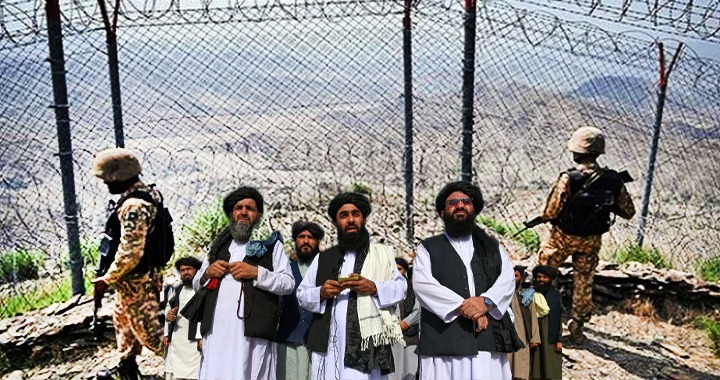
Afghanistan’s security landscape is entering a phase where contradictory developments are unfolding at the same time, creating a complex and often confusing picture for regional observers.
On one hand, reports of the formation of a new elite security formation under the Taliban leadership, commonly referred to as the Hibati Unit, suggest an attempt to strengthen centralized control over security operations. On the other hand, emerging reports of internal dissent and armed defiance by certain Taliban commanders indicate that internal cohesion may be under strain.
Taken together, these developments do not point toward a single clear trajectory. Instead, they reflect a system attempting to consolidate authority while simultaneously managing internal fragmentation.
For countries directly affected by Afghanistan’s internal dynamics, particularly Pakistan, this duality carries significant implications.
Centralization Without Stability
The reported creation of an 8,000-member elite force under direct leadership authority reflects a clear intent to build a more structured and responsive security architecture.
Such formations typically emerge in environments where leadership seeks to improve command control, enhance border security management, and respond more effectively to both internal and external threats.
However, institutional expansion alone does not automatically translate into stability.
The effectiveness of any security structure depends not only on its size or equipment but also on its internal cohesion, legitimacy, and ability to function within a unified command framework.
At the same time, reports of dissent within Taliban ranks, including challenges to authority by regional commanders in northern Afghanistan, point toward underlying tensions that cannot be ignored.
These tensions are often rooted in a combination of factors, including governance disputes, regional power dynamics, resource allocation, and questions of representation within the broader political and military structure.
The coexistence of these two trends centralization at the top and fragmentation at the periphery creates a complex security environment.
Why Internal Dynamics Matter Beyond Afghanistan
Afghanistan’s internal stability has direct implications for regional security, particularly for Pakistan, due to geographic proximity, historical linkages, and shared border vulnerabilities.
Over the past several years, Pakistan has repeatedly raised concerns regarding cross-border terrorist activity originating from Afghan territory. Despite diplomatic engagement and repeated assurances, security incidents along the western frontier have continued to pose serious challenges.
In this context, any shift in Afghanistan’s internal security architecture becomes more than a domestic issue. It becomes a regional security variable.
A centralized force may improve operational coordination in certain areas, particularly border management and counter-infiltration efforts. However, internal divisions can create parallel risks, including gaps in governance, inconsistent enforcement, and the emergence of localized power centers.
Such conditions can be exploited by non-state actors who thrive in environments where authority is uneven or contested.
The presence of multiple competing security dynamics within Afghanistan therefore introduces uncertainty into an already sensitive regional equation.
At the same time, external actors continue to shape the broader strategic environment.
Russia’s reported engagement with Afghan authorities in areas such as training, equipment maintenance, and limited security cooperation reflects its interest in maintaining influence in a strategically important region.
China’s focus remains largely economic, centered on stability required for connectivity and infrastructure initiatives.
Pakistan’s primary concern remains security-related, particularly the prevention of cross-border militant activity and the safeguarding of civilian and security personnel.
These overlapping but distinct priorities contribute to a geopolitical environment where Afghanistan is not isolated but deeply embedded in regional calculations.
The Risk of Misreading Structural Change
One of the key analytical challenges is avoiding simplified interpretations of Afghanistan’s evolving situation.
Viewing the establishment of new security units as purely a sign of consolidation overlooks internal tensions. Similarly, focusing only on internal dissent without recognizing institutional development can lead to an incomplete assessment.
The reality is that both processes may be occurring simultaneously.
In transitional or post-conflict systems, such dual dynamics are not uncommon. Attempts to strengthen central authority often coincide with resistance from regional power holders or established networks within the system.
This does not necessarily indicate immediate collapse or stability. It indicates an ongoing process of institutional recalibration.
For regional stakeholders, including Pakistan, the key issue is not predicting internal outcomes within Afghanistan but understanding how these developments affect external security conditions.
The primary concern remains whether Afghan territory is effectively governed in a manner that prevents its use by non-state actors targeting neighboring countries.
As long as that question remains open, regional security calculations will continue to be shaped by uncertainty.
Afghanistan’s future security architecture will therefore be judged not only by its internal structure but by its external impact.
If centralized mechanisms improve border management and reduce militant mobility, that would represent a positive development for regional stability.
If internal fragmentation weakens governance and creates operational gaps, the risks may persist or even expand.
At present, both possibilities remain visible.
This dual reality defines Afghanistan’s current security puzzle.
And for the wider region, especially Pakistan, it is a puzzle whose outcome carries immediate and tangible consequences.



