
(Babar Khan)
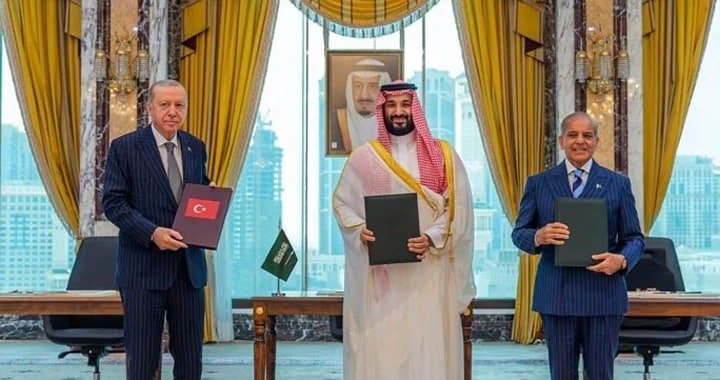
Saudi Arabia, Türkiye, and Pakistan have entered into a landmark defence partnership that is emerging as a potentially consequential development in the strategic landscape of the Middle East and wider Muslim world.
The agreement brings together three influential regional powers with complementary economic, military, technological, and strategic capabilities and reportedly establishes a collective-defence framework under which an attack against one member would be treated as an attack against all three.
While analysts caution that the practical application of the mutual-defence provision would depend heavily on the circumstances of any future crisis, the pact itself represents a significant strategic signal. It indicates that the three countries are seeking to strengthen regional deterrence, diversify their security partnerships, and develop greater capacity to respond collectively to emerging threats.
The agreement comes at a time of heightened instability across the Middle East, with the continuing conflict, attacks on regional infrastructure, disruption to maritime commerce, and growing confrontation involving Iran and its regional partners placing increasing pressure on the traditional US-led security architecture.
For decades, the security architecture of the Gulf and wider Middle East has relied heavily on American military power, including an extensive network of bases, naval deployments, air-defence systems, and security partnerships.
However, the continuing conflict has raised questions about the limits of external deterrence and the ability of even the world’s most powerful military to completely shield regional partners from missile, drone, and proxy attacks.
Iran’s ability to threaten maritime traffic around the Strait of Hormuz, combined with disruption to shipping routes in the Red Sea by its Houthi allies, has further highlighted the vulnerability of critical regional infrastructure and global trade routes.
Against this backdrop, the Saudi-Türkiye-Pakistan agreement can be viewed as part of a broader regional effort to develop additional layers of security and deterrence rather than relying exclusively on a single external guarantor.
Political analyst Ali Shihabi, who is regarded as close to the Saudi government, has argued that the effectiveness of American deterrence has been weakened and that regional powers will increasingly have to assume responsibility for managing threats originating within the region.
One of the most significant features of the emerging partnership is the complementary nature of the capabilities possessed by its three members. Saudi Arabia brings substantial financial resources, energy wealth, strategic geography, and growing investment in defence and advanced technology. The kingdom has increasingly sought to strengthen domestic defence production and reduce its dependence on external suppliers.
Türkiye possesses one of the region’s most developed indigenous defence industries, with growing capabilities in unmanned systems, aerospace, naval platforms, missiles, electronic warfare, and military manufacturing. Ankara also brings a large and experienced conventional military and significant operational experience.
Pakistan, meanwhile, contributes extensive military manpower, institutional military experience, strategic depth, a mature defence establishment, and a nuclear deterrent. Its defence industry also possesses established capabilities in areas including aircraft, armoured systems, missiles, and other military equipment.
Security specialist Andreas Krieg of King’s College London has described the three countries as unusually complementary. Saudi Arabia possesses financial strength but comparatively limited indigenous military-industrial depth; Türkiye possesses technology and manufacturing capacity but requires markets and investment; while Pakistan has manpower, military institutional depth, and strategic deterrence but requires financing and expanded industrial opportunities.
The combination creates the possibility of a broader strategic ecosystem in which financial resources, defence technology, industrial capacity, manpower, and military expertise reinforce one another.
The agreement is also being closely examined through the lens of Iran’s growing regional influence and its ability to project military pressure through direct and proxy capabilities. The continuing conflict has demonstrated that attacks involving ballistic missiles, drones, and non-state armed groups can impose significant costs on regional states even in the presence of sophisticated Western military assets. The Strait of Hormuz remains particularly critical. Any prolonged disruption to the waterway could have consequences far beyond the region, given its importance to international energy supplies and global commerce.
The Red Sea represents another major strategic vulnerability, with attacks and disruptions affecting one of the world’s most important maritime trade corridors. The new trilateral partnership therefore carries a message extending beyond conventional military cooperation: regional states are increasingly seeking the ability to manage regional threats through regional partnerships.
Despite the pact’s collective-defence language, analysts do not expect Türkiye or Pakistan to immediately enter a direct offensive war against Iran in the event of renewed Iranian attacks on Saudi Arabia. Both countries maintain important geographic, economic, diplomatic, and security interests in maintaining stability with Tehran. Türkiye and Pakistan have also sought to position themselves as potential mediators and stabilising actors during regional crises.
Asli Aydıntaşbaş of the Brookings Institution has assessed that Türkiye and Pakistan are unlikely to fight Iran directly, arguing that both countries view themselves as potential stabilisers seeking to create political momentum toward de-escalation.
Saudi security analyst Hesham Alghannam similarly expects neither country to undertake offensive military action against Iran in the immediate term. However, he distinguishes between what the agreement can deliver immediately and what it could potentially evolve into over time.
If attacks against Saudi territory or critical infrastructure were to continue and escalate, Pakistan could potentially deepen its air-defence, military advisory, and security-support role inside the kingdom, while Türkiye could accelerate defence-industrial cooperation, technology transfers, and military-equipment support.
Such cooperation could significantly increase the cost and risk for any actor contemplating sustained attacks against Saudi Arabia. For Riyadh, the agreement provides an opportunity to diversify its strategic partnerships at a time when the kingdom is seeking greater autonomy in its foreign and security policy.
Rather than depending exclusively on one external security umbrella, Saudi Arabia could increasingly pursue a multilayered approach involving the United States alongside partnerships with Türkiye, Pakistan, and other regional powers. This approach would provide Riyadh with greater strategic flexibility while simultaneously expanding its options in defence procurement, military cooperation, intelligence coordination, air defence, and defence-industrial development.
The pact also reflects Saudi Arabia’s increasingly close relations with Türkiye and Pakistan, as well as its broader diplomatic engagement with regional powers seeking to prevent the conflict from expanding further.
The agreement could also have implications for the security framework that Washington has sought to develop across the Middle East. For years, the United States has supported the expansion of the Abraham Accords and advocated a regional architecture that could bring Israel and Arab states closer together through diplomatic, economic, and security cooperation. The Saudi-Türkiye-Pakistan arrangement introduces a different strategic model—one centred on major regional powers rather than an architecture in which Israel plays a central security role.
Türkiye and Pakistan have maintained strong positions against Israeli military actions, while Saudi Arabia has repeatedly linked any future normalisation with Israel to meaningful progress toward Palestinian statehood. H.A. Hellyer of the Royal United Services Institute has noted that Washington would have preferred a regional security architecture incorporating Israel and continued to favour Saudi-Israeli normalisation. The emerging trilateral arrangement, however, points toward a different strategic direction.
Beyond immediate security considerations, the agreement could create substantial opportunities for defence-industrial cooperation among the three countries. Türkiye’s expanding defence sector could benefit from Saudi investment and access to one of the world’s largest defence markets. Pakistan could provide military expertise, manpower, training, and defence-industrial cooperation while benefiting from greater financing and investment opportunities.
Saudi Arabia, meanwhile, could accelerate its objective of developing a more self-reliant defence ecosystem through partnerships with established regional military powers. Potential areas of cooperation could include air defence, unmanned systems, aerospace, military training, intelligence cooperation, logistics, maritime security, and defence manufacturing. The strategic importance of the agreement ultimately extends beyond the question of whether Pakistan or Türkiye would enter a future war. Its immediate significance lies in deterrence. By linking the security interests of three strategically important states, the agreement could alter the calculations of any actor considering attacks against Saudi Arabia or its critical infrastructure.
At the same time, the partnership demonstrates that Riyadh, Ankara, and Islamabad are prepared to assume a more active role in shaping the security environment of the region. The three countries are unlikely to replace the United States as the dominant external military power in the Middle East. However, they could increasingly help fill gaps in regional security while providing their own strategic alternatives.
The true significance of the defence pact will ultimately depend on its implementation. Its collective-defence provision will face its greatest test if one of the three countries comes under a sustained and serious military attack. The response in such a scenario would reveal whether the agreement functions primarily as a political deterrent or develops into a fully operational security mechanism.
For now, the pact represents a clear evolution in the strategic thinking of three major regional powers. Saudi Arabia brings financial strength and strategic geography. Türkiye contributes advanced defence technology and industrial capacity. Pakistan provides military depth, strategic deterrence, and extensive institutional experience. Together, they have created a framework that could evolve into one of the Middle East’s most consequential regional security partnerships.
The agreement therefore marks more than a new defence relationship. It signals the emergence of a more multipolar regional security environment, in which countries traditionally dependent on external guarantees are increasingly seeking to build their own networks of deterrence, cooperation, and strategic resilience.
As the Middle East continues to confront unprecedented security challenges, the Saudi-Türkiye-Pakistan partnership could become an important test of whether regional powers are capable of collectively shaping the future security architecture of their own neighbourhood.



