
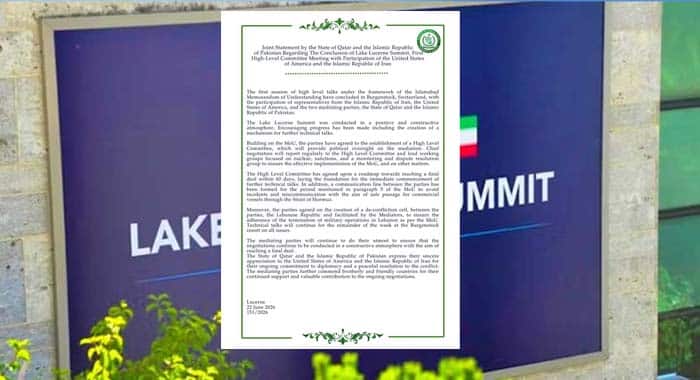
Pakistan and Qatar have issued a joint statement following the conclusion of the first round of high-level talks under the Islamabad Memorandum of Understanding, marking what officials describe as a transition from informal engagement to a sustained diplomatic process.
The discussions, held in Switzerland at Lake Lucerne, brought together representatives from the United States, Iran, Pakistan, and Qatar. According to the joint statement, the negotiations were described by participating delegations as positive, constructive, and forward-looking, reflecting a shared intent to reduce tensions and establish durable mechanisms for dialogue.
A key outcome of the summit is the establishment of a formal structure to ensure continuity of engagement. This includes the creation of a High-Level Committee tasked with overseeing and politically supervising the mediation process.
In addition, technical working groups have been constituted to address core areas of concern, including:
- Nuclear-related issues
- Sanctions and economic measures
- Monitoring mechanisms and dispute resolution frameworks
Chief negotiators from all participating parties will report regularly to the High-Level Committee, ensuring structured oversight and continuous political guidance.
The parties have agreed to pursue a final agreement within a 60-day timeframe, signaling an accelerated diplomatic roadmap aimed at narrowing differences and preventing escalation.
Technical-level negotiations are scheduled to continue throughout the week in Bürgenstock, Switzerland, as part of the ongoing process.
A significant development includes the establishment of a direct communication channel between the relevant parties, designed to prevent misunderstandings, miscalculations, and potential escalation during periods of heightened tension.
Furthermore, a separate de-confliction mechanism involving Lebanon has been agreed upon, aimed at supporting the maintenance of the cessation of military operations and improving regional stability.
Among the key objectives outlined in the framework is the ensuring of safe passage for commercial shipping through the Strait of Hormuz, a critical global maritime corridor with significant geopolitical and economic importance.
Pakistan and Qatar jointly expressed appreciation for the diplomatic engagement demonstrated by both Washington and Tehran, acknowledging their commitment to sustained dialogue and peaceful resolution of outstanding issues.
Observers note that the most significant outcome of the Lake Lucerne Summit is the establishment of an institutionalized diplomatic mechanism, designed to maintain continuity of dialogue even in times of crisis.
Historically, engagement between the United States and Iran has largely depended on indirect or back-channel communication. The current framework suggests a shift toward a more structured, multi-tiered process with defined oversight, technical channels, and reporting mechanisms.
If successfully implemented, the Islamabad Memorandum of Understanding could represent one of the most consequential diplomatic initiatives facilitated in recent years, with the potential to reshape regional engagement architecture.
The coming 60 days are expected to be critical in determining whether this framework can translate diplomatic momentum into a durable agreement.



