
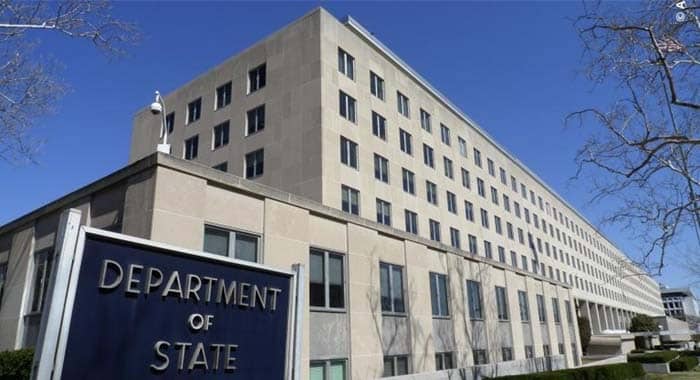
The United States has reaffirmed its support for Pakistan’s right to defend itself against terrorism, underscoring growing international recognition of the country’s legitimate security concerns amid continuing instability along the Pakistan-Afghanistan border.
Speaking on Thursday, the U.S. Department of State stated that Washington “supports Pakistan’s right to defend itself against terrorist attacks,” while acknowledging the immense human cost Pakistan has endured over decades of violent extremism.
“The Pakistani people have suffered greatly at the hands of terrorists,” the State Department said, recognizing the sacrifices made by Pakistan in its long-standing fight against terrorism.
The statement comes at a time of heightened tensions between Pakistan and Afghanistan following a series of cross-border security incidents that have significantly strained bilateral relations. Pakistan has consistently maintained that terrorist organizations operating from Afghan territory pose a serious threat to its national security.
According to Islamabad, militant groups continue to exploit ungoverned spaces near the border to plan and execute attacks inside Pakistan, resulting in the loss of civilian lives and security personnel. Pakistan has repeatedly urged the Afghan authorities to take effective and verifiable action against terrorist organizations operating from Afghan soil, emphasizing that no country’s territory should be used to threaten another state.
Recent months have witnessed one of the most serious periods of military tension between Pakistan and Afghanistan in recent years. The situation intensified following military operations along the border, with both countries exchanging accusations over cross-border attacks and security violations. The United Nations reported that civilian casualties occurred during Pakistani air operations near the border, highlighting the urgent need for measures to prevent further escalation and protect civilian populations.
Subsequently, Afghan Taliban authorities announced that they had carried out air operations targeting Pakistani territory. Pakistan, however, stated that its armed forces successfully intercepted and destroyed four rudimentary drones attempting to enter its airspace in Balochistan. These developments reflect the increasingly fragile security environment along one of the world’s most sensitive international frontiers.
The latest statement from Washington represents another indication of continued international recognition of Pakistan’s counterterrorism challenges. For decades, Pakistan has remained on the frontline of the global fight against terrorism, suffering thousands of civilian and military casualties while conducting extensive counterterrorism operations across the country.
The United States’ acknowledgment reinforces the principle that every sovereign nation possesses the inherent right to protect its citizens and territorial integrity from terrorist violence, consistent with international law.
Despite Pakistan’s conventional military superiority and advanced defense capabilities, regional security remains highly complex. The Afghan Taliban, who returned to power in 2021 following the withdrawal of U.S.-led coalition forces, possess decades of experience in asymmetric warfare and continue to govern Afghanistan amid significant political and economic challenges.
The persistence of militant activity, cross-border infiltration, and competing security narratives has complicated efforts to normalize relations between Islamabad and Kabul.
Pakistan maintains that terrorist organizations continue to operate from Afghan territory and has repeatedly called upon the Afghan authorities to prevent their soil from being used against neighboring countries.
These contrasting positions remain a central obstacle to improving bilateral relations and achieving long-term regional stability.
While security concerns remain paramount, Pakistan has consistently emphasized that lasting peace cannot be achieved through military measures alone. The country continues to advocate enhanced intelligence cooperation, stronger border coordination, sustained diplomatic engagement, and practical mechanisms to combat terrorism while preventing unnecessary escalation. Constructive dialogue, mutual trust, and respect for sovereignty remain essential components of any durable solution capable of ensuring peace and stability throughout the region.
The United States’ reaffirmation of Pakistan’s right to defend itself against terrorism highlights the international community’s recognition of the serious security challenges confronting the country.
As regional tensions continue to evolve, Pakistan remains committed to protecting its citizens, safeguarding its territorial integrity, and working with regional and international partners to eliminate terrorism while pursuing peaceful relations with its neighbors.
Pakistan believes that effective counterterrorism, responsible diplomacy, and regional cooperation must remain complementary objectives in the collective pursuit of lasting peace, stability, and prosperity across South Asia.



