
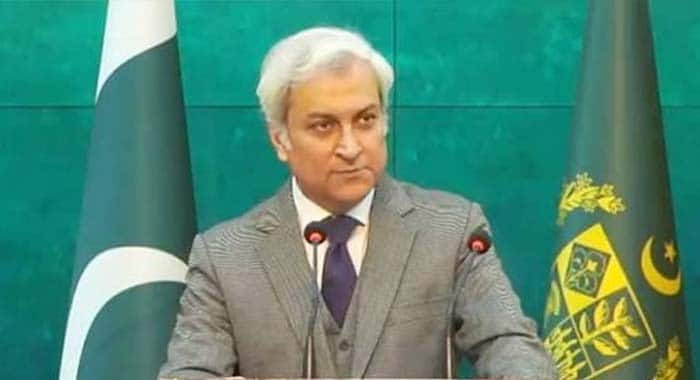
Pakistan has once again reaffirmed that any unilateral attempt by India to suspend, undermine, or deviate from the Indus Waters Treaty (IWT) is illegal, without legal effect, and contrary to international law. The position was reiterated by Foreign Office Spokesperson Tahir Andrabi during the Ministry of Foreign Affairs’ weekly press briefing in Islamabad.
The spokesperson emphasized that water cannot be used as an instrument of political coercion or strategic pressure, warning that any attempt to deprive Pakistan of its legitimate share of water under the Indus Waters Treaty would carry serious consequences for regional peace, stability, and international confidence in treaty obligations.
Referring to a seminar titled “Indus Waters Treaty: A Guarantee of Peace and Regional Stability,” Tahir Andrabi stated that the event brought together political leaders, legal experts, international scholars, members of the diplomatic corps, and representatives of civil society to discuss the future of transboundary water cooperation.
Participants at the seminar strongly opposed the weaponization of water and rejected unilateral measures affecting shared water resources. They stressed that all water-related disputes must be addressed through mutually agreed legal mechanisms in accordance with international law. Speakers further cautioned that any attempt to deny Pakistan access to its lawful share of shared water resources could have far-reaching implications for regional peace, security, and sustainable development.
Quoting Deputy Prime Minister and Foreign Minister Senator Ishaq Dar, the spokesperson stated that Pakistan categorically rejects any purported suspension of the Indus Waters Treaty by India, describing such actions as unilateral, illegal, and devoid of legal validity. He reaffirmed that Pakistan will continue to protect its water rights under international agreements.
The spokesperson expressed concern over what he described as an emerging strategic mindset within India’s leadership that increasingly views water as an asset capable of being controlled, diverted, or withheld for political leverage. He noted that such an approach contradicts not only the spirit and framework of the Indus Waters Treaty but also established principles of international law governing shared water resources.
Pakistan also expressed concern over reports that India is allocating financial resources for projects aimed at altering river flows. In this context, the Foreign Office reiterated Pakistan’s support for the inclusion of China in any comprehensive dialogue concerning regional water management, noting that several major rivers originate in the Himalayan region and impact multiple countries, making broader regional cooperation both necessary and beneficial.
The spokesperson observed that annual meetings under the Indus Waters Treaty have not taken place since 2022, adding that this reflects a broader pattern of disengagement. Pakistan maintains that it has continued to fulfill all of its obligations under the Treaty and remains committed to its implementation.
During the briefing, the spokesperson also provided updates on several regional and international developments. He noted that diplomatic engagements between the United States and Iran are expected to continue following ongoing consultations in Doha, while parallel contacts involving Saudi Arabia, China, Bahrain, Iran, the United Kingdom, and the European Union remain underway.
Highlighting Pakistan’s humanitarian efforts, Tahir Andrabi announced that Pakistan has facilitated the safe repatriation of more than 70 Iranian nationals, including 22 crew members of an Iranian vessel who recently arrived safely in Karachi before returning home.
The spokesperson further stated that the United Nations Special Envoy on Combating Islamophobia recently met Deputy Prime Minister and Foreign Minister Senator Ishaq Dar. During the meeting, Pakistan reiterated its full support for international efforts to combat Islamophobia and expressed hope that the United Nations Action Plan on the issue would soon be finalized to provide a stronger global framework against religious discrimination.
Reaffirming Pakistan’s commitment to counterterrorism, the Foreign Office stated that three additional operatives belonging to Fitna al-Hindustan were recently neutralized. The spokesperson emphasized that Pakistan remains fully committed to eliminating terrorism in all its forms and will continue taking all necessary measures to safeguard national security and protect the lives and property of its citizens.
Addressing recent terrorist incidents in Khyber Pakhtunkhwa, Balochistan, and Karachi, the spokesperson said Pakistan launched Operation Ghazab-ul-Haq targeting terrorist hideouts. He added that the Afghan Chargé d’Affaires had been summoned to the Ministry of Foreign Affairs and formally presented with a diplomatic démarche following evidence indicating the involvement of Afghan nationals in the attacks.
The Foreign Office also confirmed that Pakistan and India have exchanged updated lists of prisoners. According to Pakistan’s assessment, more than 700 Pakistani nationals are believed to be imprisoned in India, while India’s officially shared list includes over 400 Pakistani prisoners. Pakistan reiterated its commitment to pursuing humanitarian issues concerning prisoners through diplomatic channels.
Commenting on the demolition of a Gurdwara structure in Farooqabad, the spokesperson clarified that the building had been in a severely deteriorated condition, was not being used as a place of worship, and posed a safety risk to nearby residents. He stated that the demolition had been carried out without authorization from the Evacuee Trust Property Board, following which action was taken against the responsible tenant, who has since been evicted. Restoration work is currently underway.
Responding to questions regarding minority rights, the spokesperson maintained that Pakistan remains committed to protecting places of worship and rejected external criticism on the issue.
Regarding Pakistani nationals held hostage in Somalia, the Foreign Office stated that efforts for their safe release remain ongoing. Pakistan continues to coordinate closely with Puntland authorities, the Somali government, the vessel’s owners, and other relevant stakeholders. According to information received through international maritime channels, all hostages are alive and continue to receive food and essential supplies while diplomatic efforts for their release continue.
Pakistan concluded the briefing by reiterating its commitment to regional peace, responsible diplomacy, adherence to international law, and the protection of its national interests, while continuing active engagement on security, humanitarian, and regional cooperation issues.



