
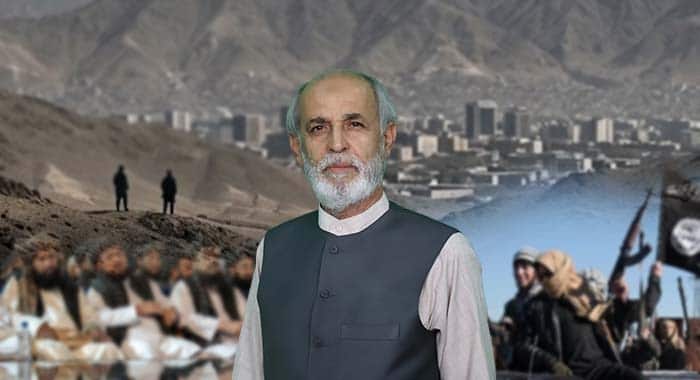
Shamim Shahid
Afghanistan has entered another defining phase in its troubled modern history. Five years after the Taliban returned to power in Kabul, the country remains caught between humanitarian desperation, international isolation, terrorism, political uncertainty and a growing regional security crisis. The latest reports emerging from the United States and the United Nations raise questions that can no longer be dismissed as merely diplomatic disagreements. They point toward a much larger problem: Afghanistan’s political future, economic survival and security are deeply interconnected, and failure in one area can rapidly produce consequences in another.
The reported American decision to halt or restrict assistance to Afghanistan is particularly significant. According to the information under discussion, a report from the US State Department has raised serious concerns about terrorism and the conduct of the Taliban authorities. The report reportedly says that approximately 11 billion in assistance has been sent to Afghanistan during the last five years, with the United States contributing more than half of that amount. The American share is cited at approximately $3.8 billion.
If this assistance is stopped, the consequences will not necessarily fall only on the Taliban authorities. They could fall most heavily on ordinary Afghans.
That distinction is crucial.
The Taliban may control the state, but the Afghan population is not synonymous with the Taliban. Millions of Afghans are already struggling with unemployment, poverty, inadequate housing and weak infrastructure. Many people have been forced to depend on humanitarian assistance simply to survive. Afghanistan’s economic system has also remained constrained by international isolation, restrictions on banking channels and the absence of normal international recognition.
Therefore, an aid cutoff may be intended as political pressure on the Taliban, but the humanitarian consequences could be borne by people who have little influence over Taliban decision-making.
This is the central dilemma confronting Washington and the international community: How can the Taliban be pressured without pushing an already vulnerable Afghan population deeper into misery?
It is tempting to view foreign aid as purely an economic issue. Afghanistan demonstrates why that is a mistake. A country without sufficient employment, functioning institutions and economic opportunity becomes fertile ground for instability. Where young people cannot find work, communities lack basic services and legitimate economic activity is weak, armed organizations can exploit frustration and desperation.
This is where the reported UN concerns about the Tehreek-e-Taliban Pakistan (TTP) and Daesh-Khorasan become especially important. According to the information presented, a UN assessment has raised concerns about alleged Taliban support for TTP militants. It has also warned about the continued strength of Daesh-Khorasan in Afghanistan. The report reportedly describes Daesh-Khorasan as a serious threat and refers to a substantial militant presence, while also raising concerns about the use of cryptocurrency to finance attacks.
The alleged use of approximately $3 million in cryptocurrency is particularly noteworthy because it highlights the changing nature of terrorist financing. Extremist organizations are no longer dependent solely on traditional cash networks. Modern technology has created new avenues for fundraising, transferring and concealing money. Cryptocurrency can potentially make financial tracing more complicated, particularly when funds move through multiple wallets, exchanges and jurisdictions.
But one should be cautious about drawing the conclusion that every cryptocurrency transaction connected to a militant organization proves the involvement of a state or institution. Such claims require strong evidence. What is beyond dispute, however, is that terrorist organizations have become increasingly adaptive. They learn from international counterterrorism measures and continuously search for alternative methods of recruitment, financing and communication. Daesh-Khorasan is therefore not simply an Afghan problem. It is a regional problem. And potentially, it is an international problem.
For Pakistan, the TTP issue is even more immediate. Pakistan has repeatedly faced attacks linked to militant groups operating from or connected to Afghanistan. The security situation in parts of Khyber Pakhtunkhwa has deteriorated to the point where terrorism is no longer merely a matter for military planners. It has become a political, administrative and social crisis. The most dangerous mistake would be to treat these dimensions separately.
Afghanistan’s economic isolation, Taliban policies, cross-border militancy and Pakistan’s internal political divisions are all connected. If the Taliban authorities are unable or unwilling to prevent Afghan territory from being used against neighboring states, Afghanistan’s relationship with Pakistan will remain deeply strained. At the same time, if Pakistan responds only through security operations without a broader diplomatic and political strategy, the cycle of violence may continue.
The answer cannot be found through slogans. It requires cooperation between governments, security institutions, political leadership and local communities.
Another striking element in the discussion is the reported criticism of Pakistan by former Afghan prime minister and longtime political figure Gulbuddin Hekmatyar. Hekmatyar historically maintained close relations with Pakistan, particularly during the anti-Soviet jihad. His political and strategic connections with Pakistan were once widely recognized. That makes his reported criticism all the more significant.
According to the information presented, Hekmatyar has argued that the conflict between Pakistan and Afghanistan is, in effect, connected to the broader rivalry between Pakistan and India. He has also reportedly suggested that while the Kashmir question has changed or moved into a different phase, a struggle continues to be played out in Kabul. Most importantly, he has criticized Pakistan’s policy toward Afghan nationals, describing it as a major mistake and warning that Pakistan is making a blunder that could have long-term consequences. Whether one agrees with Hekmatyar or not, his remarks deserve attention because they reflect a broader reality: Afghan perceptions of Pakistan are changing.
For decades, Pakistan attempted to maintain influence in Afghanistan through relationships with various Afghan political and militant groups. That history created deep connections, but it also created deep suspicions. The relationship between Pakistan and Afghanistan cannot be rebuilt simply by referring to their shared religion, ethnicity, geography or history.
It must be rebuilt through mutual interests. Interestingly, the discussion also recalls a meeting with Hekmatyar in Kabul in June 2022, when his tone toward Pakistan was described as relatively soft and friendly despite repeated questions about the relationship. Reports that he later traveled to Malaysia for medical treatment, amid restrictions, add another layer to the political context surrounding his recent statements.
The important point is not merely where Hekmatyar is physically located. The important question is why his political message appears to have become more critical of Pakistan. That question deserves serious diplomatic analysis rather than emotional reaction.
While Afghanistan faces international pressure, Pakistan cannot afford to ignore what is happening on its own side of the border. The situation described in Bannu is particularly alarming. The security environment there has reportedly become extremely tense. Bajaur has also experienced serious incidents, including target killings, while concerns have been raised about the situation in Lakki Marwat and Hangu as well. The broader picture is worrying. When target killings become recurrent, when police officers operate under severe pressure, when tribal communities are forced to organize meetings to respond to insecurity, and when different levels of government appear disconnected from one another, the problem is no longer simply one of isolated terrorist attacks.
It becomes a crisis of governance. One of the strongest arguments emerging from this discussion is that there is a gap between the provincial government and the police. That gap is dangerous. Police cannot fight terrorism effectively if political institutions do not provide consistent support. Similarly, a provincial government cannot manage a deteriorating security environment without effective coordination with police, intelligence agencies, the administration and federal authorities. Security is not a department that can operate in isolation.
It is a whole-of-government responsibility. The criticism that political disputes are consuming the attention of the provincial government should therefore be taken seriously. Political competition is normal in a democracy, but when terrorism rises, political leadership must demonstrate that public safety comes before partisan confrontation.
The situation in Bannu and Bajaur should be understood as part of a broader pattern. When insecurity spreads from one district to another, it creates a psychological effect that is often more damaging than individual incidents. People begin to question whether the state can protect them. Businesses become reluctant to invest. Families restrict movement. Young people lose faith in institutions. Local disputes can become more difficult to resolve. This is how insecurity gradually damages society.
The state must therefore act before violence becomes normalized. Khyber Pakhtunkhwa needs a coordinated strategy involving the provincial government, federal government, police, security agencies, tribal elders, political parties and civil society. Kinetic operations may sometimes be unavoidable, but military or police action alone cannot provide a permanent solution. There must also be intelligence coordination, border management, economic development, political engagement and community-level confidence building. The gap between institutions must close. Otherwise, militants will exploit it.
The discussion also touches on Pakistan’s wider political crisis, particularly the situation surrounding Imran Khan and PTI and the proposed September 27 long march. There are differing opinions over whether the political confrontation will continue in the same form. If political tensions ease, negotiations succeed and communication channels remain open, the need for a major street mobilization could diminish. That possibility should not be underestimated.
Pakistan does not have the luxury of allowing political instability and terrorism to reinforce one another. When political parties are consumed by confrontation, security institutions can become politically controversial, governments become distracted and public attention moves away from terrorism. The country’s political leadership therefore has a responsibility to distinguish political competition from national security. Pakistan can have political disagreement without allowing its security architecture to collapse. Indeed, political dialogue may be one of the most important security tools available to the country at present.
August 15, 2021 remains one of the most consequential dates in Afghanistan’s recent history. The Taliban entered Kabul and returned to power after two decades of war against the US-backed Afghan government and foreign forces. Five years later, Afghans remain divided over what that moment represented.
For the Taliban and their supporters, August 15 symbolizes victory. For many Afghans living abroad or opposing Taliban rule, it is remembered as a Black Day. Both perceptions exist, and neither can simply be erased. The deeper question is what has happened to Afghanistan during these five years. The Taliban have controlled the country, but control is not the same thing as legitimacy, stability or prosperity.
Afghanistan needs more than a government that can hold territory. It needs a political system capable of bringing together different sections of society. It needs functioning institutions, education, employment, investment, healthcare and a credible banking system.
Most importantly, it needs a future for its young people. The Afghan people have experienced almost every imaginable political system over the past half-century: monarchy, republic, communist rule, mujahideen governments, Taliban rule, international intervention and another Taliban government. Yet the country has repeatedly returned to conflict. This should teach both Afghans and outsiders an important lesson: no political system can survive indefinitely by relying only on force.
If the Taliban genuinely want Afghanistan to move toward stability, their policies on education, employment and political inclusion must be reconsidered. The restrictions placed on women and girls have generated enormous international criticism and have also harmed Afghanistan’s social and economic potential. A country cannot build a sustainable economy while excluding a substantial part of its population from education and employment. Education is not merely a human-rights issue.
It is an economic-security issue. A generation deprived of education is a generation with fewer opportunities, weaker earning capacity and greater vulnerability to radicalization and poverty. Similarly, political revenge cannot become a permanent feature of governance. Afghanistan has suffered enough from cycles of revenge. Every new government that punishes its opponents creates the possibility that those opponents will eventually return seeking revenge themselves. The country needs a political settlement based on inclusion rather than permanent retaliation.
Perhaps the most important lesson from the past five decades is that Afghanistan cannot be permanently redesigned by foreign powers. The United States attempted nation-building. The Soviet Union attempted to shape Afghanistan through military force. Regional powers have repeatedly sought influence. Neighboring countries have backed different Afghan actors at different times.
Yet Afghanistan remains Afghanistan. The Afghan people must ultimately determine their political future. That does not mean the international community should abandon Afghanistan. On the contrary, humanitarian assistance, diplomacy, counterterrorism cooperation and economic engagement remain essential. But foreign governments must distinguish between helping Afghanistan and controlling Afghanistan. Pakistan must also recognize this distinction. Its legitimate security concerns cannot be ignored, particularly when militant groups threaten Pakistani citizens. But Pakistan’s long-term interests are better served by a stable, peaceful and economically functional Afghanistan than by attempts to dominate Afghan politics. The same principle applies to every other regional power.
Afghanistan today sits at the intersection of several crises: economic hardship, international isolation, terrorism, political exclusion, humanitarian vulnerability and regional mistrust. Pakistan is facing a related crisis on its western frontier, particularly in parts of Khyber Pakhtunkhwa. The United States is concerned about terrorism and the use of its assistance. The United Nations is warning about militant activity. Daesh-Khorasan remains a threat.
The TTP question continues to poison Pakistan-Afghanistan relations. And ordinary Afghans continue to pay the highest price. This is why the reported aid debate should not be reduced to the question of whether America will provide or withdraw $3.8 billion.
The real question is what happens after the money stops. If humanitarian support disappears without an alternative mechanism, ordinary Afghans could become poorer. If poverty deepens, instability could increase. If instability increases, extremist organizations could find more recruits. If terrorism expands, neighboring countries will face greater threats. And if regional tensions rise, Afghanistan could once again become a battlefield for competing interests. That is the cycle the international community should be trying to prevent.
The solution requires pressure and engagement at the same time. The Taliban should be held accountable for terrorism, human rights, education and political inclusion. But humanitarian assistance should be designed so that it reaches the Afghan population without unnecessarily strengthening militant structures. International financial mechanisms should be developed to keep legitimate economic activity alive.
Regional states should coordinate more effectively on terrorism. Pakistan and Afghanistan should maintain diplomatic channels even during periods of intense disagreement. And the Afghan people must be given a greater voice in determining their political future. The international community cannot demand that Afghanistan become peaceful while ignoring the economic foundations of peace. Likewise, Afghanistan’s rulers cannot demand international recognition while refusing to address the concerns that prevent that recognition. Both sides have responsibilities.
Five years after the Taliban’s return to Kabul, Afghanistan remains a country waiting for a political settlement that can finally outlive its rulers. The reported American aid restrictions, UN concerns about TTP and Daesh-Khorasan, Gulbuddin Hekmatyar’s criticism of Pakistan, the deteriorating security environment in Bannu and Bajaur, and Pakistan’s continuing political tensions should not be viewed as separate headlines. They are pieces of the same regional puzzle.
Afghanistan’s tragedy has always been that too many actors have tried to decide its future while too few have invested in building a durable peace. The Taliban have an opportunity to prove that their return to power can produce something different from the cycles of the past. Pakistan has an opportunity to replace short-term crisis management with a coherent Afghanistan policy. The United States and other international actors have an opportunity to use their influence without repeating the mistakes of intervention. And the Afghan people deserve the opportunity to live without war, fear and political revenge.
The ultimate test of the Taliban’s five years in power should not be whether they captured Kabul. It should be whether they can build a country in which an Afghan child can go to school, a young person can find a job, a family can live safely, a business can operate normally and a political opponent does not have to fear persecution. That is the real definition of victory. Afghanistan has had enough of military victories.
What it desperately needs now is the victory of peace.



