
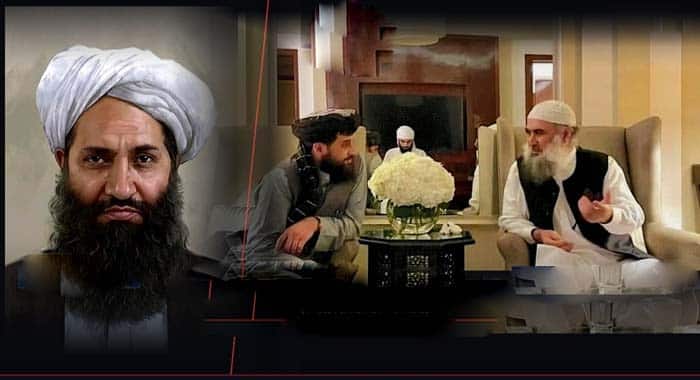
On 13th September evening, Taliban intelligence forces reportedly surrounded a religious school in Kabul in a discreet security operation that culminated in the detention of Mullah Mutasim Agha Jan, a founding member of the Taliban and former finance minister during the rule of the movement’s founder, Mullah Mohammad Omar. Within approximately an hour, Mutasim was reportedly taken into custody and transferred directly to Kandahar, the principal seat of Supreme Leader Hibatullah Akhundzada’s authority.
Taliban officials in Kabul initially attempted to characterize the heavy security presence as part of a routine gathering of local religious scholars. However, accounts attributed to sources familiar with the operation present a substantially different picture. An insider identified as a member of the Taliban’s General Directorate of Intelligence (GDI) reportedly said that the detention had been ordered directly by the office of Supreme Leader Hibatullah Akhundzada. According to the source, instructions included confiscating Mutasim’s mobile phones and documents, placing him in isolation and cutting off his communications with political, religious and other contacts inside and outside Afghanistan.
The reported operation is significant because Mutasim Agha Jan is not an ordinary former Taliban official. He belongs to the surviving generation of veterans who were closely associated with Mullah Mohammad Omar and who retain historical standing among sections of the Taliban’s veteran commanders, religious scholars and political figures. His connection to the movement’s founding generation has reportedly continued to give him access to networks that extend beyond the formal institutions of the current Taliban administration.
That influence has allegedly made Mutasim an important political intermediary for Mullah Mohammad Yaqoob, the Taliban’s Defence Minister and eldest son of Mullah Omar. According to sources inside Afghanistan, Mutasim had been quietly engaging religious scholars, influential elders and other figures in an effort to develop support for Yaqoob as a potential future Supreme Leader. The reported objective was to construct a broad coalition capable of influencing the Taliban’s eventual succession process rather than immediately launching an open challenge to Hibatullah.
The reported detention therefore assumes a significance far beyond the fate of a single former official. If the accounts are accurate, the operation represents an attempt to disrupt an emerging political network before it becomes sufficiently organized to challenge the authority of Kandahar. By targeting an intermediary with connections to Mullah Omar’s veteran network and Yaqoob’s supporters, the Taliban leadership could potentially weaken the channels through which an alternative center of influence is being assembled.
At the heart of the reported struggle is a fundamental difference between formal authority and historical legitimacy. Hibatullah Akhundzada controls the official position of Supreme Leader and exercises extensive authority over the Taliban’s judicial, religious and security structures. Yaqoob, by contrast, carries the name and legacy of Mullah Mohammad Omar, whose role as founder continues to hold powerful symbolic importance within the movement. For sections of the Taliban’s veteran generation, that lineage remains a significant source of loyalty and political influence.
Yaqoob does not necessarily need to openly confront Hibatullah to become a potential alternative center of power. His family connection to Mullah Omar, combined with relationships among veteran fighters and commanders, gives him an established historical constituency. The reported political activity of figures such as Mutasim could provide the organizational bridge between that legacy and a broader coalition of scholars, elders and influential Taliban figures.
This creates a sensitive political equation for Kandahar. A direct confrontation with the Defence Minister could potentially destabilize the movement, whereas disrupting the network surrounding him would allow the Supreme Leader’s camp to weaken a potential succession coalition without confronting Yaqoob personally. The reported arrest of Mutasim can therefore be viewed as a potentially deliberate attempt to isolate Yaqoob from influential intermediaries and demonstrate that connections to the Mullah Omar family do not place individuals beyond the reach of Kandahar’s security apparatus.
The detention also reportedly follows an earlier episode involving Mutasim. According to the information examined in the investigation, in April 2026, Mutasim was stopped on the Kabul–Kandahar highway after attempting to organize an independent council involving Afghan and Pakistani religious scholars. He was subsequently released. His reported re-detention several months later has raised questions over whether his activities had continued to attract the attention of Taliban intelligence and whether the latest operation forms part of a broader effort to restrict independent political and religious networks.
The reported circumstances become even more sensitive because of allegations concerning Mutasim’s recent contacts with Tehrik-e-Taliban Pakistan (TTP) leadership. Intelligence sources cited in the investigation claim that, shortly before his detention, Mutasim held a confidential meeting in Kabul’s diplomatic Green Zone with TTP chief Mufti Noor Wali Mehsud. According to sources familiar with the alleged discussions, the meeting reportedly touched upon the establishment of new operational staging bases in Afghanistan’s eastern border regions as well as shared grievances concerning Hibatullah’s increasingly forceful internal security measures.
The same sources allege that several Taliban commanders and cadres associated with different factions have recently been imprisoned by Kandahar’s intelligence apparatus. If independently substantiated, the alleged meeting would place Mutasim at the intersection of two highly sensitive developments: the Taliban’s internal succession struggle and the militant networks operating along Afghanistan’s eastern frontier.
These allegations require careful distinction between intelligence claims and independently verified facts. Nevertheless, their significance lies in the broader pattern they describe. Mutasim was reportedly maintaining contacts across religious, political and militant networks at a time when Hibatullah’s administration has increasingly sought to consolidate authority and prevent the emergence of independent centers of influence.
The reported detention consequently offers a window into the deeper internal dynamics of Taliban rule. Despite repeated public assertions of unity, influence within the movement appears to be distributed across competing networks whose sources of authority are not identical. One derives its strength from Hibatullah’s control of the formal state and religious-security apparatus. Another is connected to the governmental and military establishment in Kabul. A third revolves around the legacy of Mullah Omar and the political standing of his son, Mullah Mohammad Yaqoob, alongside veteran figures associated with the movement’s founding generation.
The contest between these networks is not necessarily being conducted through open declarations of rivalry. It can instead manifest through appointments, detentions, intelligence operations, restrictions on independent councils, religious alliances and efforts to control access to influential commanders and scholars. In such an environment, intermediaries can become strategically important because they connect otherwise separate constituencies.
Mutasim’s reported position makes him particularly relevant in this context. His historical association with Mullah Omar, his reported relationships with religious figures and his alleged efforts to cultivate support for Yaqoob place him in precisely the kind of intermediary role that could become critical during a future succession process.
The broader significance of the reported arrest also lies in what it may reveal about the Taliban’s approach to internal dissent. If the allegations surrounding Mutasim are confirmed, the operation would indicate that Kandahar is not merely monitoring political activity but actively attempting to prevent alternative networks from developing sufficient cohesion to influence the future leadership of the movement.
The internal power struggle is unfolding while Afghanistan continues to face severe humanitarian and economic pressures. According to figures cited in the investigation from the United Nations Development Programme (UNDP), approximately 74 percent of Afghans are unable to meet their basic daily needs. The World Food Programme (WFP) has reported figures cited in the material indicating that more than 17 million people face severe hunger, while nearly five million women and children require emergency treatment for malnutrition.
These humanitarian realities stand in sharp contrast to the political priorities reportedly occupying the Taliban leadership. While millions of Afghans remain concerned with food, employment, healthcare, education and household survival, senior figures within the movement are reportedly engaged in surveillance, factional maneuvering, detention of potential rivals and the positioning of competing networks for a future succession contest.
Women and girls also continue to face extensive restrictions on education and participation in public life, adding another dimension to Afghanistan’s continuing social and humanitarian crisis. The country’s economic and humanitarian difficulties therefore provide the backdrop against which the Taliban’s internal struggle for authority is taking place.
The reported arrest of Mutasim Agha Jan consequently raises questions that extend beyond one individual or one security operation. It touches upon the unresolved question of how authority within the Taliban will ultimately be transferred, preserved or contested. Hibatullah possesses the formal instruments of power, including the Supreme Leadership and the institutions operating under its authority. Yaqoob possesses the historical capital associated with being the son of Mullah Omar and reportedly retains relationships with influential members of the movement’s veteran generation.
Between these two centers of influence stand the clerics, commanders, elders and intermediaries whose loyalties could become increasingly important as the question of succession assumes greater significance. Mutasim, according to the accounts examined here, had reportedly become one of those intermediaries.
His reported detention and transfer to Kandahar may therefore represent more than a conventional security action. It could signal a calculated effort to prevent a potential coalition around Mullah Mohammad Yaqoob from consolidating and to reinforce the message that all meaningful political networks must ultimately remain subject to Kandahar’s authority.
At the same time, the alleged contact with Mufti Noor Wali Mehsud introduces a regional security dimension that cannot be separated from the internal Taliban equation. Any verified interaction involving senior Taliban figures and TTP leadership, particularly concerning alleged operational activity along Afghanistan’s eastern border, would carry implications extending beyond the Taliban’s internal politics.
For Afghanistan, the consequences of this struggle are ultimately measured not only in terms of which faction gains influence, but also in the conditions faced by the population under Taliban rule. As political networks compete over authority, ordinary Afghans continue to confront hunger, poverty, unemployment, restrictions on women and girls, and an uncertain economic future.
The reported detention of Mullah Mutasim Agha Jan has therefore brought an increasingly important question into sharper focus: is the Taliban’s next major struggle about governing Afghanistan, or about determining who will control the movement when the succession question can no longer be deferred?
The answer will depend not only on the formal authority of Hibatullah Akhundzada, but also on whether the networks surrounding Mullah Mohammad Yaqoob and the surviving veterans of Mullah Omar’s era can maintain their influence in the face of Kandahar’s expanding security apparatus.
For now, the reported detention of one of Mullah Omar’s veteran confidants offers a revealing glimpse into a struggle that is largely taking place behind closed doors — a contest involving loyalty, legacy, religious influence, security power and the future leadership of the Taliban.



