
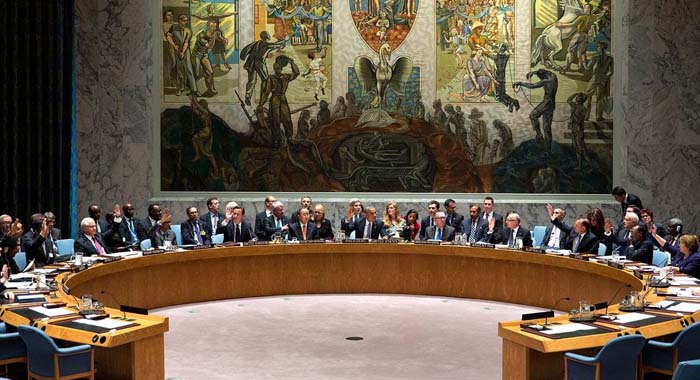
Pakistan has called for a renewed, comprehensive and forward-looking international strategy to combat terrorism, warning the United Nations Security Council that the global terrorist threat has undergone profound changes over the past 25 years and now requires a stronger, better coordinated and technologically equipped international response.
Addressing a special Security Council briefing marking the 25th anniversary of the September 11, 2001 terrorist attacks, Pakistan’s Permanent Representative to the United Nations, Ambassador Asim Iftikhar Ahmad, urged the international community to adapt its counterterrorism mechanisms to emerging threats and take effective action against terrorist organizations operating from or benefiting from safe havens across borders.
The Pakistani envoy expressed particular concern over terrorism emanating from Afghan territory and called for effective international action against the Tehrik-e-Taliban Pakistan (TTP), Baloch Liberation Army (BLA), East Turkestan Islamic Movement (ETIM), ISIS and other terrorist organizations.
Ambassador Asim Iftikhar paid tribute to all those who lost their lives in the September 11 attacks, including seven Pakistani nationals, and expressed solidarity with the government and people of the United States. He emphasized that the 25th anniversary of the attacks represents not only an occasion to remember the victims but also an opportunity for the international community to assess the evolution of terrorism and examine whether existing global counterterrorism mechanisms remain adequate to meet today’s security challenges.
Pakistan, he noted, has remained a frontline country in the global fight against terrorism and has paid an exceptionally heavy human and economic price. According to figures cited by the Pakistani representative, more than 90,000 Pakistanis, including security personnel and civilians, have lost their lives to terrorism since the beginning of the century, while terrorism has also inflicted severe damage on the country’s economy and development.
The Pakistani envoy underscored Pakistan’s contribution to international counterterrorism efforts, particularly its intelligence-sharing, law-enforcement and military operations against terrorist networks. He argued that some of the international community’s major successes against Al-Qaeda were facilitated by Pakistan’s active intelligence coordination and counterterrorism efforts.
Pakistan’s experience, he said, demonstrates that effective intelligence cooperation and sustained international coordination are essential to defeating terrorist networks that operate across national borders. However, the nature of terrorism has changed substantially since the early years of the post-9/11 campaign.
Ambassador Asim Iftikhar warned that the global security environment has transformed dramatically over the past quarter-century. While traditional terrorist organizations remain active, the international community now faces an increasingly diverse range of threats, including far-right extremism, continuing terrorism in the Middle East and Africa, online radicalization, dark-web activity, virtual assets, cryptocurrency-based financing and the misuse of emerging technologies.
These developments, he stressed, require governments to move beyond traditional counterterrorism approaches and develop mechanisms capable of addressing rapidly evolving technologies and financial systems. The absence of appropriate regulation and international coordination, he warned, could allow terrorist organizations to exploit these technologies on an even greater scale.
Pakistan expressed particular concern over the continued emergence of terrorist threats from Afghan territory. According to the figures presented by Ambassador Asim Iftikhar, more than 4,700 Pakistanis have been killed during the past three years in terrorist incidents whose networks, according to Pakistan, have links across the border.
The Pakistani representative urged the Security Council and the wider international community to take effective and timely action against terrorist organizations that threaten Pakistan and regional security. He specifically called for action against the TTP, BLA, ETIM and ISIS, emphasizing the need to prevent terrorist groups from exploiting territory, cross-border networks and safe havens to plan or facilitate attacks.
Pakistan’s position is that terrorism emanating from the region cannot be treated solely as a domestic challenge. It represents a wider regional and international security concern requiring collective action. Pakistan warned that terrorist organizations have demonstrated an increasing ability to adapt to changing political and technological environments.
The evolution of terrorist networks has been accompanied by greater use of modern communications systems, digital financial channels, virtual assets and other technologies that can facilitate recruitment, propaganda, financing and operational coordination. At the same time, cross-border sanctuaries and weakly governed spaces can provide terrorist organizations with opportunities to reorganize, recruit new members and develop operational capabilities. Pakistan therefore called for a stronger international framework combining intelligence cooperation, financial monitoring, border security, technology regulation and coordinated law-enforcement action.
The Pakistani representative argued that the international counterterrorism system must evolve alongside the threats it is designed to combat. Following the September 11 attacks, the Security Council moved rapidly to strengthen the international counterterrorism framework, including through the adoption of Resolution 1373, which established important obligations for states to prevent terrorist financing, suppress terrorist activity and strengthen international cooperation.
Pakistan has described itself as a frontline participant in the global campaign against terrorism and has consistently advocated stronger international cooperation. However, Islamabad now argues that the global counterterrorism architecture must be upgraded to reflect the realities of 2026. The threat landscape today is considerably more complex than it was in 2001, with terrorist organizations capable of exploiting digital platforms, encrypted communications, virtual financial systems, emerging technologies and transnational networks.
Ambassador Asim Iftikhar also emphasized that an effective global counterterrorism strategy must address the underlying drivers that allow extremism and violence to flourish. He called for balanced implementation of all pillars of the international counterterrorism strategy and argued that counterterrorism efforts should be accompanied by attention to political grievances, conflict, occupation, instability and violations of fundamental rights.
He further maintained that populations living under foreign occupation must not be denied their right to self-determination and that those responsible for state repression should also be held accountable. Pakistan’s position, he emphasized, is that the international community must apply counterterrorism principles consistently and without double standards.
Pakistan’s warning comes as security dynamics across South and Central Asia continue to evolve. The return of the Taliban to power in Afghanistan in 2021 fundamentally altered the regional security environment. Since then, concerns over the activities of various militant organizations operating in or around Afghanistan have remained a major issue in Pakistan’s security calculations.
Islamabad has repeatedly raised concerns about attacks inside Pakistan that it says are connected to networks operating from Afghan territory. Pakistan maintains that preventing the use of Afghan territory against neighboring countries is essential not only for Pakistani security but also for regional stability and the broader international campaign against terrorism.
Pakistan’s message to the Security Council was ultimately centered on the need for collective international responsibility. No single country, Islamabad argues, can effectively confront a terrorist threat that operates across borders, exploits international financial systems, uses globally accessible technologies and adapts rapidly to changing security conditions.
The international community must therefore strengthen:
- Intelligence-sharing and counterterrorism cooperation;
- Measures against terrorist financing and illicit financial networks;
- Monitoring of virtual assets and cryptocurrency-related risks;
- International cooperation against dark-web activity;
- Border security and mechanisms to prevent the movement of terrorist operatives;
- Measures to prevent terrorist organizations from exploiting emerging technologies;
- International action against terrorist safe havens; and
- Effective implementation of existing Security Council sanctions and counterterrorism obligations.
The 25th anniversary of September 11 provides a moment for reflection, but Pakistan’s intervention at the Security Council also sought to direct attention toward the future. The terrorist threat of 2026 is not identical to the threat confronted in 2001.
Terrorist organizations have become more decentralized, technologically adaptable and financially sophisticated. Their ability to operate across borders and exploit digital platforms has created challenges that could not have been fully anticipated a quarter-century ago. Pakistan argues that the international community must therefore move from a reactive approach toward a proactive, technology-aware and globally coordinated counterterrorism strategy.
Pakistan has urged the United Nations Security Council to respond to the changing global terrorism landscape with renewed determination, stronger international coordination and an updated legal and institutional framework. Ambassador Asim Iftikhar’s warning placed particular emphasis on terrorism emanating from Afghan territory and called for effective international action against the TTP, BLA, ETIM, ISIS and other terrorist organizations.
At the same time, Pakistan highlighted the emergence of new forms of terrorism facilitated by technology, dark-web networks, virtual assets, cryptocurrencies and modern communications systems. As the international community marks 25 years since September 11, Pakistan’s message is that the global fight against terrorism cannot remain anchored solely in the security realities of the past.
The terrorist threat has evolved and the international response must evolve with it. Pakistan has reaffirmed its commitment to international counterterrorism cooperation and called on the Security Council and the wider international community to strengthen collective action, close emerging security gaps, deny terrorists safe havens and financial channels, and ensure that the international counterterrorism system remains capable of confronting the threats of the next generation.



