
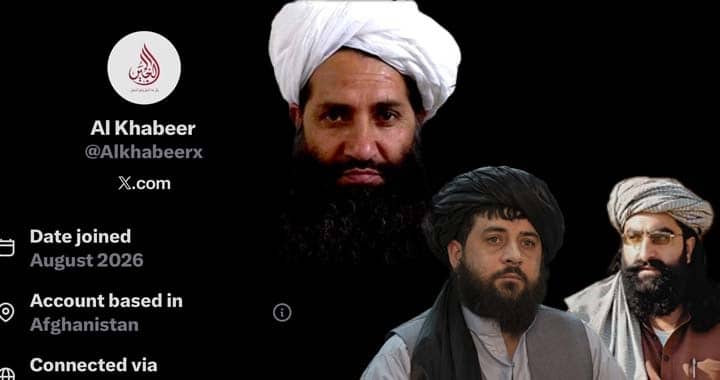
The recent reports of arrests of Tehreek-e-Taliban Pakistan (TTP) members in Kabul may represent far more than a routine security crackdown. Information attributed to sources inside Afghanistan points to a potentially deeper struggle unfolding between competing centers of power within the Taliban leadership, with Mullah Mohammad Yaqoob Mujahid increasingly emerging as a central figure in the reported friction.
According to these sources, a new contest involving Yaqoob, the TTP leadership and the Taliban’s top leadership may be taking shape between Kabul and Kandahar. The claims are based on information from sources inside Afghanistan and include political and intelligence-related allegations that cannot be independently verified.
Yaqoob and the TTP Connection
Sources claim that Yaqoob has maintained close ties with the TTP for years and has played a role in supporting the group. This alleged support reportedly included financial assistance as well as help for the families of TTP members killed during Pakistani security operations.
However, according to the same sources, Yaqoob’s relationship with the TTP may extend beyond ideological or organizational solidarity. They allege that his support for the group is connected to a broader political ambition, namely strengthening his own position within the Taliban hierarchy.
The sources claim that Yaqoob ultimately aspires to replace Taliban supreme leader Haibatullah Akhundzada and become the head of the so-called Islamic Emirate. They further allege that he wants to consolidate his position before the Haqqani faction can strengthen its own claim to the Taliban’s future leadership.
If accurate, such an ambition would transform the TTP from merely a Taliban-aligned Pakistani militant organization into a potentially important component of an internal Afghan power struggle.
Noor Wali’s Reported Role
At the center of this alleged strategy is TTP chief Noor Wali Mehsud.
Sources describe Noor Wali as a de facto deputy-like figure within Yaqoob’s reported network and claim that Yaqoob views the TTP as a potential reserve force that could become useful if a major confrontation erupts within the Taliban leadership.
The sources further allege that Yaqoob has offered Noor Wali an important leadership position in Afghanistan’s southeastern region. Under the reported arrangement, Noor Wali could potentially serve as a deputy emir or regional emir under a broader central command, with his influence possibly extending into Pakistani areas where the TTP already maintains an operational presence.
Such an arrangement, if it exists, would give the TTP something considerably more valuable than sanctuary: an embedded political and territorial role within a competing Taliban power structure.
The India Angle
The allegations become even more consequential with claims concerning India.
According to the sources, Yaqoob has allegedly developed close contacts with certain elements of Indian intelligence and has reportedly offered space for Indian operations in Afghanistan in return for support.
These claims have not been independently verified. Nevertheless, if substantiated, they would point to a potentially wider strategic dimension in the reported Yaqoob-TTP relationship, linking an internal Taliban succession struggle with competing regional intelligence interests.
Why the Kabul Arrests Matter
The reported arrests of TTP members in Kabul therefore acquire a different significance when viewed against these allegations.
Sources claim that elements loyal to Haibatullah became increasingly concerned about Yaqoob’s growing relationship with the TTP and moved against members of the group as part of an effort to disrupt the emerging network.
But the sources allege that the pressure failed to dismantle the relationship. Yaqoob reportedly intervened once again in support of the TTP, suggesting that the arrests may have been only one episode in a much larger contest over influence.
This raises a critical question: were the Kabul arrests simply an attempt to enforce Taliban authority over the TTP, or were they part of a struggle between rival factions over who controls the group and how it can be used in Afghanistan’s future power equation?
A Dangerous Power Struggle
Any serious confrontation between Haibatullah, Yaqoob and the Haqqani faction would have consequences extending well beyond Taliban internal politics.
Afghanistan already hosts a complex ecosystem of armed organizations, including Islamic State Khorasan Province (ISKP), al-Qaeda, the East Turkestan Islamic Movement (ETIM), Jamaat Ansarullah and the TTP. A major fracture within the Taliban leadership could create additional space for these organizations to expand their activities, exploit rivalries and pursue their regional and international agendas.
For Pakistan, the stakes would be particularly high. A TTP network embedded within a factional struggle inside the Taliban could potentially make the organization even harder to contain, while simultaneously turning Afghanistan into a more volatile battleground for competing internal and external interests.
The most visible part of this story may currently be the arrests in Kabul. The more consequential struggle, however, may be unfolding behind closed doors in Kabul and Kandahar.
The central question is no longer simply whether the Taliban can control the TTP. It is whether the TTP itself is becoming a piece on the chessboard of a much larger struggle for the future leadership of Afghanistan.
Note: This report is based on reporting and analysis published by Al Khabeer, an independent source covering Afghanistan, with a focus on terrorism, counterterrorism and regional security. The political and intelligence-related allegations cited in the report are attributed to sources inside Afghanistan and could not be independently verified.



