
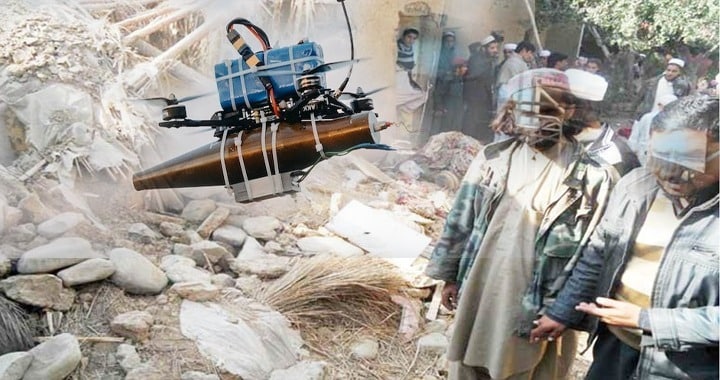
The emergence of quadcopter-based attacks across Khyber Pakhtunkhwa, including cross-border quadcopter attacks by the Afghan Taliban, marks a structural shift in the nature of conflict, not just an escalation in frequency. From Bajaur to Hangu and North Waziristan, the use of commercially adaptable aerial devices has introduced a new layer of unpredictability into an already volatile security landscape.
Unlike conventional attacks, quadcopters compress three advantages into a single tool: distance, concealment, and psychological reach. This combination allows armed groups to strike without direct engagement while significantly expanding the range of potential targets.
The recent martyrdom of a promising youth in North Waziristan, or the injury of three children in Bajaur’s Mamund area while playing cricket in a ground, or the targeting of peace committee member’s relatives in Lakki Marwat is part of this evolving pattern. The choice of target location, a civilian play area, reflects a growing operational trend where every day spaces are no longer insulated from conflict dynamics.
In Hangu, the targeting of a police checkpoint via a quadcopter attack further reinforces the dual-use nature of this tactic. It is being deployed against both state installations and civilian clusters, depending on perceived vulnerability and operational opportunity.
Earlier incidents highlight the severity of the threat. On 27 April 2026, a quadcopter strike in Spinwam, North Waziristan, injured three children at the residence of Malik Liaqat Ali Khan. On the same day, another attack in Aka Khel Bara claimed the life of a young girl and left six others injured. On 5 April 2026, a quadcopter incident was reported in Melowar Bara, while on 10 March 2026, three children were injured in Lakki Marwat. In a particularly tragic case on 11 December 2025, a quadcopter strike targeted a cricket ground near a school in Sheikh Landak, Bannu, resulting in the deaths of three children.
Meanwhile, in North Waziristan, the situation illustrates a different but connected dimension of instability. Here, the confrontation is not limited to aerial attacks but extends into ground-level tensions between local communities and armed actors, particularly following jirga-based decisions to expel terrorist presence. The resulting friction highlights how governance, tribal authority, and armed pressure intersect in contested spaces.
Taken together, these incidents suggest that quadcopter warfare is not an isolated technological adoption but part of a broader tactical evolution. It sits within a wider ecosystem of asymmetric methods, including infiltration attempts, targeted killings, and improvised explosive deployment.
What makes this shift particularly significant is its accessibility. Unlike conventional air power or complex missile systems, quadcopters can be modified using commercially available components, lowering entry barriers for deployment while increasing operational flexibility.
At the same time, the psychological dimension of this shift cannot be ignored. The unpredictability of aerial strikes introduces a persistent sense of vulnerability among civilian populations. Children playing in open spaces, commuters near roadsides, and residents in semi-urban clusters all become potential exposure points.
This changes the texture of daily life in affected districts. Security is no longer perceived as a boundary around sensitive sites, but as a fluctuating condition across entire communities.
The pattern also raises structural questions about response capacity. While reactive measures exist in multiple districts, including surveillance and interception attempts, the rapid adaptability of drone-based tactics continues to challenge conventional policing and border management frameworks.
From Bajaur’s civilian casualties to Hangu’s checkpoint strike and North Waziristan’s ground-level confrontations, the emerging picture is one of layered instability rather than isolated incidents.
This is not a linear escalation. It is a diffusion of threat across domains: air, ground, and community space simultaneously.
And in that diffusion lies the core challenge for security architecture in the region.



