
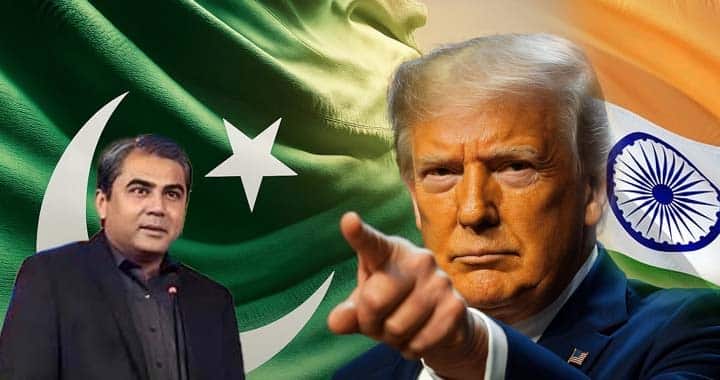
Federal Interior Minister Mohsin Naqvi on Wednesday said Pakistan’s success in Marka-e-Haq came with the help of Allah, while Field Marshal Syed Asim Munir received “special divine support” during the conflict, as he disclosed fresh details about Pakistan’s military, intelligence, cyber, and drone capabilities demonstrated during last year’s war with India.
Addressing a press conference alongside Minister of State for Interior Talal Chaudhry, Naqvi said nationwide events were being held to commemorate Marka-e-Haq and Operation Bunyan al-Marsoos, launched in response to India’s Operation Sindoor during the May 2025 conflict.
He stated that India had deployed small and medium-sized drones toward various Pakistani regions during the war, but most were destroyed near the border by Pakistani Rangers before reaching deep inside the country.
“Only a few Indian drones managed to enter Pakistani territory,” he said, adding that India had also attempted cyberattacks but failed to match Pakistan’s cyber capabilities.
Naqvi said the conflict marked an unprecedented use of drone warfare between the two nuclear-armed neighbors, noting that Pakistan’s armed forces “raised the nation’s head with pride” through their response.
Revealing further operational details, the interior minister claimed Pakistani drones flew over the residence of the Indian prime minister in New Delhi, creating panic among Indian authorities.
“Our target was never Indian civilians, while they targeted our civilian population,” he said, adding that Pakistani Rangers remained positioned directly along the border during the confrontation.
“India was eventually forced to wave white flags,” he remarked.
The minister also praised the Pakistani media for what he described as its responsible and unified coverage during the conflict, contrasting it with what he called confusion and disinformation within sections of Indian media.
Speaking about the military leadership, Naqvi said Field Marshal Asim Munir had received “special blessings and support from Allah,” adding that he had personally witnessed developments during foreign visits which, according to him, reflected unusual circumstances surrounding the conflict and diplomacy.
He further claimed India launched attacks on Pakistani bases shortly before the ceasefire, after which Pakistan carried out retaliatory strikes on sensitive targets, including what he described as a major Indian oil depot.
“There were dozens of things that happened which even seemed impossible,” he said, asserting that Indian aircraft and naval installations were within Pakistan’s operational range during the conflict.
Naqvi also credited Pakistan’s intelligence agencies with playing a decisive role in Operation Bunyan al-Marsoos, saying advance intelligence enabled effective preparation and response.
“We were receiving details from India as if it were our own country,” he remarked, praising both intelligence agencies for their performance despite public criticism they often face.
The interior minister further claimed that then-US President Donald Trump played a role in preventing India from suffering even greater losses by helping facilitate a ceasefire.
According to Naqvi, the scale of damage inflicted during Marka-e-Haq would force India to think “multiple times” before considering any future escalation against Pakistan.
Responding to a separate question, he also referred to tensions between the United States and Iran, expressing confidence in Field Marshal Asim Munir’s diplomatic role and saying people should “trust his efforts” regarding broader regional de-escalation.
Pakistan has intensified commemorative events this month marking one year since the May 2025 conflict with India, officially referred to in Pakistan as Marka-e-Haq and Operation Bunyan al-Marsoos. Senior civil and military officials have repeatedly highlighted the role of drone warfare, cyber capabilities, intelligence coordination, and multi-domain operations during the confrontation, while reaffirming Pakistan’s readiness to respond to any future aggression.



