
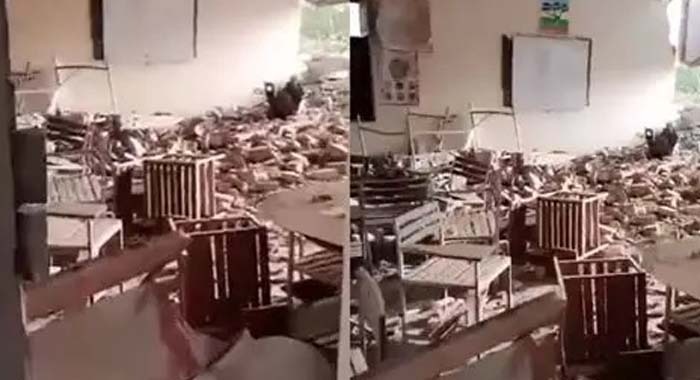
In Tank District, the silence of the night was shattered by yet another act of calculated destruction, as terrorists of a proscribed terror outfit targeted a government primary school in Kot Gullan, reducing a place of learning to rubble.
According to police sources, explosives were planted inside the Government Boys Primary School, which detonated with force, leaving the building severely damaged. The blast sent waves of fear and uncertainty through the area, as residents woke to an incident that has, tragically, become all too familiar.
Law enforcement agencies, along with security forces, swiftly reached the scene, cordoned off the area, and launched a search operation to trace those responsible. Yet, beyond the immediate response, a larger and more troubling picture continues to emerge.
This was not an isolated incident. It carries the unmistakable signature of terrorists, widely identified as the banned Tehreek-e-Taliban Pakistan (TTP), often referred to as Fitna al-Khawarij, whose hostility toward education is neither hidden nor new.
These attacks are not random bursts of violence. They are deliberate strikes against the very foundations of society, aimed at extinguishing opportunity, silencing classrooms, and pushing entire communities into darkness.
A school is not just a building of bricks and cement. It is a quiet promise, a contract between the present and the future. When such a place is bombed, the damage travels far beyond shattered walls, seeping into the soul of a community.
A Pattern Written in Rubble
This pattern is not new, rather a recurrent one, especially across the terrorism-affected districts of Lakki Marwat District, Bannu District, and Tank.
Time and again, terrorists have turned schools and hospitals into battlegrounds. In Bannu’s Bakakhel area, an educational institution was seized and converted into a base, while another was forcibly shut down, placing entire communities at risk. In Tank’s Chini Machan Khel, a hospital was demolished, stripping residents of essential healthcare. Schools in both Tank and Lakki Marwat were repeatedly targeted, denying children access to education and eroding hopes for a stable future.
The duplicity of these elements becomes even more evident in their claims. While portraying themselves as protectors of public welfare, they continue to destroy the very facilities built for the people. In Lakki Marwat, a Government Girls Primary School in Pahar Khel Pakka was bombed, just hours after a bridge in Bannu was blown up in a failed attempt to target security forces. These back-to-back attacks exposed a clear pattern; terrorism wrapped in hollow rhetoric.
In another incident in Tank’s Gara Buddha village, terrorists led by commanders Shah Zeb alias Jarrar and Hidayatullah demolished a girls’ primary school under the cover of darkness, once again targeting education with precision. Such acts are not isolated incidents; they are part of a sustained campaign.
The assault extended beyond Tank. In Azam Warsak, South Waziristan, terrorists stormed a government school, looted equipment, vandalized classrooms, and fled, marking yet another strike in what appears to be a coordinated effort to destabilize the region. The timing of these attacks, particularly following stalled regional peace efforts, points towards a broader design, one that seeks to derail not just internal stability but also Pakistan’s role in regional de-escalation.
Even in remote parts of Tank, two more government schools were destroyed in night-time explosions, reinforcing a grim reality, educational institutions have become prime targets in this war against the future.
The message behind these attacks is chillingly clear. Terrorists fear education more than defeat.
Yet, amid the debris and dust, another truth stands firm.
The people of these areas, despite fear and repeated loss, continue to endure. Authorities have repeatedly stressed that defeating this menace is not the responsibility of security forces alone. It requires public unity, vigilance, and an uncompromising rejection of those who enable or shelter such elements.
Because in this fight, every destroyed classroom is a question, and every united response is the only way forward.



