
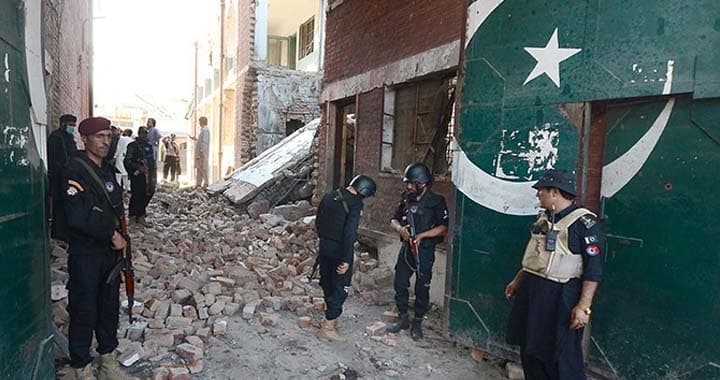
The latest wave of violence in Pakistan’s north-western’s province, Khyber Pakhtunkhwa is revealing a dangerous transformation in the operational strategy of terrorist networks. What was once largely a conflict centered around direct attacks on security forces has steadily evolved into a broader campaign targeting the foundations of everyday civilian life.
Recent incidents across the province illustrate this shift with alarming clarity.
In Lakki Marwat, terrorists destroyed yet another girls’ school using explosives, continuing a pattern of attacks aimed not only at damaging infrastructure but at undermining education itself. Similar attacks in nearby regions have already forced interruptions in academic activity, particularly affecting vulnerable communities where access to schooling remains fragile.
In Bannu, the aftermath of the Fateh Khel attack triggered large-scale clearance operations across Domel, Akbar Ali Khan Kallay, and Sada Khel Waziri. Security forces recovered weapons, dismantled terrorist hideouts, detained suspected facilitators, and restored control in several areas where terrorist influence had begun disrupting civilian movement and local confidence.
But the operational battlefield no longer ends at roads and compounds.
The targeting of schools, police homes, commercial activity, transport routes, and even civilian psychology indicates that terrorist groups are increasingly pursuing what security analysts describe as “environmental destabilization.” The objective is no longer limited to inflicting casualties. It is to create a permanent climate of uncertainty in which ordinary life itself becomes difficult to sustain.
This pattern has become visible across multiple districts.
In Lakki Marwat, attacks on educational institutions have coincided with assaults on homes linked to police personnel and intimidation tactics targeting local communities. In Bannu, repeated attacks on police positions and surrounding infrastructure have intensified fears among residents already living under prolonged security pressure.
Even Punjab recently witnessed a disturbing tactical evolution when Khwarij allegedly used a quadcopter drone to target a police station in Tunsa Sharif. The attack demonstrated how terrorist groups are adapting commercially available technology to conduct asymmetric strikes against state institutions while attempting to spread psychological fear far beyond the immediate blast zone.
The Battlefield Is No Longer Limited To The Battlefield
What makes the current security environment particularly concerning is that terrorism in KP is now being fought simultaneously on physical, psychological, technological, and narrative fronts.
The physical attacks are visible.
The deeper battle is over societal confidence.
When schools are bombed, roads blocked, police families targeted, and local markets disrupted, the intention extends beyond immediate destruction. Terrorist organizations seek to weaken public trust in the state’s ability to maintain order and protect normal life.
At the same time, analysts warn that ambiguity in political messaging and the absence of a coherent province-wide counterterrorism narrative risk creating additional space for extremist propaganda.
Recent debate surrounding audio leaks involving extremist figures and political references, regardless of verification, has further fueled public anxiety and mistrust. Security observers caution that such controversies thrive in environments where terrorist violence intersects with political polarization and institutional confusion.
Meanwhile, violent infighting among terrorist factions in Central Kurram, where at least 14 extremists were reportedly killed in clashes between rival commanders, underscores another evolving reality: multiple armed networks continue operating across sensitive regions, often independently competing for influence, territory, and operational dominance.
Security experts argue that operational victories alone cannot fully stabilize the province unless accompanied by strong governance, public reassurance, institutional clarity, and a unified national narrative against terrorism.
The sacrifices being made by police personnel and security forces on the ground require parallel political and societal alignment.
Without that alignment, terrorist organizations gain opportunities not only through violence, but through confusion.
And in modern insurgencies, confusion itself becomes a weapon.



