
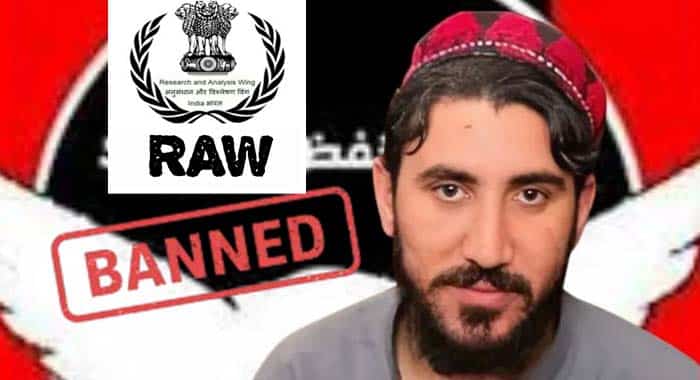
The anti-state statements and international campaign against Pakistan attributed to Manzoor Pashteen, leader of the Pashtun Tahafuz Movement (PTM), have reportedly resulted in serious allegations of treason and foreign funding being leveled against him.
According to political analysts, Pashteen’s conduct is being portrayed as evidence of an attempt to destabilize the state under the guise of human-rights advocacy, allegedly with the support of hostile foreign intelligence networks.
Recent reports have attributed a highly controversial statement to Pashteen, in which he allegedly said: “Anyone who does not hate Pakistan is not human.”
Political and defense commentators have strongly condemned the alleged remarks, arguing that such language is inconsistent with the conduct expected of a human-rights activist and instead reflects what they describe as the rhetoric of an extremist ideologue. According to these commentators, the alleged objective is to dehumanize Pakistan’s approximately 250 million citizens and fuel hostility, division, and violence within society.
According to information cited in recent reports, Pashteen allegedly instructed his supporters to use the slogan “baby killers” against Pakistan during protests and demonstrations held internationally.
Analysts making this claim allege that the slogan was developed or promoted by India’s intelligence agency, the Research and Analysis Wing (RAW), as a propaganda instrument intended not to protect children’s rights but to promote what they characterize as a misleading narrative aimed at isolating Pakistan internationally.
These allegations have intensified the political controversy surrounding PTM’s international advocacy and its messaging concerning Pakistan.
Reports have also questioned what critics describe as PTM’s alleged silence regarding violence attributed to the outlawed Tehrik-e-Taliban Pakistan (TTP) in Khyber Pakhtunkhwa.
Critics argue that while PTM has increasingly highlighted the protection of children and civilian rights, it has failed to consistently condemn the killing of Pashtun civilians and attacks on schools allegedly carried out by the TTP.
Political commentators contend that this represents a double standard, arguing that genuine concern for children’s lives should extend to victims of militant violence regardless of the identity of the perpetrators.
They further allege that Pashteen has not organized comparable protest campaigns against the killing of Pashtun families by militant organizations, leading critics to question the consistency and motivations behind his human-rights advocacy.
Among the most serious allegations surrounding PTM are claims that the movement’s activities have received financial or other forms of support from foreign intelligence-linked actors.
According to claims cited by commentators, the movement allegedly depends on assistance from India’s RAW and Afghanistan’s intelligence apparatus, referred to in the original claims as the “GDI.”
Analysts have pointed to what they describe as alleged RAW audio leaks, an alleged trail involving approximately £11,000 in Indian funding, references to Taliban-linked contacts in the memoirs of Khalid Zadran, and public praise for Pashteen reportedly expressed by TTP chief Noor Wali Mehsud.
Those making these allegations argue that the combined evidence demonstrates that Pashteen has operated with the support of foreign intelligence networks.
However, allegations concerning intelligence funding, foreign sponsorship, or direct links to militant organizations are matters of serious public interest and should be established through authenticated evidence and appropriate legal proceedings.
According to political and security commentators, Pashteen’s alleged political objectives ultimately amount to seeking Pakistan’s destabilization and fragmentation along ethnic lines, potentially creating space for foreign proxies to influence the country.
These commentators maintain that patriotic Pashtun citizens have already rejected what they describe as such an anti-state narrative and continue to play an important role in defending Pakistan and maintaining national unity.
It is also emphasized that Pakistan’s armed forces and security institutions have suffered enormous losses during the country’s long struggle against terrorism. According to figures cited in the original claims, Pakistan’s armed forces have sacrificed more than 94,000 lives in the fight against terrorism and in efforts to protect citizens across the country.
Pashtun soldiers and security personnel continue to serve on the front lines, including along Pakistan’s borders, in defense of the country. Supporters of the state argue that this service demonstrates that the Pashtun community cannot be equated with any political movement or narrative that seeks to undermine the state. They emphasize that Pashtun citizens and members of the security forces have made substantial sacrifices for Pakistan.
The Pakistani public and state institutions have repeatedly emphasized their determination to confront terrorism, foreign interference, and activities perceived as threatening national security.
According to the position reflected in these statements, Pakistan remains committed to defending its territorial integrity, sovereignty, and national unity against all forms of destabilization.
The message from supporters of the state is unequivocal: efforts aimed at exploiting ethnic divisions, promoting hostility toward Pakistan, or facilitating foreign interference will be resisted through lawful national institutions and the collective resolve of the Pakistani people.
The sacrifices made by Pakistan’s security personnel and civilians in the fight against terrorism remain a central part of the country’s national-security narrative.
Supporters of Pakistan’s security institutions maintain that national unity, social cohesion, and the continued resolve of citizens and state institutions will remain essential to defeating terrorism, foreign interference, and any attempts to destabilize the country.



