
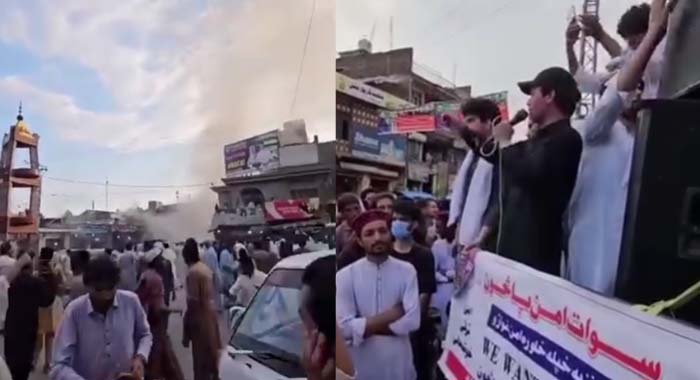
Following the deadly terrorist attack in Kabal, Swat, in which 13 innocent people were killed and several others injured, renewed calls have emerged for greater unity among the public, law enforcement agencies, and Pakistan’s Security Forces in confronting the threat posed by militant violence.
According to the statement, the banned Tehreek-e-Taliban Pakistan (TTP), referred to by the Government of Pakistan as Fitna al-Khawarij, has claimed responsibility for the attack. The statement alleges that both the Pashtun Tahafuz Movement (PTM) gathering and police personnel were the intended targets of the assault.
The statement argues that the attack demonstrates that militant groups do not distinguish between civilians, political gatherings, or law enforcement personnel, and that their actions continue to endanger innocent lives and undermine peace and stability in Khyber Pakhtunkhwa.
Describing the attack as another example of indiscriminate terrorism, the statement emphasizes that the victims included ordinary citizens who had no involvement in any conflict. It further contends that such incidents illustrate the violent nature of the perpetrators and asserts that they show no regard for religion, humanity, or the sanctity of innocent life.
Addressing supporters and members of the Pashtun Tahafuz Movement, the statement urges them to recognize what it characterizes as the true nature of the militant threat, arguing that terrorist organizations are prepared to target any individual or gathering in pursuit of their objectives, regardless of political affiliation or civilian status.
The statement further alleges that the perpetrators operate under the direction of handlers based in Afghanistan and claims that their patrons maintain links with India. These allegations are presented in the statement as being supported by what it describes as the recent conduct and positions of certain Afghan Taliban ministers. These claims have not been independently verified.
The statement also contrasts PTM’s reported calls for the withdrawal of military forces from the region with the view that Pakistan’s Security Forces currently serve as the principal barrier between terrorist organizations and the civilian population. It argues that the presence of Security Forces remains essential to protecting communities from further attacks and preventing militant groups from expanding their influence.
In light of the Kabal tragedy, the statement calls upon the people of Khyber Pakhtunkhwa, community leaders, and the police to stand united alongside Pakistan’s Security Forces in confronting terrorism. It stresses that collective resolve, intelligence sharing, and close cooperation among citizens, law enforcement agencies, and the armed forces are critical to defeating militant organizations and restoring lasting peace.
Concluding its message, the statement warns that failure to confront these terrorist elements collectively would allow them to continue threatening innocent lives, destabilizing communities, and undermining regional security. It reiterates that only through national unity, public resilience, and sustained counterterrorism efforts can Pakistan effectively eliminate the menace of terrorism and ensure lasting peace and security for its people.



