
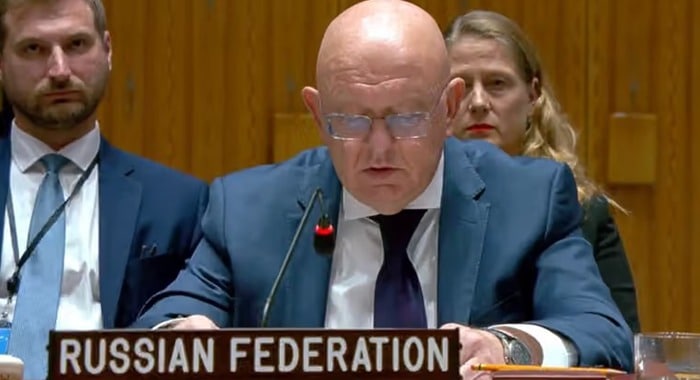
Russia has warned that ISIS-Khorasan remains a serious and evolving security threat emanating from Afghanistan, urging the international community to strengthen coordinated efforts to confront the changing nature of transnational terrorism.
Speaking at a United Nations Security Council meeting on Friday marking the 25th anniversary of the September 11, 2001, terrorist attacks, Vasily Nebenzya, Russia’s Permanent Representative to the United Nations, highlighted the continued threat posed by terrorist organizations operating in Afghanistan and other regions, particularly parts of Africa.
Nebenzya stressed that, despite significant international counterterrorism efforts over the past quarter-century, the global terrorist threat has not been eliminated. Instead, terrorist organizations have adapted their structures, methods, financing mechanisms, recruitment strategies, and operational capabilities to exploit emerging technologies and changing geopolitical conditions.
The Russian envoy specifically drew attention to ISIS-Khorasan, commonly known as ISIS-K, which has continued to pose a significant security challenge in Afghanistan. ISIS-K has carried out a series of deadly attacks in Afghanistan in recent years and has demonstrated the capability and intent to plan and facilitate operations beyond the country’s borders.
According to Nebenzya, the persistence of such groups demonstrates that the international community must remain vigilant and cannot afford to underestimate the threat posed by extremist organizations operating from fragile and conflict-affected environments. The warning comes amid continuing international concern over Afghanistan’s security environment following the Taliban’s return to power in 2021.
Although the Taliban has repeatedly asserted that Afghan territory will not be used against other countries, the continued presence and activities of ISIS-K have remained a major concern for regional governments and the wider international community.
Nebenzya emphasized that contemporary terrorism cannot be addressed solely within national borders. One of the major unresolved challenges, he said, is the movement of foreign terrorist fighters between conflict zones and the transfer of combat experience, operational knowledge, recruitment methods, and extremist networks from one region to another. Terrorist organizations have increasingly demonstrated the ability to operate through decentralized networks and exploit instability in different parts of the world.
The Russian representative pointed to Afghanistan and parts of Africa as examples of environments where terrorist organizations continue to pose significant threats to regional and international security. The movement of experienced fighters and the exchange of operational expertise between terrorist networks can enable groups to adapt rapidly, establish new cells, and expand their geographic reach. This transnational dimension, Nebenzya stressed, requires an equally coordinated international response.
A central element of the Russian warning was the rapid evolution of the tools available to terrorist organizations. Nebenzya said extremist groups are increasingly exploiting new technologies, digital financial instruments, drones, artificial intelligence, and modern communications networks to strengthen their operations.
These technologies can provide terrorist organizations with new opportunities to recruit members, disseminate propaganda, raise and transfer funds, communicate securely, coordinate operations, and potentially conduct or support attacks. The growing accessibility of sophisticated digital technologies has therefore created a new layer of complexity for international counterterrorism agencies.
Terrorist organizations are no longer dependent exclusively on traditional physical networks. Digital platforms and modern communications systems can allow extremist messaging and recruitment efforts to reach audiences across borders at unprecedented speed. Similarly, emerging financial technologies can complicate efforts by governments and financial institutions to identify and disrupt terrorist financing. The increased use of drones and other modern technologies also presents evolving security challenges for governments and critical infrastructure.
The reference to artificial intelligence reflects growing international concern about the potential misuse of rapidly developing technologies by terrorist and extremist organizations. AI-enabled tools and automated digital systems can potentially increase the scale and speed of propaganda production, facilitate multilingual communications, assist online recruitment campaigns, and enable terrorist actors to adapt their messaging to specific audiences.
The proliferation of such technologies means that counterterrorism institutions must continuously adapt their capabilities and develop new methods of detecting, disrupting, and preventing terrorist exploitation of emerging technologies. For the international community, this creates a race between technological innovation and security preparedness.
One of the most significant examples of ISIS-K’s demonstrated ability to project violence beyond Afghanistan was the March 22, 2024, terrorist attack at Crocus City Hall near Moscow. The attack killed more than 130 people and was claimed by ISIS-K.
The incident generated renewed international attention concerning the group’s operational reach and its ability to inspire, facilitate, or organize terrorist violence outside Afghanistan. For Russia, the attack remains a powerful illustration of why ISIS-K must be treated as an international security threat rather than solely as an Afghan or regional problem. The incident also reinforced concerns that terrorist organizations based in or operating from conflict-affected areas can develop networks capable of reaching targets thousands of kilometers away.
The continued activities of ISIS-K have intensified international debate over Afghanistan’s future security trajectory. Following the Taliban’s return to power, governments and international security institutions have closely monitored whether Afghan territory could again become a permissive environment for international terrorist organizations.
The presence of ISIS-K, together with concerns over other extremist networks, has kept the issue at the center of international discussions concerning Afghanistan. The possibility that Afghanistan could once again serve as a platform for the planning, preparation, financing, recruitment, or export of terrorism remains a major concern for neighboring countries as well as governments further afield.
At the same time, the ability of ISIS-K to conduct attacks independently of territorial control demonstrates that the modern terrorist threat cannot be measured solely by the amount of territory controlled by an organization.



