
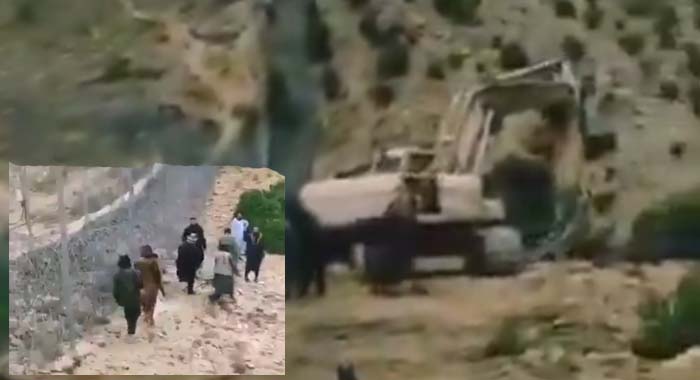
Fresh visual evidence reportedly showing Afghan Taliban officials and TTP fighters dismantling sections of border fencing along the Afghanistan–Pakistan frontier has raised serious concerns over the continued use of Afghan territory and border routes by militant networks seeking to conduct attacks inside Pakistan.
According to the information available, the individuals seen in the footage are allegedly involved in deliberately removing or dismantling border fencing, creating openings along the frontier that can facilitate unauthorized cross-border movement.
The reported activity has renewed scrutiny of the security environment along the Afghanistan–Pakistan border and raised questions about whether Taliban-controlled territory is being used to facilitate the movement of armed groups, including the Tehrik-e-Taliban Pakistan (TTP) and Al-Qaeda-linked elements.
Border fencing was established to strengthen frontier management, reduce unauthorized crossings, and prevent armed groups from exploiting remote routes between Afghanistan and Pakistan. The reported dismantling of these barriers represents a serious security concern.
When established border-control infrastructure is deliberately breached, the resulting gaps can provide armed groups with additional opportunities to move personnel, weapons, and other resources across difficult-to-monitor sections of the frontier. The reported presence of Taliban personnel alongside TTP fighters makes the allegations particularly significant.
The information indicates that the breached routes are being deliberately cleared to facilitate the movement of TTP and Al-Qaeda militants. Such routes could potentially be used by armed operatives seeking to evade formal border crossings and enter Pakistan through isolated areas.
The rugged terrain along parts of the Afghanistan–Pakistan frontier already presents substantial challenges for effective monitoring. Deliberately creating additional gaps in border barriers could further complicate efforts to prevent unauthorized movement. For security agencies, the concern is not simply the removal of a physical fence. It is what can potentially move through the opening once the barrier is gone.
The reported involvement of TTP fighters is particularly significant given the group’s long-standing presence in Afghanistan and its continued campaign of violence targeting Pakistan. The alleged coordination between TTP members and Afghan Taliban personnel would reinforce concerns that militant networks continue to enjoy operational space inside Afghanistan. The Taliban takeover of Afghanistan was accompanied by repeated assurances that Afghan territory would not be permitted to become a platform for attacks against other countries. The reported border activity, if independently confirmed, would raise serious questions about the implementation of those commitments.
The concern extends beyond the TTP. The information also points to the potential movement of Al-Qaeda-linked militants through breached border routes. The presence of multiple militant networks within Afghanistan has long been a source of international security concern. The possibility that established border barriers could be intentionally removed to facilitate the movement of such groups adds another dimension to the regional security challenge. Rather than functioning solely as a geographical boundary, the frontier risks becoming an operational corridor for armed networks if border-control mechanisms are deliberately weakened.
The reported footage also places renewed attention on the role of Afghan Taliban authorities. If Taliban officials are indeed participating in or facilitating the dismantling of border fencing alongside TTP members, the issue goes beyond the actions of individual militants.
It would raise questions about institutional responsibility and whether elements within the Taliban administration are actively tolerating or assisting militant movement. Such allegations warrant serious independent scrutiny. The international community has repeatedly emphasized that Afghan territory must not be used as a safe haven or launching ground for terrorism against neighboring countries. Any systematic cooperation between Taliban authorities and militant organizations would therefore have implications extending beyond bilateral security concerns.
The reported incidents raise a broader question about the changing security environment along the frontier. Afghanistan’s vast and difficult-to-monitor terrain has historically provided armed groups with opportunities to establish hideouts, training locations, logistical networks, and recruitment structures. If border barriers are intentionally removed in coordination with militant groups, previously restricted areas could become easier to access.
This could transform isolated stretches of the frontier into operational corridors for militant infiltration. The implications would be particularly serious for communities located near the border, which could face increased risks of violence, intimidation, displacement, and disruption of normal economic activity.
The issue also carries wider regional implications. Militant organizations operating from one country’s territory can rapidly create security consequences across international borders. Terrorist networks do not recognize political boundaries when planning attacks. They exploit gaps in security infrastructure, weak governance, remote terrain, and permissive environments. Consequently, any deliberate weakening of border controls can have consequences far beyond the immediate location where the breach occurs. The reported developments therefore warrant attention not only from Pakistani and Afghan authorities but also from regional and international stakeholders concerned with counterterrorism and border security.
The reported dismantling of border fencing presents a troubling picture of how militant groups could exploit the frontier when physical barriers are removed or weakened. The key concern is the potential combination of three factors: militant networks operating from Afghan territory, alleged cooperation or facilitation by Taliban personnel, and deliberately opened routes across the frontier.
Together, these developments could create an environment conducive to infiltration and cross-border attacks. For communities on both sides of the frontier, the stakes are exceptionally high.
The allegations also constitute a test of the Taliban authorities’ repeated commitments that Afghan soil will not be used against other countries. Words alone cannot provide regional security. Credible action against militant infrastructure, restrictions on armed groups, effective border management, and transparent accountability are required if those commitments are to carry meaningful weight.
If Taliban authorities genuinely intend to prevent Afghan territory from being used for terrorism, any reported collaboration between their personnel and militant groups in dismantling border controls should be investigated and addressed decisively.
Border security is ultimately about more than fences. It is about preventing armed groups from exploiting geography, governance gaps, and vulnerable communities to move across borders and plan attacks. The reported evidence of Taliban officials and TTP fighters dismantling sections of the Afghanistan–Pakistan border therefore deserves close scrutiny.
If the allegations are substantiated, the development would provide significant insight into the relationship between Taliban-controlled institutions and militant networks operating from Afghan territory. The international community must remain vigilant against any development that allows Afghanistan to become an operational platform for cross-border militancy. The security of the region depends not only on preventing attacks after they occur, but on closing the routes, networks, and enabling structures that allow armed groups to move freely in the first place.



