
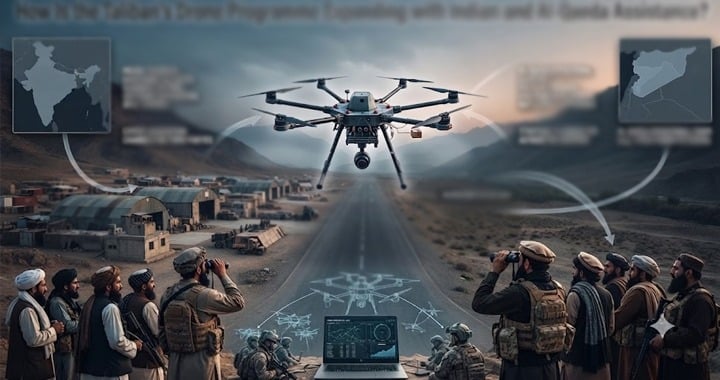
The Taliban authorities in Kabul are reportedly expanding their emerging drone capabilities, marking a potentially significant evolution in the group’s military posture and raising fresh security concerns for Pakistan.
According to Pakistani security assessments and media reports, the Taliban have been acquiring commercially manufactured drones from China and modifying them for military applications, potentially transforming relatively inexpensive civilian platforms into systems capable of reconnaissance, surveillance, and attack missions.
The reported development represents a shift from predominantly conventional, ground-based operations toward increasingly technology-enabled warfare, giving the Taliban access to a low-cost aerial capability that could alter the operational environment along Afghanistan’s borders.
Of particular concern to Pakistani security officials and analysts are allegations that the Taliban’s drone programme may be benefiting from a combination of Indian technical expertise and Al-Qaeda-linked technical and financial assistance.
These allegations have not been independently verified, but if substantiated, the convergence of commercially available drone technology with external technical support and militant expertise could create a significantly more capable and potentially transferable drone ecosystem inside Afghanistan.
The reported procurement and modification of commercial drones highlights a broader trend in modern conflict: armed groups can increasingly acquire relatively inexpensive civilian technologies and adapt them for military purposes without requiring the extensive industrial infrastructure traditionally associated with airpower.
According to reports cited in the assessment, the Taliban have procured Chinese-made commercial drones in significant numbers and have sought to convert them into military platforms.
The reported systems are said to have been used against Pakistani security forces as well as anti-Taliban resistance groups inside Afghanistan.
If sustained, such a capability could provide the Taliban with an inexpensive means of conducting aerial surveillance, identifying targets, monitoring movement, and potentially delivering explosives or other payloads.
The attraction of such technology lies partly in its cost. A commercially available drone can be substantially cheaper and easier to replace than conventional military aircraft or sophisticated missile systems, while still providing an armed group with an aerial perspective previously unavailable to many non-state actors.
Pakistani security assessments have expressed particular concern over allegations that Indian military engineers are providing technical assistance to Taliban personnel seeking to enhance their ability to convert commercial drones into military platforms.
Media reports have also alleged that Taliban officials travelled to India on several occasions in connection with the development of their drone capabilities and that Indian assistance facilitated the acquisition and deployment of drones at different Taliban military locations.
These allegations remain subject to independent verification.
Nevertheless, Pakistani security officials regard the reported possibility of external technical assistance as a significant development because access to specialized engineering knowledge could accelerate the Taliban’s ability to adapt commercially available systems for military purposes.
A second dimension of concern involves the reported involvement of Al-Qaeda-linked technical expertise.
UN-linked assessments have previously highlighted efforts by Al-Qaeda specialists to provide technical assistance to the Taliban, including support related to the development of locally produced suicide drones and improvements in technical and explosive capabilities.
The alleged convergence of Taliban personnel, commercial drone technology, external technical expertise, and Al-Qaeda’s accumulated experience in asymmetric warfare could potentially produce a more sophisticated capability than the Taliban could develop independently.
If these assessments are substantiated, the issue would extend beyond Afghanistan’s internal security environment and raise concerns regarding the potential proliferation of drone-related expertise among militant and terrorist networks.
For Pakistan, the development carries particular significance because of the country’s geographical proximity to Afghanistan and the continuing security challenges along the border.
Pakistani defence and security analysts are reportedly monitoring the Taliban’s evolving drone capabilities not simply as an Afghan military development, but as a potential new dimension of the cross-border security threat.
A senior Pakistani security official, speaking anonymously according to media reporting, reportedly warned that the combination of expanding Taliban drone capabilities, alleged Indian technical assistance, and Al-Qaeda expertise could increase the possibility of Afghanistan becoming a centre for the proliferation of low-cost drone technology among militant organisations.
Such a development could complicate existing counterterrorism and border-security efforts.
Traditional security measures designed primarily to detect personnel, vehicles, and conventional weapons may become less effective if armed groups increasingly employ small unmanned aerial systems for surveillance or attacks.
The reported expansion of the Taliban’s drone programme is not entirely new.
According to the information cited in the reports, Taliban forces have been employing drones for strike and surveillance operations for approximately a year, with activity reportedly increasing in areas such as Zebak district in Badakhshan, where anti-Taliban resistance groups remain active.
The reported use of drones against resistance groups demonstrates that the technology is already becoming part of the Taliban’s operational toolkit rather than remaining solely an experimental capability.
British media outlet The Independent has also reported allegations concerning efforts by the Taliban to expand their drone programme, including claims regarding Taliban officials’ visits to India and alleged assistance in acquiring and deploying drones.
Separately, United Nations assessments have drawn attention to Taliban efforts to develop relatively inexpensive drone capabilities, adding to international scrutiny of Afghanistan’s evolving military-technical environment.
The strategic significance of the reported development lies not necessarily in the sophistication of the individual drones, but in their potential scalability.
Modern commercial drones can provide capabilities that were once accessible only to states possessing expensive military aviation systems.
Even comparatively unsophisticated platforms can potentially provide armed groups with:
- Aerial surveillance and reconnaissance
- Real-time observation of security positions
- Target identification and tracking
- Battlefield assessment
- Low-cost strike capabilities
- Operational reach beyond conventional ground formations
For organizations operating with limited resources, the ability to conduct aerial operations at relatively low cost can significantly change tactical calculations.
The technology can also be modified rapidly, making it difficult for conventional security structures to predict exactly how commercially available systems might be employed.
The broader concern for Pakistan extends beyond the Taliban’s own use of drones.
Security officials are reportedly examining whether Afghanistan could gradually become a hub for the development, modification, and proliferation of low-cost drone technology among militant and terrorist organizations.
Such a scenario would represent a qualitatively different security challenge.
Instead of Afghanistan serving primarily as a base from which conventional armed groups conduct cross-border infiltration and attacks, the country could potentially become an environment in which inexpensive aerial technologies are developed, adapted, shared, and subsequently transferred to other militant networks.
The possibility becomes particularly concerning if technical expertise from experienced actors can be combined with commercially available components that are relatively easy to obtain.
The reported evolution of Taliban drone capabilities is likely to require Pakistan to reassess aspects of its border-security and counterterrorism planning.
The emergence of small unmanned aerial systems introduces additional challenges for the protection of military installations, border posts, population centres, and other sensitive infrastructure.
It also increases the importance of counter-drone surveillance, detection, electronic protection, intelligence-sharing, and rapid identification of emerging drone threats.
For Pakistani security agencies, the key concern is therefore not simply the number of drones reportedly possessed by the Taliban, but the speed at which the group may be developing the technical knowledge required to operate, modify, and potentially manufacture such systems domestically.
The evolution of the Taliban’s drone capabilities represents a potentially important development in Afghanistan’s post-2021 security environment.
The transformation of commercially available drones into military platforms could provide the Taliban with an additional operational tool while reducing their reliance on conventional military systems.
The alleged involvement of Indian technical personnel and Al-Qaeda-linked specialists, if independently established, would add another layer of concern by potentially accelerating the development of indigenous drone expertise and increasing the risk of technology transfer to other armed groups.
At present, many of the specific allegations surrounding the sources of technical assistance and the scale of the Taliban’s drone programme remain subject to verification.
Nevertheless, the reported trend itself warrants close monitoring.
The emergence of low-cost armed drone capabilities in Afghanistan could have implications extending beyond Pakistan.
Neighbouring states and regional security organisations are increasingly confronted with a form of warfare in which inexpensive commercially available technology can provide armed groups with capabilities once monopolised by conventional militaries.
For Pakistan, the immediate concern is the possibility that existing cross-border militant threats could eventually be supplemented by drone-enabled surveillance and attack capabilities.
Such a development would add a new layer to an already complex regional security environment and could require significant adaptation in border management, intelligence collection, military protection, and counterterrorism strategies.
The reported expansion of the Taliban’s drone programme signals a potentially important transition in Afghanistan’s military landscape—from predominantly ground-based operations toward a more technology-enabled model of warfare.
The reported acquisition of Chinese commercial drones, their alleged conversion into military platforms, and claims of assistance involving Indian technical expertise and Al-Qaeda-linked specialists have generated serious concern within Pakistani security circles.
While the specific allegations require independent verification, the broader trend toward the militarisation of inexpensive commercial drone technology is well established and represents a growing challenge for regional security.
For Pakistan, the central question is no longer simply whether drones are being used in Afghanistan, but whether Afghanistan could emerge as a source of affordable drone technology, expertise, and operational know-how for militant networks across the region.
The development therefore warrants sustained intelligence monitoring, regional coordination, and heightened attention to the proliferation of drone technology and associated technical capabilities.



