
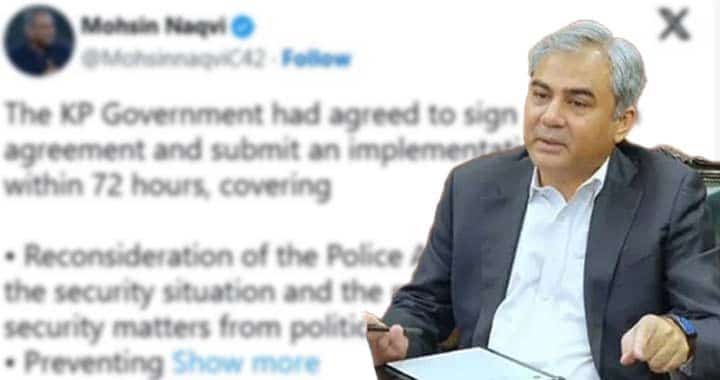
Interior Minister Mohsin Naqvi has said that negotiations between the federal government and the Khyber Pakhtunkhwa (KP) government reached an impasse at the final stage after the provincial side, according to him, backed away from previously agreed commitments concerning counterterrorism measures, police capacity-building and the protection of security affairs from political interference.
In a statement posted on social media platform X, the Interior Minister said the KP government had agreed to sign a written agreement within 72 hours and submit a detailed implementation plan covering a range of security-related measures.
According to the minister, the proposed commitments were aimed at strengthening the province’s response to terrorism, enhancing the operational capacity of the police and ensuring that security-related decisions remained focused on public safety rather than political considerations.
Naqvi said the discussions had reached their final stage when, according to his account, the KP government withdrew from these commitments. The Interior Minister said one of the principal understandings was that the KP government would provide a written agreement and implementation plan within 72 hours. The proposed framework, he said, was intended to translate the commitments reached during negotiations into concrete administrative and security measures.
Among the issues reportedly covered was a review of the KP Police Act 2026 in light of the prevailing security situation, along with measures to ensure that security matters remained insulated from political interference. Naqvi maintained that the implementation framework was particularly important given the scale of the security challenges facing the province.
According to the Interior Minister, the proposed commitments also included measures to prevent terrorists from operating freely in KP or establishing safe havens within the province. He said the understanding included an unambiguous condemnation of the banned Tehreek-e-Taliban Pakistan (TTP), the Taliban government and other terrorist organisations. The stated objective, according to Naqvi, was to ensure that no armed group could exploit the province’s security environment to establish operational space or use local territory for terrorist activities.
Naqvi said the proposed agreement also incorporated support for the national policy concerning Afghan refugees. According to his statement, the understanding included measures relating to the return of Afghan refugees and steps concerning Afghan camps established in KP.
The Interior Minister presented these measures as part of a broader security framework intended to address cross-border security concerns and prevent the exploitation of refugee or settlement structures for unlawful activities.
Another point cited by Naqvi was an understanding that the KP government would not maintain contact with the Afghan interim government on matters covered by the proposed framework. The minister also said that the commitments included allocating adequate financial resources for counterterrorism operations and the police, along with accepting full provincial responsibility for counterterrorism measures within KP.
The emphasis, according to the Interior Minister, was on establishing clear responsibility and ensuring that the provincial security apparatus had sufficient resources to respond effectively to the threat of terrorism.
Naqvi further stated that strengthening cooperation between the provincial government and the armed forces was among the commitments discussed. The proposed framework also reportedly included counterterrorism-related decisions concerning former FATA and the merged districts, areas that continue to face significant security challenges. Implementation of the National Action Plan was likewise cited as part of the understanding reached during the negotiations. The minister said these measures were intended to create greater coordination between federal and provincial institutions in confronting terrorism.
According to Naqvi, the dispute emerged during the final phase of negotiations held the previous night. He said that while the discussions had progressed toward an agreement, the KP government subsequently stepped back from the commitments that had formed the basis of the proposed arrangement.
The development effectively stalled progress on the negotiations, with security and counterterrorism measures emerging as the central point of disagreement. The account reflects the federal government’s position on the negotiations; the KP government’s position and response may differ.
The Interior Minister stressed that KP is currently facing a serious security situation and argued that counterterrorism and public safety should not become subjects of political confrontation. He maintained that the province’s security challenges require institutional cooperation, operational clarity and a unified approach to combating terrorist organisations.
Naqvi’s remarks underscore the federal government’s position that counterterrorism responsibilities require coordinated action between the federal government, the provincial administration, police, security institutions and other relevant state bodies.
The latest development places counterterrorism policy and security administration at the centre of the ongoing political deadlock between the federal government and the KP administration. The issues reportedly under discussion extend beyond political differences and encompass practical questions concerning police capacity, counterterrorism financing, security coordination, terrorist safe havens, implementation of the National Action Plan and responsibilities in the merged districts. The disagreement therefore carries implications for both governance and the province’s broader security environment.
With KP continuing to confront terrorism-related threats, the dispute highlights the importance of coordination between provincial and federal institutions. The proposed written agreement and implementation plan, as described by the Interior Minister, were intended to establish specific responsibilities and measurable steps for addressing the security situation.
Whether the negotiations can be revived and whether the disputed commitments can be reconciled remain key questions following the reported breakdown at the final stage. For the federal government, the central message remains that counterterrorism cannot be separated from effective governance, adequately resourced police institutions and coordinated security policy.
As the political dialogue continues, the focus is now likely to remain on whether the two sides can bridge their differences over security commitments and establish a mutually acceptable framework for addressing terrorism in Khyber Pakhtunkhwa.



