
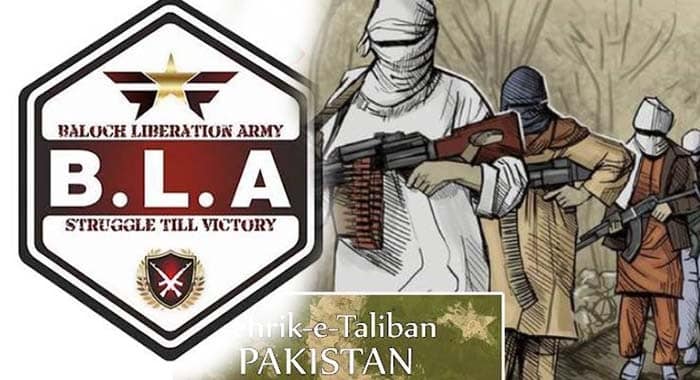
After Losing Public Support in Khyber Pakhtunkhwa, the Outlawed Tehreek-e-Taliban Pakistan (TTP) Seeks Safe Haven in Balochistan; Pakistan Delivers an Unambiguous Message to Afghanistan: No Negotiations Until Terrorism Ends
After facing intense military pressure from the Pakistan Army, dwindling public support, and heavy casualties, Fitna al-Khawarij and Fitna al-Hindustan have been compelled to collaborate.
Despite being ideologically at odds with one another, these two groups have now been forced to work together. Tehreek-e-Taliban Pakistan (TTP) exploits the name of Islam to justify its terrorist activities, whereas the Balochistan Liberation Army (BLA) carries out acts of terrorism under the banner of ethnic and linguistic nationalism, while allegedly receiving financial assistance and support from forces hostile to Pakistan.
Over the past several months, Pakistan has achieved significant successes in its counterterrorism operations, severely degrading the operational capabilities of both organizations. According to Pakistan, India provides financial backing to both terrorist groups, while Afghan territory is used as their operational base.
Pakistan’s Ministry of Foreign Affairs has repeatedly stated in several official statements that terrorists continue to use Afghan territory to carry out attacks. It has maintained that no negotiations with Afghanistan will take place until this issue is effectively addressed.
The Foreign Office has further clarified that Pakistan made extensive diplomatic efforts to establish peace until October 2025. However, it now insists that no further negotiations will take place unless Afghanistan provides written guarantees.
The trilateral talks held in Urumqi under China’s mediation in April 2026 also failed to produce meaningful results. Earlier rounds of negotiations in Istanbul and Doha had likewise ended without any tangible outcome because the Afghan Taliban regime refused to provide any form of written guarantees.
Pakistan’s former Special Representative for Afghanistan, Asif Durrani, addressed the Taliban regime and its alleged financial backer, India, in a post on X, warning that they were “playing with fire.”
He wrote that the Taliban must recognize that they enjoy only very limited international legal and diplomatic legitimacy. If they continue to shelter TTP, the BLA, ISIS-Khorasan, the East Turkestan Islamic Movement, the Islamic Movement of Uzbekistan, and more than two dozen other terrorist organizations, the region could once again descend into the dangerous pre-9/11 environment, with unpredictable and severe consequences for the entire region.
He further stated that it is equally alarming that India is allegedly financing the TTP and the BLA, while the Taliban government is providing these groups with safe havens and protection. If these policies continue, both the Taliban administration in Kabul and the Hindutva leadership in New Delhi will be playing with fire. History has repeatedly shown that those who sponsor violent proxy groups eventually become victims of the very threats they cultivate.
Following border tensions in March and April 2026, Pakistan and representatives of the Afghan Taliban met in Urumqi under China’s mediation. The primary objectives of these talks were to reduce border tensions, explore the possibility of a ceasefire, build confidence on counterterrorism issues, and restore bilateral engagement. In April, Afghanistan’s Ministry of Foreign Affairs described the discussions as constructive. However, no comprehensive agreement or permanent framework for future negotiations was announced.
As of July 2026, the most significant point of contention between Pakistan and Afghanistan remains the issue of the TTP. Pakistan maintains that Afghan territory is being used by the TTP to launch terrorist attacks inside Pakistan, an allegation that the Taliban government has consistently denied.
According to diplomatic sources, if a new round of negotiations takes place in the future, it is expected to focus on the activities of the TTP and other cross-border militant groups, border ceasefire arrangements, mechanisms for preventing military escalation, intelligence cooperation, communication channels, and the restoration of bilateral trade.
The success of any future negotiations will depend largely on whether the Taliban government takes credible, verifiable, and practical measures to address Pakistan’s security concerns, particularly regarding the TTP. Consequently, the current diplomatic contacts are being viewed as part of a confidence-building process rather than a step toward a final peace agreement.
Afghanistan affairs expert and senior journalist Tahir Khan said that diplomacy between Pakistan and Afghanistan has effectively come to a standstill. He noted that when Pakistan’s Foreign Office stated that the country had pursued diplomatic efforts from 2021 until October 2025, it effectively acknowledged that such diplomacy is no longer taking place. He added that mediation efforts from the Doha process to China’s Urumqi initiative have failed to produce meaningful results because the core issue, namely terrorist violence, continues unabated.
According to Tahir Khan, it is possible that internal developments within Afghanistan have prompted the TTP to alter its operational strategy. Since Balochistan already faces serious security challenges, the group may have calculated that increasing violence there would further complicate the government’s security situation. He emphasized that Balochistan holds immense strategic and economic importance for Pakistan and shares borders with two neighboring countries, making it particularly vulnerable.
Veteran journalist and Afghanistan expert Mahmood Jan Babar stated that one of the reasons behind the TTP’s movement into Balochistan is its growing operational cooperation with the BLA, which, he claimed, also enjoys the support of the Afghan Taliban. He explained that another major factor is the complete erosion of public support for the TTP in Khyber Pakhtunkhwa. As a result, the group has suffered heavier casualties there, whereas it considers Balochistan comparatively safer for its operations.
He further argued that those supporting terrorism inside Pakistan have greater strategic interests in Balochistan than in Khyber Pakhtunkhwa. While the BLA is already active in the province, deploying the TTP there appears intended to create additional security challenges for Pakistan. Mahmood Jan Babar also stated that diplomacy with Afghanistan has effectively ceased. According to him, Pakistan’s position remains clear: terrorism must end before any meaningful engagement can resume.
At the same time, he observed that anti-Pakistan rhetoric from members of the Afghan Taliban regime has recently become somewhat less aggressive. However, he claimed that certain individuals continue to pursue personal agendas. He cited Afghan Defense Minister Mullah Yaqoob as an example, alleging that Yaqoob had wanted to succeed his father, Mullah Omar, as the Taliban’s supreme leader but failed to do so, and therefore holds Pakistan responsible.
He concluded by saying: “The Afghanistan issue cannot be resolved through a single measure. It requires a comprehensive set of different approaches; otherwise, no lasting solution will emerge.”



