
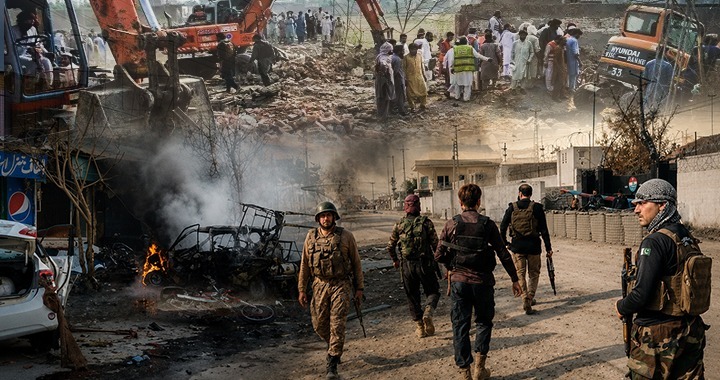
The security situation in Khyber Pakhtunkhwa continues to occupy a central position in Pakistan’s overall counterterrorism landscape. While terrorist incidents occur sporadically across different parts of the country, it is the southern districts of the province that have consistently emerged as the most persistent and complex security challenge. The recent quadcopter attack in Bannu, which injured civilians including a child, once again underscores the evolving and adaptive nature of this threat environment.
Southern Khyber Pakhtunkhwa, particularly districts such as Bannu, North Waziristan, South Waziristan, Lakki Marwat, Tank, and Dera Ismail Khan, has remained a recurring theatre of terrorist activity. These areas are geographically positioned at the intersection of settled districts and the former tribal belt, creating both strategic depth and operational complexity for terrorist networks. The terrain, combined with historical movement patterns and socio-economic vulnerabilities, has allowed these groups to maintain a degree of mobility despite sustained counterterrorism operations.
Over the years, terrorist tactics in KP have undergone significant transformation. Earlier phases were dominated by large-scale attacks, suicide bombings, and direct assaults on security installations. While these threats have not disappeared, they have increasingly been supplemented by smaller, more dispersed, and technologically adaptive methods, including the use of improvised explosive devices and commercially available aerial platforms such as quadcopters. This shift reflects both operational pressure on terrorist networks and their attempts to remain relevant in the face of intensified security operations.
Bannu, in particular, has emerged as a focal point of these evolving tactics. Its proximity to key routes connecting various districts, along with its strategic importance as a logistical and administrative hub, has made it a frequent target. Repeated incidents in and around Miryan, Baka Khel, and surrounding localities demonstrate a pattern of sustained pressure by terrorist groups attempting to disrupt both civilian life and security presence.
However, the security challenge in KP is not limited to kinetic attacks alone. It also includes a significant psychological and informational dimension. Terrorist groups increasingly rely on propaganda, misinformation, and selective amplification of incidents to influence public perception. This narrative strategy is designed to create an impression of instability, even when security forces continue to conduct successful intelligence-based operations across the province.
At the operational level, Pakistan’s security response in Khyber Pakhtunkhwa has evolved into a more intelligence-driven framework. Coordination between civil law enforcement agencies, counterterrorism departments, and military formations has improved, resulting in a greater number of pre-emptive actions and disruption of planned attacks. Despite this, the fluid nature of the threat means that complete elimination of risk remains a long-term objective rather than an immediate outcome.
Another key dimension shaping KP’s security landscape is the cross-border factor. The porous border with Afghanistan continues to influence the movement, regrouping, and logistical support structures of various terrorist networks. This cross-border dynamic complicates enforcement efforts and introduces an external layer to what might otherwise appear as a purely internal security issue.
Socio-economic conditions in certain districts also contribute indirectly to the persistence of insecurity. Limited development, unemployment, and uneven state presence in remote areas create conditions that can be exploited by non-state actors for recruitment and influence. Addressing these structural issues remains as important as kinetic counterterrorism operations in achieving long-term stability.
Despite these challenges, it is also important to recognize that Khyber Pakhtunkhwa’s security environment is not static. It is a continuously contested space where terrorist networks face sustained pressure from state institutions. While incidents like the Bannu quadcopter attack highlight ongoing risks, they also exist within a broader context of active counterterrorism operations and institutional adaptation.
Ultimately, the security landscape of Khyber Pakhtunkhwa reflects a layered and evolving conflict environment. It is shaped by geography, history, cross-border dynamics, technological adaptation, and information warfare. The persistence of terrorism in certain pockets does not negate the broader trajectory of sustained state engagement, but it does underline the complexity of achieving lasting stability in a region that remains central to Pakistan’s internal security architecture.



