
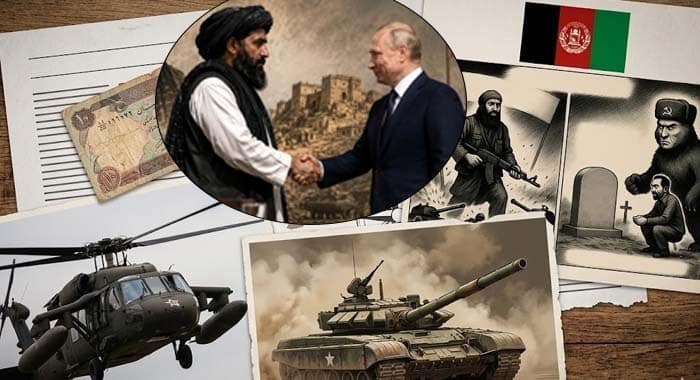
A significant and wide-ranging debate has erupted across Afghan social media platforms, as political commentators, analysts, and ordinary citizens engage in increasingly heated discourse surrounding the Taliban government‘s evolving diplomatic and security ties with Russia and what those ties mean in the context of the movement’s foundational ideology and history.
At the heart of the debate lies a striking historical juxtaposition: Mullah Mohammad Omar, the revered founding leader of the Taliban movement, dedicated much of his life to waging a fierce armed resistance against Soviet forces during the decade-long Soviet-Afghan War (1979–1989) a conflict that left hundreds of thousands of Afghans dead, devastated entire villages, and scarred multiple generations. Today, his son, Mullah Mohammad Yaqoob, serves as the Taliban government’s Minister of Defense and is among the key figures overseeing a discernible warming of relations between Kabul and Moscow.
Posts, commentary threads, and political cartoons circulating across platforms including X (formerly Twitter), Facebook, and Telegram have labeled the current situation a “tarikhī tazaad” a historical contradiction with many users questioning whether the Taliban’s contemporary foreign policy posture is consistent with the sacrifices and principles of its founding generation.
One widely shared post captured the sentiment prevalent in online discussions, stating: “During the Soviet war, thousands of Afghan civilians lost their lives, villages were razed to the ground, and entire generations bore the wounds of that conflict. Are we now forgetting those painful lessons of history?”
Critics argue that the sight of Taliban officials engaging in diplomatic courtship with Moscow represents not merely a pragmatic policy shift, but a profound symbolic departure from the movement’s own narrative of resistance against foreign domination a narrative that has long been central to Taliban identity and recruitment.
The online debate has been further inflamed by a series of posts alleging expanding security cooperation between the Taliban administration and the Russian Federation. These claims suggest that military-level contacts and coordination between the two sides are deepening, though independent verification of the full scope of these reports has not yet been established. Taliban officials, for their part, have maintained on various occasions that their foreign policy is guided exclusively by national interests and the practical imperatives of regional engagement.
The lack of transparency surrounding the reported security ties has only served to amplify speculation and skepticism among Afghan diaspora communities and domestic observers alike.
Political analysts and regional security experts have offered broader context for understanding the Taliban’s diplomatic recalibrations. Afghanistan has, for several decades, served as a theater of competition among global and regional powers — from the Soviet invasion of 1979, through the American military intervention that began in 2001 and ended with the Taliban’s return to power in August 2021, to the present-day realignment of regional geopolitics.
In this context, the Taliban government’s growing proximity to Russia, China, and other regional actors is viewed by some analysts as a calculated strategic necessity rather than ideological betrayal.
“The regional and international environment has changed dramatically,” one political commentator noted in their analysis shared widely on Afghan platforms. “Afghanistan is navigating a complex geopolitical landscape in which it finds itself isolated from Western financial systems and recognition, leaving it few alternatives but to cultivate relationships with neighboring and sympathetic powers.”
Supporters of the Taliban administration have been quick to push back against the criticism, arguing that international relations are not and should not be governed by permanent enmity or friendship, but rather by the shifting calculus of national interest.
In their framing, the current Afghan government faces acute and urgent challenges: an economy in crisis, near-total international isolation from Western institutions, a humanitarian emergency affecting millions, and pressing security concerns along multiple borders. In this environment, they argue, forging workable relationships with Russia and other regional powers is not a betrayal of history but an act of responsible statecraft.
“No country can afford the luxury of ideological purity in its foreign relations,” one pro-Taliban commentator argued online. “What Afghanistan needs today is economic stability, diplomatic recognition, and regional cooperation and those require engagement with the world as it is, not as we might wish it to be.”
Beyond the immediate diplomatic question, analysts suggest the online discourse reflects a deeper and more existential tension within Afghan political culture: how does a movement rooted in resistance, religious ideology, and historical grievance adapt to the responsibilities of governance and the realities of international politics?
The comparison between Mullah Omar’s legacy of jihad against Soviet occupation and Mullah Yaqoob‘s stewardship of Taliban-Russia relations is, in many respects, a proxy debate about the soul of the Taliban movement itself and about whether the current leadership represents a pragmatic evolution or an ideological abdication.
The debate currently unfolding on Afghan social media shows no signs of abating. As the Taliban government continues to develop its foreign policy posture and as its ties with Moscow are reported to grow, the tension between the movement’s historical narrative and its present-day diplomatic conduct is expected to remain a fault line in Afghan political discourse — both domestically and within the vast Afghan diaspora communities spread across the globe.
The coming months, particularly as any formal agreements or high-level visits between Taliban and Russian officials are announced, are likely to further intensify scrutiny of a relationship that many Afghans view with a complex and deeply personal mixture of pragmatism, suspicion, and grief.



