
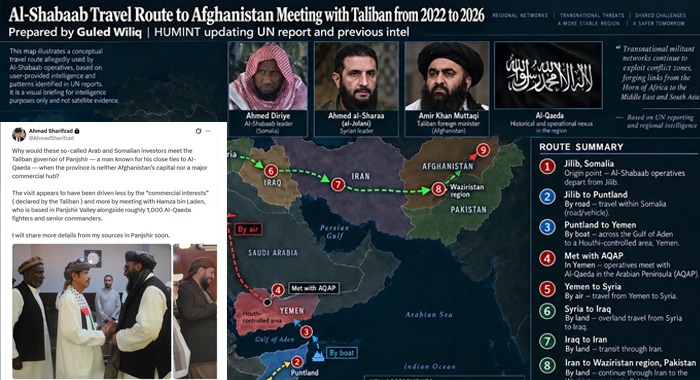
New research by Somali researcher and security analyst Guled Ahmed examines what he describes as the increasingly visible re-emergence of Afghanistan as a permissive environment for transnational jihadist networks and the renewed physical, financial, political, and organizational connections between Taliban-controlled Afghanistan and Somalia’s al-Qaeda affiliate, Al-Shabaab.
The research follows the United Nations’ 10 August 2026 acknowledgement that Al-Shabaab fighters had traveled from Somalia to Afghanistan. While the UN disclosure represents an important official confirmation, Ahmed argues that the movement should not be understood as an entirely new development. Open-source reporting and human-source intelligence had indicated renewed Somalia–Afghanistan movement well before the UN acknowledgement, and Ahmed had publicly reported Al-Shabaab travel to Taliban-controlled Afghanistan in January 2025.
The warning signs, he notes, were visible even earlier. On 23 April 2024, Afghanistan International reported comments by former Afghan intelligence chief Ahmad Zia Siraj, who said that Boko Haram and Al-Shabaab had come to Afghanistan and argued that the country had become a center for terrorist organizations following the Taliban’s return to power.
The significance of these developments, according to Ahmed, extends beyond the question of whether individual Al-Shabaab fighters or leaders traveled to Afghanistan. The more consequential issue is the widening intelligence and reporting gap surrounding Afghanistan since the fall of Kabul, and the possibility that Western intelligence and military agencies possess substantially more information about these networks than has entered the public record.
Official U.S. oversight reporting reinforces the continuing importance of Afghanistan to international counterterrorism efforts. Lead Inspector General reporting for Operation Enduring Sentinel has continued to monitor ISIS-K, al-Qaeda, and other terrorist organizations operating in or connected to Afghanistan, including assessments informed by the Defense Intelligence Agency. Reports covering 2025 and 2026 demonstrate that Afghanistan remains an active counterterrorism concern rather than a closed chapter.
The historical record is equally significant. Before the Taliban takeover, U.S. oversight reporting stated that the Taliban continued to maintain its relationship with al-Qaeda and provide the organization safe haven. The July 2022 U.S. operation that killed al-Qaeda leader Ayman al-Zawahiri in Kabul, at a residence associated with a senior Taliban figure, subsequently raised renewed questions about the Taliban’s willingness and ability to prevent Afghanistan from becoming a sanctuary for internationally connected jihadist organizations.
At the same time, the Taliban has actively fought ISIS-K, which it considers a major security threat. Ahmed argues that this apparent contradiction is essential to understanding Afghanistan’s current security environment: the Taliban can suppress one jihadist organization while maintaining, tolerating, or remaining historically connected to other militant networks.
For Al-Shabaab, the Taliban’s return to power in August 2021 represented both a symbolic victory and a potentially practical model. Al-Shabaab and other al-Qaeda affiliates publicly celebrated the Taliban’s seizure of Kabul. The wider al-Qaeda movement portrayed the U.S. withdrawal as evidence that a long insurgency could survive overwhelming foreign pressure and eventually convert military endurance into political authority.
Al-Shabaab similarly presented the Taliban victory as a model for Somalia. Following the fall of Kabul, Al-Shabaab media outlets praised the U.S. withdrawal and drew explicit parallels between Afghanistan and Somalia, arguing that just as the Taliban had captured U.S.-supplied military vehicles, Al-Shabaab would ultimately seize Turkish-supplied equipment from Somali forces. The message reflected a broader strategic narrative: foreign military support could eventually be exhausted, internationally backed governments could lose external political support, and an insurgent movement could survive long enough to inherit the political space left behind.
Ahmed’s research places these developments within a much older historical relationship. The Afghanistan connection predates Al-Shabaab itself. Several figures associated with the movement’s early leadership, including Aden Hashi Ayro, Ahmed Abdi Godane, Ibrahim Haji Jama al-Afghani, and Mukhtar Robow, were reported to have trained, fought, or developed jihadist relationships in Afghanistan or the broader Afghanistan–Pakistan environment.
Much of this founding generation was subsequently killed. Mukhtar Robow remains the most prominent surviving figure from that era. The United States removed him from its Rewards for Justice wanted list in 2017, and he later entered the Somali government as Minister of Endowments and Religious Affairs.
Al-Qaeda subsequently became the clearest institutional bridge connecting Somalia to the wider Afghan jihadist milieu. Al-Shabaab publicly addressed Osama bin Laden in its 2009 message “At Your Service, Osama.” Correspondence from 2010 between bin Laden and Ahmed Godane documented discussions concerning formal unity, and in February 2012 Al-Shabaab formally joined al-Qaeda.
Although public evidence of an independent Taliban–Al-Shabaab command structure has historically remained limited, al-Qaeda provided an established institutional and ideological connection between Al-Shabaab and the broader Afghan jihadist environment.
The post-2021 period therefore did not create the Afghanistan–Somalia relationship. Rather, Ahmed argues, it appears to have physically reactivated an older jihadist ecosystem whose personnel, ideology, institutional relationships, and operational memory predated the attacks of 11 September 2001.
According to human-source intelligence from Somali military-intelligence sources in Mogadishu cited in Ahmed’s research, the renewed relationship developed through several distinct stages involving medical travel, strategic consultations, procurement, military learning, political engagement, financial activity, and governance-related exchanges.
The first reported post-Kabul visit occurred in November 2022, according to the sources. Al-Shabaab emir Ahmed Umar Abu Ubaidah, also known as Ahmed Diriye, reportedly traveled to Afghanistan for medical treatment accompanied by three senior associates: Dahir Gacamey, Abdi Ali Kahin, and Bashir Abdi Samad.
The intelligence reporting states that the four men received treatment at a regional or general hospital in Kandahar City. Because the source reporting does not identify the facility by name, several hospitals in Kandahar could potentially fit the description, including Mirwais Regional Hospital, Aino Mina Hospital, Mohmand Hospital, Al Farhad Hospital, Ayoubi Hospital, Sial Curative Hospital, and Sidal Hospital. The specific facility therefore remains unconfirmed.
The same source reporting characterizes the November 2022 visit as Al-Shabaab’s first post-2021 journey to Afghanistan and its first direct engagement with Taliban authorities following the fall of Kabul. It further alleges that Ahmed Diriye provided $3 million to the Taliban authorities for reconstruction during the visit.
The reported journey itself illustrates the transnational character of the network. According to the HUMINT, the delegation began in Jilib and traveled by road through Somalia to Puntland before crossing the Gulf of Aden by boat to Houthi-controlled Yemen. The route allegedly included contact with al-Qaeda in the Arabian Peninsula. From Yemen, the travelers reportedly flew to Syria, continued overland through Iraq and Iran, entered the Waziristan region of Pakistan, and ultimately crossed into Afghanistan before proceeding toward Kandahar Province.
The reporting identifies two alleged liaison figures in Afghanistan: Abdusatar Abu al-Junud, described as a Taliban contact for Al-Shabaab, and Abdulaziz Higmatiyar, described as an al-Qaeda contact for Al-Shabaab in Afghanistan. Ahmed emphasizes that these names are reported aliases and that their legal identities have not been independently confirmed.
The second reported phase occurred in February 2024.
According to multiple Somali military-intelligence sources interviewed by Ahmed, Al-Shabaab dispatched a three-person delegation to Taliban-controlled Afghanistan to obtain materials associated with its improvised explosive device program.
The delegation reportedly consisted of Daahir Gacmey, also known as Cadi Al Xaq; Sheikh Hassan Yacquub; and Mahamed Abdi Samakaab. The sources state that the men traveled using Somali passports and remained in Afghanistan until early November 2024, operating under the protection of al-Qaeda-linked and Taliban networks.
Ahmed notes that this chronology corrects an earlier assessment that had placed the journey in August 2024. Following renewed verification with the original sources, the departure was assessed as having occurred in February 2024.
The reported mission was linked to a broader logistical challenge facing Al-Shabaab. Somali military-intelligence sources assessed that the organization was experiencing shortages of materials used in IED production and was examining alternative supply networks beyond its traditional connections in Yemen.
The Red Sea crisis was reportedly disrupting established channels, increasing the incentive for Al-Shabaab to explore Afghanistan as an alternative source while continuing efforts to maintain relationships with Houthi-linked networks. At the time, Somali intelligence assessments also anticipated that Al-Shabaab was preparing for a more aggressive campaign during 2025, including efforts to seize additional territory and intensify pressure on the Somali government in Mogadishu.
One of the most significant public warnings regarding an Al-Shabaab presence in Taliban-controlled Afghanistan came in April 2024 from Ahmad Zia Siraj, the former head of Afghanistan’s National Directorate of Security.
Siraj stated that representatives of Al-Shabaab and Boko Haram were present in Afghanistan and were in contact with the Taliban. He characterized Afghanistan under Taliban rule as a training center for terrorist organizations and warned that al-Qaeda, ISIS, and other groups were inviting members from abroad because they enjoyed freedom of action.
His warning also highlighted the potential vulnerability created by Afghanistan’s permissive environment, particularly the ability of outside actors with financial resources to interact with militant organizations.
Despite these warnings, Ahmed argues that the issue received comparatively limited sustained international attention.
The emerging relationship was not confined to clandestine travel or militant activity. The Taliban also appeared to be pursuing a broader information strategy directed toward Somali audiences, including Somali-born influencers living in Western countries.
In June 2024, Somali-Australian content creator AbdiXplorer traveled to Afghanistan, met Taliban members, referred to them as “brothers,” and portrayed Afghanistan as safer than many Western countries. Somali-American influencer Marian Abdi, known as Geenyada Madow, separately traveled to Afghanistan during July and August 2024 and published favorable material from Kabul and Bamyan.
Her coverage generated criticism from Afghan women, who accused her of presenting a sanitized image of Taliban rule while women in Afghanistan faced severe restrictions.
Ahmed’s assessment is that such outreach should be considered within the broader information environment surrounding the Taliban–Al-Shabaab relationship. The objective is not necessarily limited to propaganda in the conventional sense. By presenting Taliban-controlled Afghanistan as secure, functional, religiously legitimate, and increasingly normalized, such messaging can contribute to making Taliban-style governance appear familiar and potentially governable to Somali audiences.
The information campaign later acquired a more explicitly political character.
On 21 March 2025, a prominent pro-Taliban account published an image of Somali President Hassan Sheikh Mohamud accompanied by the caption “A Puppet President.” The incident was significant because Taliban-aligned messaging had moved beyond promoting Afghanistan to Somali audiences and had begun directly attacking Somalia’s sitting president.
Ahmed argues that, viewed against the broader development of Taliban–Al-Shabaab ties through al-Qaeda-linked networks, the message fits a larger narrative aimed at delegitimizing Somalia’s internationally recognized government while presenting Taliban-style rule as an alternative model of political authority.
The third phase of the relationship involved reported outreach between actors associated with Syria, Afghanistan, and Somalia.
According to Somali military-intelligence sources, Abu Mohammad al-Jolani contacted Al-Shabaab emir Ahmed Diriye and Mahad Karate in January 2025. The reported conversation, said to have occurred on 9 January, focused on persuading Al-Shabaab to reduce attacks against Sunni Muslims in Somalia, distance itself from al-Qaeda, and consider a broader Sunni alignment against Iran and the Houthis.
A subsequent intelligence briefing from Mogadishu in April 2025 alleged that al-Jolani and Afghan Foreign Minister Amir Khan Muttaqi had held extensive telephone discussions with ISIS-Somalia leader Abdul Qadir Mumin and Ahmed Diriye.
According to the reporting, those discussions went beyond civilian targeting and addressed a broader political-security alignment involving Somalia, the Gulf of Aden, the Indian Ocean, and governance models associated with Syria and Afghanistan.
Ahmed stresses that these specific telephone contacts remain source-derived and require independent corroboration.
Nevertheless, the broader militant environment demonstrates that such cross-theater engagement is not inherently implausible. U.S. Lead Inspector General reporting, citing the Defense Intelligence Agency, has noted the Islamist roots of HTS in al-Qaeda and the continuing presence of al-Qaeda-associated elements even after Hurras al-Din announced its dissolution. At the same time, ISIS remains an adversary of Syria’s new authorities.
This environment demonstrates how organizations can remain operationally hostile while nevertheless occupying overlapping ideological, logistical, political, and geographic ecosystems.
By 13 May 2025, Ahmed had publicly assessed that militant movements were increasingly examining three governance models: the Taliban model, the Syria model, and the Lebanon model.
That assessment was subsequently reinforced by United Nations Security Council document S/2025/482, dated 24 July 2025. Paragraph 74 reported that AQAP had hosted hundreds of Al-Shabaab fighters in Yemen for training, provided them with weapons, and encouraged Al-Shabaab to replicate in Somalia what the Taliban had achieved in Afghanistan.
The UN reporting therefore provided independent documentation that the Taliban’s experience was not merely admired symbolically by Al-Shabaab but was being actively promoted within the wider al-Qaeda network as a potential strategic model.
The operational trajectory during the following period is also significant.
Ahmed’s Mogadishu dataset covering April 2025 through March 2026 records 22 incidents targeting civilians compared with 129 targeting security forces. Separately, the UN Security Council’s 4 February 2026 report, S/2026/44, assessed that Al-Shabaab primarily targeted security forces and stated that attacks inside Mogadishu were largely directed against security installations and government officials, reflecting a focus on military targets rather than mass civilian casualties.
The same UN report described Al-Shabaab as maintaining pragmatic relationships with other armed groups, including continued cooperation with AQAP and transactional cooperation with the Houthis.
Ahmed emphasizes that this UN reporting does not independently verify the alleged al-Jolani–Muttaqi conversations. It does, however, provide later evidence consistent with a broader strategic direction in which Al-Shabaab has increasingly focused on security forces and government institutions while maintaining relationships across a wider transnational militant ecosystem.
The financial dimension of the evolving relationship also warrants attention.
According to Afghan open-source reporting dated 11 August 2025 and Somali military-intelligence sources subsequently cross-checked by Ahmed, Afghan reporting showed a Somali man meeting the Taliban governor of Panjshir.
Two days later, on 13 August 2025, Ahmed identified the man as Saeed Adami.
The publicly available photographs establish the meeting itself. The identification and additional background information are derived from Somali military-intelligence reporting, which described Adami as a former al-Qaeda-linked mujahid who had trained during the bin Laden era and later relocated to Malaysia or Indonesia after leaving Afghanistan in the mid-2000s with substantial funds.
The intelligence sources further described his later commercial activity as providing a potential cover for moving money through Taliban- and al-Qaeda-linked networks and said that his return to Afghanistan was being presented publicly as an investment-related activity.
Ahmed emphasizes that these elements of the individual’s background and alleged financial role remain intelligence-derived and require independent corroboration.
The broader significance, however, is the convergence of commercial activity and historical militant networks.
By May 2026, Taliban-linked messaging was publicly promoting new development projects, including a new passenger terminal at Kabul International Airport. Such messaging forms part of the Taliban’s broader effort to present investment, infrastructure development, economic activity, and international engagement as evidence of normalization.
Ahmed argues that this creates a difficult analytical environment for governments and intelligence agencies. Legitimate investment is not terrorism. A businessman is not a terrorist merely because he invests in Afghanistan, and a religious traveler is not inherently suspicious because of his nationality or destination.
The intelligence challenge lies in identifying when legitimate commercial, religious, political, or humanitarian activity begins to intersect with legacy militant relationships, opaque capital, informal financial systems, political access, and historical jihadist networks.
This distinction is essential to avoid both overreach and analytical blindness.
Another development involved movement between Afghanistan and Somalia, with a parallel Syrian dimension.
The Somalia e-Visa breach became publicly known in November 2025. On 13 November 2025, the U.S. Embassy warned that hackers may have exposed at least 35,000 records, while Somalia formally acknowledged the breach on 16 November.
The compromised dataset included 66 Afghan nationals and 222 Syrian nationals. A separate public post obtained before subsequently being removed exposed additional traveler-level information that had not been reflected in later reporting, including entries associated with Afghan and Syrian travelers.
The data raised a critical question amid Somalia’s ongoing conflict with Al-Shabaab: who were these travelers, and whom were they meeting?
According to Somali military-intelligence sources in Mogadishu who provided information to Ahmed, some of the Afghan travelers were Taliban members sent to meet Al-Shabaab figures while operating under Tablighi cover.
Ahmed stresses that these claims remain intelligence-source allegations and should not be treated as independently established facts without further corroboration.
Nevertheless, the reported travel pattern is consistent with the broader trajectory identified in the research, beginning with Ahmed Diriye’s reported November 2022 journey to Afghanistan and subsequently expanding through alleged contacts involving Syrian, Afghan, and Somali actors.
The combined Afghan and Syrian travel indicators point toward a potentially broader Somalia–Afghanistan–Syria corridor involving people, political access, religious networks, and influence.
Within this emerging architecture, al-Qaeda remains the principal historical and institutional bridge.
The fourth and most consequential reported phase occurred during 2026.
According to Somali military-intelligence sources in Mogadishu, Al-Shabaab dispatched four senior amirs to Afghanistan in March 2026 for direct engagement with Taliban and al-Qaeda-linked networks.
The reported purpose of the mission was not simply training or ideological exchange. The sources said the delegation was studying the Taliban’s governance model for potential adaptation in territories already controlled by Al-Shabaab and, more significantly, as a possible framework for governing Somalia should Al-Shabaab ever seize Mogadishu.
According to the same reporting, the four senior figures were placed on a six-month governance course, with follow-on instruction extending through December 2026. The alleged curriculum included administration, security control, taxation, political messaging, and the transition from insurgent activity to territorial governance.
The sources further reported that the Al-Shabaab delegation was granted guided access to al-Qaeda training camps in Afghanistan through al-Qaeda contacts. The alleged purpose was to examine training structures, command systems, and organizational practices under the Taliban-era security environment.
The delegation also reportedly traveled to Waziristan, where it met TTP figures to study guerrilla warfare against a state actor.
The reported objective was to compare the TTP’s experience fighting Pakistan with Al-Shabaab’s campaigns against Ethiopia and Kenya, including lessons concerning attrition, border sanctuaries, decentralized operations, and sustaining a prolonged insurgency against a militarily superior opponent.
If independently corroborated, these developments would represent a significant evolution from ideological admiration toward structured governance learning, military exchange, comparative insurgency analysis, and institutional preparation.
Ahmed’s central assessment is that the post-2021 Afghanistan–Somalia relationship should therefore not be reduced to the emergence of a formal Taliban–Al-Shabaab alliance.
The available evidence instead points toward a more complicated and potentially more consequential ecosystem in which al-Qaeda provides historical and institutional continuity while Afghanistan, Yemen, Somalia, and increasingly Syria perform different strategic functions.
Afghanistan provides territory and a Taliban-controlled state environment. Yemen provides maritime access, AQAP infrastructure, and relationships involving the Houthis. Somalia provides Al-Shabaab’s established insurgent, taxation, financial, and territorial infrastructure. Syria represents another arena in which an organization rooted in the al-Qaeda ecosystem has transitioned from insurgency toward political authority.
These relationships do not necessarily constitute a single centralized command structure. Nor do they require formal alliances to produce strategic effects.
The emerging architecture can function through shared ideology, personal relationships, logistical access, financial networks, political learning, religious intermediaries, informal communications, commercial activity, and transactional cooperation.
This is what Ahmed describes as Afghanistan becoming the “WeWork of terrorism.”
The analogy is deliberately structural rather than literal. Afghanistan should not be understood as a centralized terrorist headquarters in which every organization operates under one command. Instead, the country increasingly resembles a permissive environment where former mujahideen, jihadist networks, financiers, legitimate investors, traders, religious intermediaries, political actors, and militant organizations can reconnect while maintaining different identities and objectives.
That distinction is critical.
A businessman investing in Afghanistan is not automatically a terrorist. A religious traveler is not inherently suspicious. A Somali national meeting an Afghan official is not, by itself, evidence of militant activity.
The analytical problem is identifying the points at which legitimate activity intersects with legacy militant relationships, opaque capital, informal financial mechanisms, political access, militant facilitation, and historical jihadist networks.
Ahmed’s research argues that this is precisely where the post-Kabul intelligence challenge has become most difficult.
The evolution of al-Qaeda itself is central to understanding the problem.
Following the fall of Kabul and the subsequent political transformation of Syria, Ahmed argues that al-Qaeda has increasingly demonstrated characteristics of a state-embedded actor rather than merely a conventional non-state terrorist organization.
Its affiliates and associated networks operate across weak, fragmented, failed, or captured state environments, exploiting gaps between formal government authority and actual control.
Al-Shabaab operates parallel systems of taxation, courts, security, administration, and political coercion in Somalia. AQAP continues to operate within Yemen’s fragmented war economy. Libya provides space for militant networks amid divided political authority. Syria demonstrates how a movement rooted in the al-Qaeda ecosystem can move from insurgency into political power. Afghanistan demonstrates how a historically jihadist movement can itself become the governing authority of a state while continuing to exist within a broader militant ecosystem.
The resulting threat is therefore not simply a terrorist organization hiding from a state.
It is an increasingly hybrid system in which jihadist movements can exploit, parallel, embed within, influence, or capture state-like structures.
This creates a new strategic environment involving governments, quasi-state authorities, insurgent administrations, terrorist organizations, financiers, criminal networks, political intermediaries, and geopolitical actors whose interests may overlap without a formal alliance.
Their cooperation can be transactional rather than ideological.
Sanctions evasion, weapons, logistics, maritime routes, illicit finance, political leverage, commercial access, and shared adversaries can create temporary or sustained areas of cooperation among otherwise competing actors.
Houthi networks can intersect with AQAP and Al-Shabaab logistics. Similar transactional relationships may emerge around Sudanese armed actors through illicit trade, maritime smuggling, or weapons-trafficking channels where interests overlap. Afghanistan can provide a connective environment involving Taliban authorities, al-Qaeda, TTP, Al-Shabaab, and other foreign militants.
This does not mean that all of these organizations are allies, nor that they share identical objectives.
Indeed, some remain bitter enemies.
The significance lies in the ability of a permissive environment to allow personnel, ideas, financing, training, political models, commercial relationships, and logistical capabilities to cross organizational boundaries.
That is the fundamental strategic shift identified by Ahmed’s research.
Twenty-five years after 9/11, jihadist organizations are increasingly seeking not merely sanctuary, but institutional durability.
They seek access to territory, state-like governance, taxation, political legitimacy, international markets, financial channels, military learning, and long-term organizational survival.
The Taliban’s experience is particularly important because it demonstrates a pathway from insurgency to territorial control and ultimately to state authority. For Al-Shabaab, which already maintains parallel governance structures in parts of Somalia, that experience offers a potential strategic template.
This also complicates the increasingly common characterization of Africa as the new global “epicenter” of al-Qaeda and ISIS.
Africa is unquestionably a major and expanding theater of jihadist activity. Al-Shabaab, JNIM, Islamic State affiliates, and other organizations have demonstrated significant operational resilience across the continent.
But Ahmed argues that Africa cannot be analyzed in isolation from Afghanistan, Yemen, Syria, Pakistan, and the wider Middle East–South Asia system.
The ideology, personnel, financial networks, strategic concepts, and historical relationships connecting these theaters remain active.
The same concern applies to descriptions of Al-Shabaab as primarily a tribal-based Islamist insurgency.
Ahmed argues that such a characterization risks understating the organization’s sophistication, wealth, transnational connectivity, and strategic ambition.
Al-Shabaab is an al-Qaeda affiliate with extensive regional and international relationships, an established taxation and financial ecosystem, parallel governance structures, and demonstrated links or interactions extending beyond Somalia into Yemen, Afghanistan, Syria, and East Africa.
Ahmed’s research estimates the organization’s broader economic and financial ecosystem at more than $1 billion, underscoring the scale of the resources available to an organization that is frequently described primarily through the lens of insurgent violence.
The central warning emerging from the research is therefore not simply that Al-Shabaab fighters have traveled to Afghanistan.
The deeper concern is that the physical movement of personnel may represent only the visible component of a much larger process.
Behind travel can come medical relationships, military consultation, procurement, financial activity, political networking, religious facilitation, information operations, governance training, commercial investment, and institutional learning.
Behind individual relationships can emerge durable networks.
And behind those networks can emerge a model in which terrorist organizations increasingly learn how to survive not merely as underground movements but as quasi-state actors.
Ahmed argues that international intelligence and counterterrorism institutions should therefore reassess the analytical framework used to monitor Afghanistan and its relationship with African jihadist organizations.
The question should no longer be limited to whether terrorist groups have established formal bases.
It should also include who is traveling, who is meeting whom, under what cover, through which commercial or religious channels, with what financial resources, and for what political or organizational purpose.
The same analytical framework should be applied across Afghanistan, Somalia, Yemen, Syria, Pakistan, and other theaters where militant organizations can exploit fragmented authority.
The objective should not be to criminalize legitimate trade, investment, religious travel, humanitarian activity, or political engagement.
Rather, the objective should be to identify the specific intersections where legitimate systems can be exploited by clandestine networks.
Ahmed’s research concludes that the renewed Somalia–Afghanistan relationship is best understood as one component of a broader post-Kabul transformation.
The Taliban’s victory did not simply change Afghanistan’s domestic political order. It altered the strategic psychology of jihadist movements across multiple theaters.
For Al-Shabaab, Kabul demonstrated that an insurgency could endure years of foreign military intervention, survive extensive international pressure, weaken an internationally backed government, and ultimately inherit political authority.
For al-Qaeda, Afghanistan restored an environment in which the movement’s historical networks could potentially reconnect with state-like power. For other militant organizations, Afghanistan offers a laboratory in which insurgency, governance, political legitimacy, international engagement, commerce, and militant infrastructure increasingly coexist.
The emergence of this environment demands a corresponding evolution in international counterterrorism strategy.
The central issue is no longer simply whether Afghanistan is once again a sanctuary.
The more difficult question is whether Afghanistan has become a platform through which formerly dispersed jihadist networks can reconnect, learn, finance themselves, obtain political access, and develop strategies for transforming insurgent power into durable institutional authority.
The evidence presented in this research suggests that the answer warrants serious investigation.
The renewed movement of Al-Shabaab personnel to Afghanistan, the historical role of al-Qaeda as a bridge between the two theaters, reported medical and military contacts, alleged procurement efforts, reported governance training, financial and commercial relationships, political messaging, and emerging links involving Yemen and Syria collectively point toward a wider strategic ecosystem.
Some individual claims remain unverified and require further independent corroboration. Others are supported by open-source reporting or subsequent United Nations and U.S. government assessments. The distinction between confirmed evidence, intelligence reporting, and analytical assessment remains essential. But the cumulative pattern should not be dismissed simply because every individual component has not yet entered the public record.
The strategic risk lies precisely in the possibility that public reporting is seeing only fragments of a larger system.
Twenty-five years after 9/11, the international community faces a jihadist threat that is increasingly adaptive, decentralized, financially sophisticated, and capable of operating across the boundaries between terrorism, insurgency, political authority, commerce, and state-like governance.
The challenge is no longer simply defeating terrorist organizations in isolation.
It is understanding the networks, environments, institutions, financial systems, political relationships, and governance models that allow them to survive and evolve. The renewed Afghanistan–Al-Shabaab connection provides an important warning. What once appeared to be separate theaters of jihadist activity may increasingly represent interconnected components of a single transnational ecosystem—one in which Afghanistan, Somalia, Yemen, Syria, and the broader Middle East–South Asia region perform different but mutually reinforcing strategic functions.
The most consequential development, therefore, may not be the movement of a handful of fighters from Somalia to Afghanistan. It may be the re-emergence of a system in which jihadist organizations can once again travel, train, finance, organize, govern, communicate, and learn across borders while exploiting the gaps between states, insurgencies, and international oversight. That is the intelligence and strategic challenge that now demands sustained international attention.



