
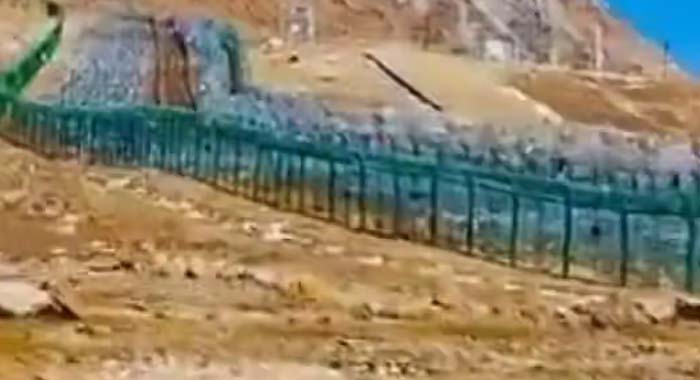
A newly circulated video purportedly showing Taliban members entering a restricted area along Afghanistan’s border with China has drawn attention to Beijing’s extensive border security measures and the unresolved question of whether the long-isolated Wakhjir Pass will ever become an operational trade crossing.
The footage, whose recording date has not been established, appears to show Taliban fighters approaching a restricted section of the China-Afghanistan border in the Wakhan Corridor. Chinese border guards can be heard warning them in English to leave the area immediately. When one Taliban member says he does not understand English and requests that the guards speak Persian, the warning is reportedly repeated in Pashto.
Beyond the exchange, the video highlights the heavily secured character of one of Afghanistan’s most remote frontiers. The border area shown in the footage reportedly features double layers of barbed-wire fencing, surveillance cameras, security towers, and Chinese flags near the Wakhjir Pass.
Although the footage’s precise date and circumstances remain unclear, the visible security infrastructure underscores the importance Beijing attaches to controlling access along its western frontier.
The China-Afghanistan boundary runs through the mountainous Wakhan Corridor, a narrow strip of Afghan territory connecting the country to China’s Xinjiang region. The Wakhjir Pass is the principal geographical connection between the two countries, but the remote terrain and stringent border controls have historically prevented it from developing into a regular commercial crossing.
China has maintained extensive security measures along this frontier for years. Reports indicate that Beijing reinforced border controls after the Taliban returned to power in Afghanistan in August 2021, amid continuing concerns about militant activity, cross-border infiltration, and security threats affecting Xinjiang.
The reported presence of layered fencing, surveillance equipment, and guarded observation points reflects a security-first approach to the border. Such infrastructure also raises questions about the conditions under which Beijing might consider permitting routine cross-border movement.
The renewed attention comes after the Taliban administration inaugurated a road project near the Chinese border in Wakhan during an official ceremony. Taliban officials presented the project as a potential means of improving trade and transit links with China.
However, a review of satellite imagery attributed to Afghanistan International reportedly indicates that the road terminates at the existing border fencing and wall rather than connecting to an operational crossing on the Chinese side.
This distinction is significant. Constructing a road up to an international boundary does not, by itself, establish a functioning trade route. Cross-border commerce requires the agreement of both governments, appropriate customs and immigration facilities, security arrangements, and formal authorization for goods and people to pass through the crossing.
China has not publicly announced the opening of the Wakhjir Pass for regular commercial traffic or cross-border travel. In the absence of such an announcement, the road’s practical value as a direct trade corridor remains uncertain.
China’s cautious approach is closely linked to its security concerns regarding Xinjiang, where Beijing has long focused on preventing the movement of extremist groups and armed networks across its borders. Chinese authorities have repeatedly emphasized regional counterterrorism cooperation and stability in Afghanistan. Beijing has also sought assurances from the Taliban administration that Afghan territory will not be used by groups threatening China or its interests.
The remote geography of Wakhan adds another layer of complexity. Operating a formal border crossing in this mountainous region would require sustained logistical support, infrastructure on both sides, reliable transport connections, and effective security and customs arrangements.
Until these requirements are addressed and both governments agree on the crossing’s operational status, a road reaching the border cannot be treated as evidence that direct trade has begun. China’s fortified frontier also reflects broader regional concerns following the Taliban’s return to power. Several of Afghanistan’s neighbouring countries, particularly in Central Asia, have strengthened border security measures amid concerns about militant infiltration, trafficking, and instability.
These developments illustrate the difficult balance facing regional governments: maintaining diplomatic engagement and exploring economic cooperation with Afghanistan while protecting their own territory against security threats.
For the Taliban administration, improving road connectivity and pursuing access to neighbouring markets could offer economic opportunities. However, such ambitions depend not only on infrastructure within Afghanistan but also on the willingness of neighbouring states to authorize transit and establish the necessary arrangements.
The apparent contrast between the Taliban’s road-building initiative and China’s fortified border therefore highlights a central challenge for Afghanistan’s regional integration: physical connectivity cannot advance without political agreement and mutual confidence.



