
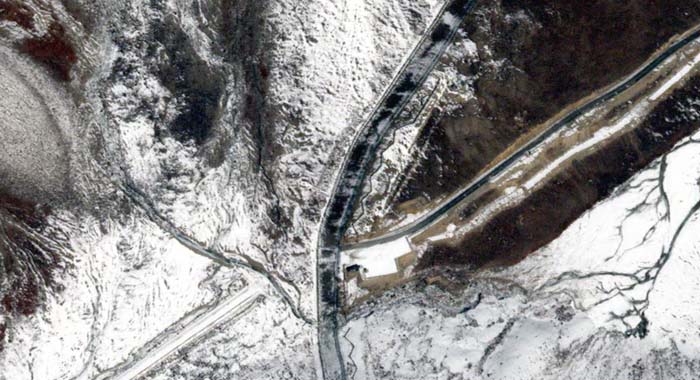
China has maintained its heavily fortified border with Afghanistan despite the Taliban administration’s completion of a road reaching close to the Chinese frontier, with security concerns surrounding suspected militant networks emerging as a major obstacle to the proposed cross-border connection.
According to a report published by Radio Free Europe/Radio Liberty (RFE/RL) on October 13, Beijing did not send representatives to the road’s inauguration on October 4 and gave no official acknowledgement of the event. The border remained closed, with surveillance cameras, razor-wire fencing and other security infrastructure visible on the Chinese side.
The development highlights Beijing’s continuing concerns about the potential security risks associated with opening a remote mountain crossing, particularly the reported presence of extremist groups in northeastern Afghanistan and the possibility of cross-border infiltration.
Although the Taliban authorities have presented the road as an important infrastructure achievement, security analysts cited by RFE/RL suggest that construction alone is unlikely to persuade China to permit regular movement across the frontier.
The newly completed road runs through Afghanistan’s Wakhan Corridor in Badakhshan Province, approaching the Chinese border at the high-altitude Wakhjir Pass. Satellite imagery examined by RFE/RL reportedly confirmed on October 11 that the route reaches within a few dozen metres of the frontier. However, the Chinese side remains heavily secured, and there is no indication that Beijing intends to open the crossing in the near future.
Zhu Yongbiao, director of the Center for Afghanistan Studies at Lanzhou University in China, told RFE/RL that the chances of the border opening soon were “extremely low.” According to Zhu, Afghanistan’s limited economic value to China, combined with the substantial financial costs and security risks of operating the route, makes an immediate opening unlikely. The assessment suggests that Beijing views the proposed crossing primarily through a security lens rather than as an immediate commercial opportunity.
China has invested in infrastructure along the mountainous frontier to improve access for security patrols. Chinese media has described the approximately 76-kilometre border with Afghanistan as a major counterterrorism front line. For Beijing, opening the crossing would therefore require more than a physical road. It would also involve addressing concerns about border monitoring, unauthorised movement and the potential activities of extremist organisations.
One of the principal concerns identified in the RFE/RL report is the East Turkestan Islamic Movement (ETIM), a Uyghur militant organisation associated with efforts to establish an independent Islamic state in China’s Xinjiang region. Beijing regards groups associated with Uyghur militancy as a security threat and has repeatedly emphasised the importance of preventing extremist networks from using neighbouring territory to threaten Chinese interests.
The RFE/RL report cited a 2026 United Nations assessment that identified ETIM activity in Badakhshan Province, where the new road is located. Zhu told RFE/RL that the Taliban authorities had failed to meet virtually all of China’s demands concerning the handling of ETIM. He argued that this had reduced the likelihood of Beijing making further concessions to the Taliban administration in the near future.
These assessments reflect security concerns attributed to Chinese experts and reporting. The presence and operational capacity of specific groups, however, should be distinguished from independently verified evidence of an imminent threat to the Chinese border. Nevertheless, the issue appears to be central to Beijing’s calculations. A crossing that facilitates legitimate trade could also create additional monitoring requirements in a remote region where terrain and weather already make border control difficult.
The security debate surrounding the Wakhan road extends beyond the presence of any single organisation. It also concerns the ability of the Taliban administration to prevent Afghan territory from being used by groups considered a threat by neighbouring countries. A commentary published on China’s Sohu platform on October 10 raised questions about the Taliban’s ability to control their territory, the reported status of militant training camps and the risk of cross-border infiltration.
The commentary argued that the key issue for Beijing was not the completion of the road but whether the security conditions required for opening the border had been established. It questioned whether the threat of infiltration had been sufficiently contained and suggested that the border barriers would remain until those concerns were addressed.
The commentary represents a published Chinese media perspective rather than an official statement by the Chinese government. However, its emphasis on territorial control and counterterrorism reflects concerns also discussed by Zhu in his comments to RFE/RL.
The Taliban authorities have presented the road as evidence of their ability to develop infrastructure in a remote region. At the inauguration, Badakhshan’s Taliban-appointed governor, Rahmatullah Najib, claimed that there were no security problems in any part of the region.
That assertion contrasts with the concerns raised by analysts about militant activity and the challenges of securing the frontier. No official Chinese statement announcing the conditions for a possible border opening was cited in the RFE/RL report.
The Wakhan Corridor presents significant geographical and logistical challenges for any future border operation. The mountain pass lies at an elevation of approximately 4,800 metres, and the route is reportedly accessible to vehicles for only around three months during the summer. Such conditions could complicate patrols, emergency responses, customs operations and the movement of commercial traffic. They could also increase the cost of maintaining surveillance and other security arrangements.
China established infrastructure on its side of the frontier more than a decade ago to strengthen access for security patrols. Despite the completion of the Afghan road, the absence of an operational border crossing means that the two sides have not yet established a functioning international transport link at this location. The terrain and seasonal restrictions therefore compound the security concerns identified by analysts, making the prospect of regular cross-border traffic dependent on both political agreement and practical arrangements.
The Wakhan road reportedly cost approximately $5.6 million and was constructed by Afghan engineers. It extends an earlier project initiated in 2019 under Afghanistan’s former government, suspended following the Taliban takeover in 2021 and resumed in 2023. The Taliban administration has promoted the route as a potential means of diversifying Afghanistan’s trade connections and reducing dependence on established transit routes through neighbouring countries.
However, the economic benefits remain uncertain without Chinese participation. Ihsanullah Omarkhail, a Malaysia-based China expert, told RFE/RL that the road was more symbolic than a practical means of connecting Afghan traders with Chinese markets. He argued that the costs of opening the border could outweigh the available opportunities for Beijing. Afghanistan’s principal exports to China include pine nuts, dried apricots and gemstones. While a functioning crossing could create additional commercial opportunities, the scale of existing trade may not justify the expense and security requirements associated with operating a remote mountain border.
For the Taliban administration, the road offers a potential route towards greater economic connectivity. For China, however, any decision to open the frontier appears closely linked to the security conditions and operational costs involved. The continued closure of the Chinese border illustrates the difficulties of converting infrastructure projects into functioning international connections when security concerns remain unresolved.
For Beijing, the key considerations include preventing cross-border infiltration, monitoring suspected extremist networks and ensuring that any future crossing can be secured effectively. The RFE/RL report indicates that experts consider these concerns a major reason China is unlikely to open the route soon. However, Beijing has not publicly announced a formal timetable or a definitive set of conditions for opening the crossing.
The road may improve transport within the Wakhan Corridor and offer local communities some relief from isolation, but its wider strategic value will depend on developments beyond construction itself. Ultimately, the question facing the Taliban administration is whether it can address the security concerns that China considers essential before permitting cross-border movement. Until Beijing is satisfied that the risks can be managed, the new road is likely to remain a limited infrastructure link rather than an operational gateway into the Chinese market.



