
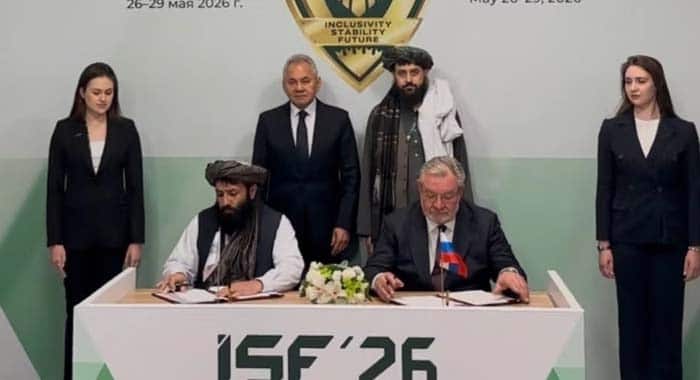
Russia and the Taliban have signed a technical-military cooperation agreement aimed at repairing and maintaining aging Soviet-era military equipment in Afghanistan, but security observers say the deal is unlikely to alter Pakistan’s counterterrorism posture or its determination to respond to threats emanating from across the border.
The agreement was signed in Moscow on May 26 in the presence of Russian Security Council Secretary Sergei Shoigu and Taliban Defense Minister Mullah Mohammad Yaqoob Mujahid. According to officials familiar with the arrangement, the accord focuses primarily on the rehabilitation, maintenance, and servicing of older Russian-made military hardware currently in Afghan possession.
Most of the equipment covered by the agreement dates back to the Soviet military presence in Afghanistan between 1979 and 1989 and reportedly requires extensive repairs, spare parts, and technical support to remain operational.
Russian officials have emphasized that the agreement does not involve the transfer of advanced military technology, major weapons systems, or new arms sales. Instead, it is largely designed to restore the functionality of existing equipment already available to Taliban authorities.
The development comes at a time of heightened tensions between Pakistan and the Taliban administration, with Islamabad repeatedly expressing concern over the continued presence of terrorist organizations operating from Afghan territory.
Pakistani security officials, speaking to foreign media on condition of anonymity, indicated that the Russia-Taliban agreement would not constrain Pakistan’s ability to take necessary measures against terrorist threats originating from across the border.
The signing of the accord has also drawn attention because it coincides with growing regional concerns over the activities of terrorist groups based in Afghanistan, including Tehreek-e-Taliban Pakistan (TTP), Al-Qaeda affiliates, and other extremist organizations that Pakistani officials say continue to enjoy operational space inside Afghan territory.
Following his return from Moscow, Mullah Mohammad Yaqoob reportedly claimed that Pakistan would no longer dare conduct strikes inside Afghanistan after implementation of the agreement. Pakistani officials have rejected such assertions, arguing that no external arrangement can override a state’s right to defend its citizens and territorial integrity against cross-border terrorism.
Only days earlier, Pakistan delivered one of its strongest public messages regarding the security situation along the Afghan border.
During a weekly media briefing, Foreign Office spokesman Tahir Andrabi stated that Pakistan could no longer tolerate the continued use of Afghan soil for terrorist attacks against Pakistani citizens and security personnel. He emphasized that Pakistan, having suffered thousands of casualties from terrorism over the years, could not remain passive in the face of cross-border threats.
The spokesman further stressed that Pakistani security forces continue to confront terrorism that is planned, facilitated, financed, and supported from beyond the border, adding that no responsible state can ignore attacks targeting its sovereignty and the safety of its people.
While reaffirming Pakistan’s commitment to dialogue and diplomacy with Afghanistan, Andrabi urged Taliban authorities to ensure that Afghan territory is not used by terrorist groups to threaten Pakistan.
Analysts note that Islamabad’s position has remained largely consistent: diplomatic engagement with Kabul remains important, but meaningful progress depends upon verifiable action against terrorist organizations operating from Afghan soil.
The issue has become increasingly central to regional security discussions. Recent assessments by security experts have warned that Afghanistan continues to host multiple terrorist organizations, with reports indicating varying degrees of interaction among TTP, Al-Qaeda-linked elements, and other extremist networks. These concerns have fueled calls for concrete counterterrorism measures rather than symbolic assurances.
Observers argue that the significance of the Russia-Taliban agreement should therefore be viewed in a broader context. While the accord may improve the operational condition of aging military equipment, it does not directly address the core concern repeatedly raised by Pakistan and other regional stakeholders: the continued presence of terrorist safe havens and infrastructure inside Afghanistan.
Security analysts maintain that regional stability ultimately depends not on military maintenance agreements but on credible and sustained action against terrorist groups that threaten neighboring countries.
As diplomatic contacts continue among Pakistan, China, Russia, and other regional actors, officials in Islamabad have repeatedly emphasized that the key test for the Taliban administration remains unchanged: whether it can demonstrate concrete, verifiable measures against terrorist organizations operating from Afghan territory.
Until then, security experts believe cross-border terrorism will remain the defining issue shaping relations between Pakistan and the Taliban authorities, regardless of new military or technical agreements signed elsewhere.



