
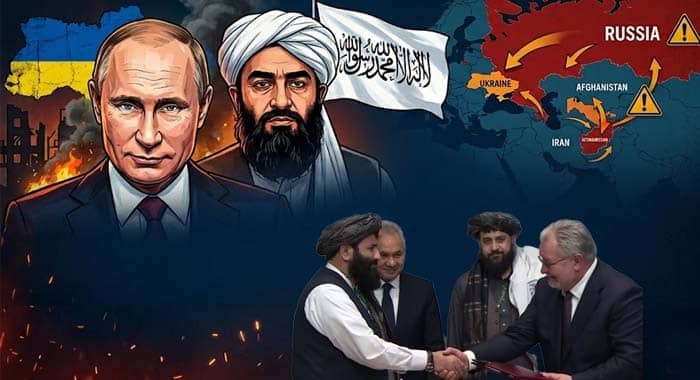
Fresh intelligence and analytical reports have surfaced indicating a deepening military engagement between the Taliban-led administration in Afghanistan and the Russian Federation a development that regional security experts warn could fundamentally alter the balance of power across Central and South Asia, and rekindle memories of Afghanistan’s long and painful role as a battleground for competing global powers.
According to a detailed investigation published by The Diplomat, a respected international affairs journal with a focus on the Asia-Pacific and Central Asian regions, specific provisions within a proposed defense cooperation framework between Moscow and the Taliban administration carry significant security implications not only for Afghanistan but for the broader region. The report identifies classified clauses within the draft agreement that analysts believe could pave the way for formal military collaboration a prospect that would mark an unprecedented shift in Taliban foreign policy.
Most critically, the report raises the alarming possibility that Taliban-affiliated fighters could be recruited, trained, or deployed to serve auxiliary roles in the ongoing Russia-Ukraine war a conflict that has already drawn mercenaries and proxy forces from multiple continents. If corroborated, this would represent a dramatic escalation in the internationalisation of the Afghan militant network, and would place the Taliban regime in direct complicity in a European theatre of war.
Senior security analysts and foreign policy researchers have moved swiftly to contextualise these developments, cautioning that the situation extends far beyond a routine state-to-state defense arrangement. The involvement of a non-state actor the Taliban, which remains unrecognised by the United Nations and most of the international community in a formal military partnership with a P5 nation would set a deeply troubling precedent for international law and norms governing state sovereignty and the conduct of war.
Historians and geopolitical scholars have long identified Afghanistan as one of the most strategically consequential territories on earth a landlocked nation at the intersection of Central Asia, South Asia, and the Middle East that has, for centuries, served as both prize and pawn in the ambitions of external powers. From the British imperial manoeuvres of the 19th century to the Soviet invasion of 1979 and the subsequent American-led intervention following September 11, Afghanistan has repeatedly been reduced to a theatre of foreign competition at immeasurable human cost.
Experts now warn that the current trajectory if left unchecked risks repeating this historic pattern. Should Taliban-aligned fighters begin appearing on European or proxy battlefields at the direction of Moscow, the ripple effects on Afghanistan’s already fragile internal security, its regional relationships, and its standing in the international community would be severe and potentially irreversible.
Reacting to the emerging reports, Pakistan’s Defence Minister Khawaja Muhammad Asif delivered a composed but unambiguous statement, signalling Islamabad’s awareness of the unfolding situation and its readiness to act in the national interest. The Minister affirmed that Pakistan possesses the full capability and institutional resolve to defend its borders, sovereignty, and strategic assets should any regional realignment including a Taliban-Russia military axis pose a direct or indirect threat to Pakistani territory or security architecture.
Pakistan shares a 2,670-kilometre border with Afghanistan and has historically maintained a complex and often turbulent relationship with successive Afghan administrations. The prospect of Afghan soil being used as a base or transit route for Russia-aligned military activities would represent a direct security threat to Islamabad one that Pakistani defence planners are undoubtedly already modelling in classified assessments.
Observers have noted that the potential Taliban-Russia defense arrangement does not exist in a vacuum. It must be viewed against the backdrop of a rapidly shifting global order one in which Russia, under sustained Western sanctions and military pressure in Ukraine, is actively cultivating non-traditional alliances and leveraging relationships with non-state actors to compensate for conventional military limitations. For the Taliban, whose government remains economically isolated and diplomatically unrecognised, a partnership with Moscow offers both financial lifelines and a measure of international legitimacy however controversial.
Regional powers including Iran, China, India, and the Central Asian republics each of which shares borders or strategic interests with Afghanistan are expected to monitor these developments with acute concern. Beijing, in particular, which has invested heavily in Central Asian infrastructure and holds the China-Pakistan Economic Corridor (CPEC) as a flagship Belt and Road project, would view any further destabilisation of the Afghan-Pakistani security environment as a direct threat to its regional economic ambitions.
As the international community grapples with simultaneous crises across multiple continents, the situation in Afghanistan demands renewed and urgent attention. The central question whether Afghanistan is once again being drawn into the orbit of great power rivalry, or whether the Taliban-Russia engagement will remain a contained diplomatic arrangement may not be answerable today. But the window for preventive diplomacy, multilateral pressure, and regional de-escalation is narrowing rapidly.



