
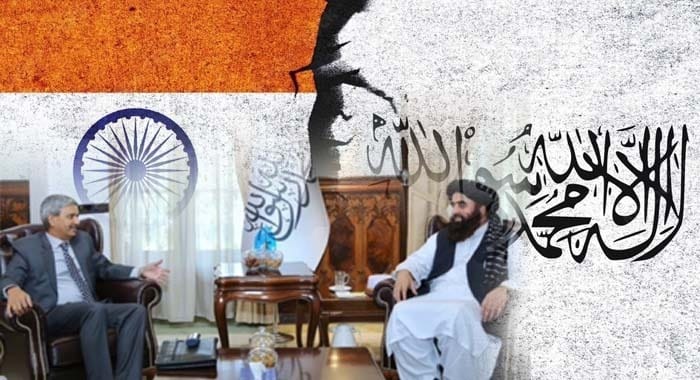
In a bombshell exposé that has sent shockwaves through diplomatic corridors across South Asia and beyond, the internationally respected journal “Policy General” has blown wide open one of the region’s most carefully guarded geopolitical secrets the quietly deepening, strategically calculated, and morally troubling diplomatic embrace between India and Afghanistan’s Taliban regime. The revelations arrive at a moment of acute global sensitivity, forcing the international community to confront an uncomfortable question: When does strategic interest become a betrayal of human conscience?
According to the explosive findings published by Policy General, diplomatic contacts between New Delhi and the Afghan Taliban have been growing not shrinking in a gradual, deliberate, and carefully concealed progression that defies India’s publicly stated commitments to human rights and democratic values.
The journal’s investigation reveals that India, despite facing significant internal political pressure from human rights advocates, opposition voices, and civil society organisations, has nonetheless chosen to walk the path of quiet engagement with a regime internationally condemned for its brutal suppression of fundamental human freedoms.
The driving force behind this controversial strategic pivot, according to Policy General, is ruthlessly pragmatic: New Delhi is consumed by the urgent need to protect and advance its strategic interests in Afghanistan interests that span regional security architecture, economic connectivity, energy corridors, and the perpetual rivalry with Pakistan for influence over Afghan soil.
Policy General’s exposé makes a particularly striking assertion that India is actively leveraging its relationship with the Taliban as a tool to safeguard its security interests across the wider region. In a geopolitical environment where China, Russia, and Pakistan have all moved to consolidate their influence over Kabul, India evidently calculated that continued isolation from the Taliban-controlled government carried a strategic cost too high to bear.
The journal poses a question that cuts to the very heart of this diplomatic scandal: “What is the justification for accepting the Taliban despite their systematic and well-documented violations of human rights?”
It is a question to which, as yet, no satisfactory answer has been offered by Indian officials. The silence from New Delhi on this fundamental moral dilemma has itself become a damning statement — suggesting that in the cold arithmetic of geopolitical calculation, human dignity is a line item that can be quietly struck from the ledger.
Policy General’s investigation further shines a spotlight on a dimension of the Afghanistan crisis that rarely receives the attention it deserves the staggering, largely untapped mineral wealth lying beneath Afghan soil, estimated to be worth trillions of dollars.
The journal makes clear that Afghanistan’s vast natural resources have become a focal point of intense interest for global powers, with lithium, rare earth elements, copper, iron, and precious stones transforming the impoverished, war-shattered nation into a high-stakes arena of resource geopolitics. India’s accelerating engagement with the Taliban, critics argue, cannot be fully divorced from this mineral dimension raising profoundly disturbing questions about whether Afghan resources are quietly being traded for diplomatic legitimacy extended to a regime that has stripped half its population of their basic humanity.
Amid the swirling currents of diplomatic manoeuvring and strategic calculation, Policy General refuses to allow the world to lose sight of what is actually happening to the Afghan people and most devastatingly, to Afghan women and girls.
The journal’s report is unsparing in its assessment, declaring that Afghanistan has today become the world’s most glaring and undeniable symbol of gender discrimination and systematic oppression. It is a nation where:
- Girls are banned from schools beyond the sixth grade, robbing an entire generation of young women of the education that is their birthright
- Women are barred from the workforce, reducing millions of educated, capable, and ambitious women to invisible prisoners within their own homes
- Female freedom of movement is shackled by restrictions requiring male guardianship for even the most basic activities of daily life
- Women in public life — former judges, politicians, journalists, professors, and activists live under constant threat of detention, torture, and execution
- Healthcare access for women has collapsed, with female patients turned away and female medical professionals barred from their own profession
- The very visibility of women in public space has been systematically erased, with burqa enforcement and disappearance from streets, markets, and civic life
Policy General’s verdict is devastating and unambiguous: Afghanistan stands today as the single most prominent example of gender apartheid anywhere on the face of the earth a designation that should shame every government that has chosen strategic convenience over the defence of Afghan women’s fundamental rights.
The revelations published in Policy General have drawn fierce and immediate condemnation from the global human rights community. Human rights activists and international advocacy organisations are intensifying their criticism of what they describe as a deeply cynical and morally bankrupt international trend the quiet, incremental normalisation of the Taliban regime under the thin disguise of “pragmatic engagement.”
These voices argue, with compelling force, that every diplomatic gesture extended toward the Taliban without iron-clad conditions on women’s rights represents a betrayal of the 20 million Afghan women currently living under one of the most oppressive administrations in recorded modern history.
The activists are particularly scathing about the manner in which the pursuit of Taliban legitimacy on the world stage is systematically burying the questions of women’s rights that should be the non-negotiable centrepiece of any engagement framework. Accountability, they warn, is being sacrificed on the altar of geopolitical convenience.
Perhaps the most searing indictment contained within Policy General’s landmark report is its conclusion regarding the status of Afghan women in the grand geopolitical chess game currently being played across the region. The journal’s finding is as stark as it is heartbreaking:
In the game of politics, the rights of Afghan women have been reduced to a secondary consideration an afterthought, a footnote, a bargaining chip to be quietly set aside when larger strategic interests demand it.
Experts consulted by Policy General warn with urgency that international efforts to grant the Taliban global acceptance and legitimacy are actively pushing women’s rights questions into the shadows creating a world where a regime that has committed what many legal scholars describe as crimes against humanity is welcomed into the community of nations, while the victims of those crimes are told to wait.
The concern among specialists is not merely about Afghanistan — it is about the precedent being set for authoritarian and misogynistic regimes worldwide. If the Taliban can be rewarded with diplomatic recognition despite gender apartheid, what message does that send to every other government contemplating the suppression of women’s rights?
Policy General’s explosive investigation leaves the international community confronting a series of urgent, unavoidable, and deeply uncomfortable questions:
To India: How does New Delhi reconcile its self-proclaimed status as the world’s largest democracy and a champion of regional stability with its quiet diplomatic embrace of a regime that has abolished democracy, education, and freedom for half of Afghanistan’s population?
To the International Community: At what point does the pursuit of strategic interest become complicity in oppression? When does silence in the face of gender apartheid become endorsement?
To the Taliban’s Would-Be Legitimisers: What price are you prepared to extract for recognition and if that price does not include the restoration of Afghan women’s rights, what exactly are your values worth?
The revelations of Policy General arrive as a clarion call to a world that has grown dangerously comfortable looking away from Afghanistan. The journal’s exposé of India’s deepening Taliban diplomacy is not merely a story about bilateral relations between two neighbours it is a story about the moral architecture of the international order itself.
It is a story about whether the rights of 20 million women matter less than lithium deposits and security corridors. It is a story about whether the language of human rights is a genuine commitment or a decorative flourish to be discarded the moment it becomes strategically inconvenient.
Afghanistan’s women did not choose to become pawns in this game. But the world including India is choosing, every single day, whether to leave them there.



