
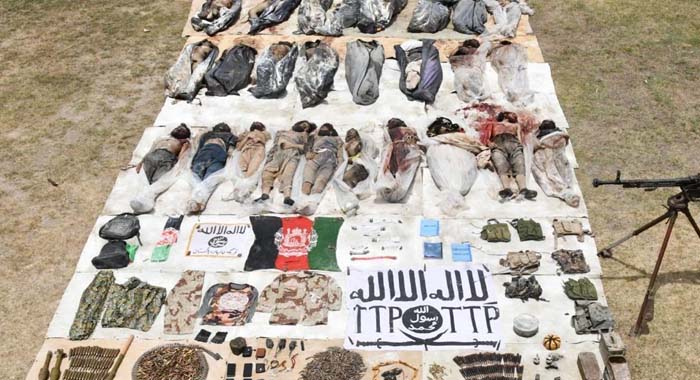
Security Forces have successfully concluded Operation Iron Fist-3, a major counterterrorism operation conducted between 1 and 12 June 2026 in the areas surrounding Miranshah. The operation resulted in the elimination of 62 Khawarij, including four high-value targets (HVTs), the destruction of extensive hostile infrastructure, and the recovery of a substantial cache of weapons, ammunition, and improvised explosive devices (IEDs). The operation was carried out under the command of 7 Division and focused on the sanitization of the villages of Palangzai, Khuzai, and Nadeem Kot, which had long been exploited by Khawarij elements as operational sanctuaries and logistical hubs.
Operation Iron Fist-3 was executed through a comprehensive and coordinated military effort involving infantry, specialized combat teams, tanks, armored personnel carriers (APCs), engineering assets, and supporting combat elements. The operation was designed to dismantle entrenched Khawarij networks, eliminate hostile combatants, destroy infrastructure supporting their activities, and restore security across the affected areas.
During the initial phase of the operation, conducted from 1 to 3 June, Security Forces successfully sanitized the villages of Nadeem Kot and Khuzai while maintaining continuous surveillance and pursuit operations throughout the target area. As pressure intensified, several groups of Khawarij attempted to flee or receive reinforcements from surrounding localities. These efforts were effectively thwarted through a series of well-coordinated ambushes and precision engagements. As a result, 28 Khawarij were eliminated, six bodies were recovered, and intelligence assessments indicated that an additional fourteen to sixteen hostile fighters sustained injuries. Partial depopulation measures were undertaken during this phase to facilitate military operations and ensure the safety of local civilians.
The second and most decisive phase of Operation Iron Fist-3 focused on Palangzai, a location identified as one of the most significant Khawarij strongholds in the region. From 4 to 12 June, Security Forces conducted a systematic clearing and sanitization campaign, targeting fortified positions, concealed hideouts, and interconnected defensive networks established by hostile elements. Fierce engagements ensued as troops advanced through the area, ultimately resulting in the elimination of 34 additional Khawarij. Security Forces recovered 24 bodies, while three more hostile combatants were found burned at the site of engagement. Significantly, the operation led to the neutralization of four high-value Khawarij commanders, whose bodies were recovered and identified. Their elimination represents a major blow to the command, control, and operational capabilities of Khawarij networks active in the region.
A key outcome of the operation was the destruction of a substantial Khawarij infrastructure network. Security Forces demolished 14 hideouts and command centres, including several interconnected tunnel systems used for concealment, movement, and storage. The operation also uncovered and destroyed extensive logistical facilities supporting hostile activities. During the engagements, a major ammunition storage site belonging to the Khawarij was destroyed, triggering powerful secondary explosions due to the large quantity of explosives and munitions stored within the facility. The scale of the detonation highlighted the significant stockpiles maintained by hostile elements and underscored the importance of the operation in degrading their operational capacity.
In addition to combat successes, Security Forces apprehended eight suspected Khawarij associates during the course of the operation. These individuals have been taken into custody and are undergoing further investigation to assist ongoing intelligence and security efforts. In a notable humanitarian achievement, troops also rescued an underage orphaned boy from a Khawarij compound in Palangzai. Preliminary findings indicate that the child had been subjected to abuse while being held at the facility. Following his rescue, the child was transferred to the relevant authorities to ensure his protection, care, and rehabilitation.
The operation yielded significant recoveries of weapons and military equipment. Among the items seized were a 12.7 mm heavy machine gun, two Zarakai weapons systems, twenty-two submachine guns, an M-16 rifle, an RPG-7 launcher, large quantities of ammunition, and a substantial stockpile of improvised explosive devices. An additional 12.7 mm heavy weapon emplacement was also destroyed during the operation, further diminishing the combat capability of hostile elements in the area.
The successful completion of Operation Iron Fist-3 marks a major achievement in ongoing efforts to eliminate Khawarij networks, restore lasting stability, and strengthen security across North Waziristan. Through the destruction of hostile infrastructure, the elimination of key commanders, and the disruption of operational and logistical networks, Security Forces have significantly degraded the ability of Khawarij elements to operate in and around Miranshah.
Security Forces remain resolute in their commitment to safeguarding the nation, protecting local communities, and ensuring that cleared areas remain secure. Intelligence-driven follow-up operations will continue to target any residual threats and prevent hostile elements from re-establishing their presence. The success of Operation Iron Fist-3 stands as a testament to the professionalism, courage, and unwavering dedication of the Security Forces in the pursuit of peace, stability, and national security.



