
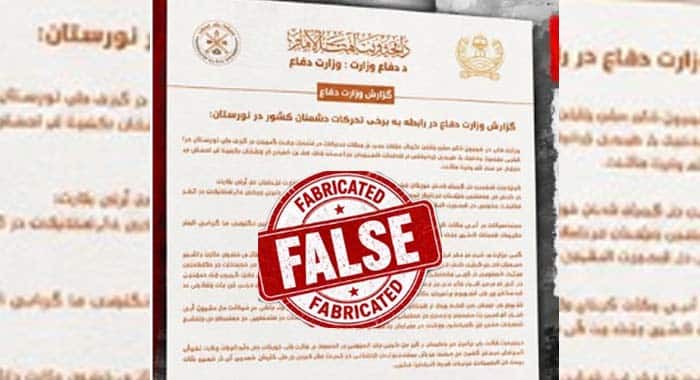
The Government of Pakistan has categorically rejected allegations by the Afghan Taliban authorities linking Pakistan or its security and intelligence agencies to alleged internal clashes in Afghanistan’s Nuristan province, describing the accusations as baseless, unsubstantiated and devoid of credible evidence.
The Information Ministry, through its official fact-check account on X, stated that Pakistan firmly rejects any allegation of involvement by its security forces or intelligence agencies in internal clashes anywhere in Afghanistan, including the alleged recruitment or training of former Afghan security personnel or the facilitation of Daesh or any other terrorist organisation operating inside Afghanistan.
The statement was issued following allegations by the Afghan defence authorities that individuals allegedly backed by Pakistan had crossed the border and become involved in reported violence in Nuristan.
Pakistan has emphasised that no credible evidence has been presented to substantiate these allegations. In particular, the Information Ministry noted the absence of identities, documentary evidence, communications records, forensic material or independent verification that could establish any connection between Pakistan and the alleged incidents.
The Ministry also rejected the use of an alleged video circulated on social media as purported evidence of Pakistani involvement. According to Pakistan’s official assessment, the footage merely depicts a small number of unarmed individuals whose identities, affiliations and circumstances have not been independently established. Pakistan therefore maintains that such material cannot constitute credible evidence of state involvement.
Pakistan has reiterated that allegations of this nature should be assessed on the basis of verifiable facts, independently corroborated evidence and established investigative procedures rather than unsubstantiated assertions or material circulated through social media.
Pakistan has consistently maintained that Afghanistan must ensure that its territory is not used as a base for terrorist activities directed against Pakistan or any other country. Islamabad has repeatedly called upon the authorities in Kabul to take effective, verifiable and sustained measures against terrorist organisations operating from Afghan territory, particularly the banned Tehreek-i-Taliban Pakistan (TTP), which Pakistan holds responsible for attacks against its citizens, security personnel and institutions.
Pakistan maintains that the issue of terrorism emanating from Afghan territory is a matter of regional and international security and requires concrete action rather than competing allegations. The Government of Pakistan has also referred to successive reports of the United Nations and other international bodies documenting the presence and activities of terrorist organisations inside Afghanistan. These reports have addressed the activities and relationships of various militant organisations operating in the country.
A recent United Nations Security Council-mandated monitoring report covering the period from December 16, 2025, to June 9, 2026, reportedly assessed that continued support for the TTP by elements within the Afghan Taliban environment had contributed to an increase in the frequency and lethality of terrorist attacks in Pakistan, while also noting that Kabul had taken some initial measures to constrain the group.
The same report identified growing operational and facilitation linkages among the TTP, Al Qaeda, Islamic State-Khorasan (ISIL-K) and the Baloch Liberation Army (BLA), underscoring the increasingly interconnected nature of militant networks operating in and around Afghanistan.
Pakistan considers these developments a serious threat to regional peace and security and has repeatedly urged the Afghan authorities to fulfil their stated commitments regarding the prevention of terrorist activity from Afghan soil.
Relations between Pakistan and Afghanistan have experienced significant strain in recent years, particularly over the issue of cross-border terrorism and attacks originating from Afghan territory. The latest deterioration in relations has included a series of security incidents along the Pakistan-Afghanistan border during September.
Following major terrorist attacks in Khyber Pakhtunkhwa, Pakistan announced on September 21 that it had conducted what it described as calibrated airstrikes against terrorist hideouts in the border region with Afghanistan. The Pakistani government stated that more than 28 terrorists had been killed in the operation.
Information Minister Attaullah Tarar described the action as part of Operation Ghazab lil Haq, which, according to the Pakistani government, was launched on the night of February 26 in response to what Pakistan described as unprovoked cross-border firing by Afghan Taliban forces.
Subsequently, Pakistani authorities reported that eight drones launched from across the Afghan border had entered Pakistani airspace near the Torkham border and Kohat and were intercepted by Pakistani security forces.
Pakistan also reported an incident involving alleged firing from the Afghan side near Kurram, while Pakistani security forces were engaged in preventing an attempted infiltration by terrorists.
In response to the reported drone incursions, Pakistan stated that it carried out what it described as precision aerial and drone strikes at 10 locations inside Afghanistan. The Pakistani government has maintained that its security measures are directed against terrorist threats and are undertaken in response to specific security incidents, while reiterating its desire for regional stability and responsible management of the shared border.
The Government of Pakistan has also pursued the matter through diplomatic channels. The Foreign Office stated on Sunday that Pakistan had delivered a formal demarche to the Afghan side concerning the reported violation of Pakistani airspace by drones.
According to the Foreign Office, the demarche was delivered on September 26, following the reported airspace violation on September 23. Pakistan has stressed that respect for territorial integrity and sovereignty is fundamental to relations between neighbouring states and that violations of national airspace cannot be treated as routine or ignored.
Pakistan has also rejected recent claims concerning alleged destruction of a Pakistani military post near the Spin Boldak border area, situated along the frontier between Balochistan and Kandahar. The Information Ministry previously dismissed the Afghan defence authorities’ claim, maintaining that the allegation was inaccurate and unsupported.
The latest rejection of the Nuristan allegations forms part of Pakistan’s broader position that claims concerning Pakistani military or intelligence involvement in Afghanistan should be supported by independently verifiable evidence rather than assertions that cannot withstand objective scrutiny.
Pakistan has reiterated that the complex security challenges confronting Afghanistan and the wider region cannot be resolved through the exchange of unsubstantiated allegations. Islamabad has called for credible and verifiable measures to address terrorist organisations operating in Afghanistan, greater cooperation on border security, and meaningful engagement through established diplomatic channels.
Pakistan further maintains that the Afghan authorities bear responsibility for ensuring that Afghan territory is not used by terrorist organisations to plan, facilitate or conduct attacks against neighbouring states. At the same time, Pakistan has rejected any attempt to attribute internal Afghan political or security developments to Pakistan without credible evidence.
The Government of Pakistan has therefore urged the Afghan authorities to focus on verifiable facts, undertake transparent investigations into security incidents, and address the presence of terrorist organisations operating within Afghan territory. Pakistan remains committed to protecting its territorial integrity and national security while pursuing diplomatic engagement aimed at reducing tensions along the Pakistan-Afghanistan border.
Islamabad has emphasised that durable peace in the region requires responsible conduct by all parties, respect for sovereignty and territorial integrity, effective action against terrorism, and credible mechanisms for addressing security concerns through evidence-based dialogue.



