
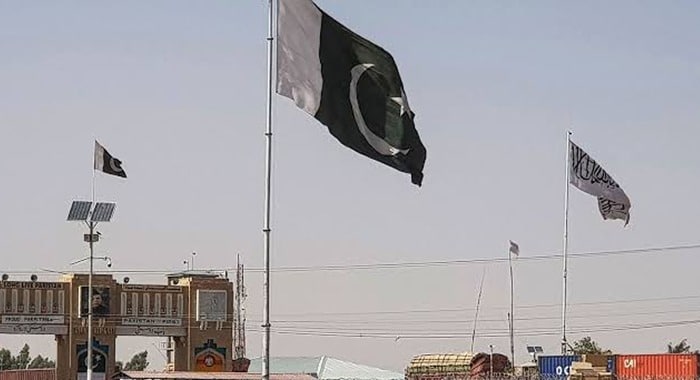
As diplomatic efforts continue to explore avenues for improved relations and renewed dialogue between Pakistan and Afghanistan, a clear and fundamental principle remains central to any sustainable engagement: Afghan territory must not be allowed to serve as a base for terrorist activities against Pakistan.
Pakistan has welcomed sincere diplomatic efforts by friendly countries, particularly China, to help reduce tensions and facilitate communication between Islamabad and Kabul. However, meaningful progress toward dialogue and long-term stability will ultimately depend on concrete and verifiable action by the Afghan Taliban authorities against terrorist groups operating from Afghan soil.
During a recent briefing, the Foreign Office welcomed China’s efforts to bridge differences between Pakistan and Afghanistan and acknowledged Beijing’s role in encouraging dialogue. China’s special envoy for Afghanistan has reportedly engaged Pakistani officials as part of efforts to revive the Urumqi process, reflecting continued international interest in preventing further deterioration in bilateral relations.
The Foreign Office has also described the recent appearance of the Afghan ambassador at the National Defence University (NDU) as “not unusual”. While diplomatic engagement between representatives of neighboring states is not inherently extraordinary, the timing of the interaction is noteworthy given the exceptionally difficult state of Pakistan-Afghanistan relations.
Despite diplomatic initiatives, the continuing presence and activities of terrorist groups based in Afghanistan remain one of the most serious obstacles to meaningful progress.
The Inter-Services Public Relations (ISPR) recently reported that several terrorists attempting to infiltrate Pakistan from the Afghan border were eliminated. The military’s media wing also highlighted continuing concerns regarding the failure of the Afghan Taliban authorities to ensure effective border management.
Such incidents demonstrate that diplomatic engagement cannot be separated from the security realities along the Pakistan-Afghanistan border. Cross-border infiltration, militant movement and attacks originating from Afghan territory directly undermine confidence-building efforts and make sustained dialogue increasingly difficult.
For diplomacy to produce lasting results, assurances must be accompanied by actions that can be independently verified.
Pakistan appreciates the efforts of China and other sincere partners seeking to facilitate communication between Islamabad and Kabul.
Beijing has a direct interest in regional peace and stability. Its economic and strategic interests in Afghanistan, as well as concerns regarding militant organizations such as the East Turkestan Islamic Movement (ETIM), make stability along the region’s security frontier particularly important.
China’s diplomatic engagement can provide a valuable platform for dialogue, but mediation alone cannot resolve the underlying security challenge. Ultimately, responsibility rests with Kabul to demonstrate that Afghan territory will not be used by groups seeking to conduct attacks against Pakistan or other neighboring states.
The Afghan Taliban authorities have reportedly taken certain measures in response to Pakistan’s concerns, including relocating some TTP fighters and their families away from areas close to the common border. There have also been reports that the Taliban supreme leader instructed the banned TTP to refrain from attacks against Pakistan.
While such steps may indicate an acknowledgment of the problem, their effectiveness must be assessed through results rather than declarations.
Continued militant activity, infiltration attempts and armed confrontations along the border raise questions about whether existing measures are sufficient to constrain terrorist organizations operating from Afghan territory.
For Pakistan, the issue is therefore not simply whether Kabul announces measures, but whether those measures produce measurable, sustained and verifiable reductions in cross-border terrorism. If diplomatic efforts are to achieve meaningful results, a clear roadmap is required.
The principle identified by Pakistan’s Foreign Office is straightforward: the Afghan Taliban must provide verifiable and written assurances that Afghan territory will not be used for attacks against Pakistan.
Such assurances would provide an essential foundation for restoring confidence and creating an environment in which political engagement can move forward.
A commitment of this nature must not remain limited to diplomatic statements. It should be supported by practical measures, including effective border management, prevention of terrorist infiltration, action against militant infrastructure and demonstrable restrictions on groups conducting or planning attacks against Pakistan.
In this context, renewed efforts to revive the Urumqi process may offer a useful avenue for engagement.
A structured diplomatic mechanism could provide Pakistan and Afghanistan with an opportunity to address security concerns, border management, terrorism, trade and broader bilateral issues through sustained dialogue.
However, any such process will require a realistic understanding of the core problem. Dialogue cannot become an alternative to action against terrorism. Rather, meaningful security measures should create the conditions under which dialogue can succeed.
Pakistan has repeatedly stated that it remains prepared for peaceful engagement with Afghanistan. The country has no interest in prolonged instability or confrontation with its neighbor. At the same time, Pakistan cannot compromise on its fundamental responsibility to protect its citizens and territory from terrorist attacks.
Pakistan’s position has remained consistent: dialogue is possible, but terrorism cannot be allowed to continue alongside dialogue.
The country has demonstrated both its willingness to engage diplomatically and its capability to defend itself against terrorist threats. Pakistan has repeatedly emphasized that it seeks peaceful relations with Afghanistan based on mutual respect, sovereignty, non-interference and the principle that neither country’s territory should be used against the other.
The path toward improved bilateral relations therefore remains open—but it requires meaningful action from Kabul.
Afghanistan’s leadership has an opportunity to demonstrate that it is prepared to address Pakistan’s legitimate security concerns through concrete measures rather than temporary or symbolic steps. Effective control over militant networks, prevention of cross-border movement and credible action against terrorist groups would significantly improve the prospects for renewed confidence.
Sustained confrontation serves neither Pakistan nor Afghanistan. Both countries share a long border, deep historical and cultural connections, and significant economic and security interests in regional stability.
A stable Afghanistan can benefit from stronger economic connectivity and regional integration, while Pakistan stands to gain from a secure western border and peaceful relations with its neighbor.
The choice, therefore, is ultimately one of political will.
China’s diplomatic efforts are welcome, dialogue remains possible, and the door to engagement is open—but lasting peace will depend on Kabul demonstrating, through verifiable action, that Afghan territory will no longer be used as a launching ground for terrorism against Pakistan.
Until that fundamental concern is addressed, diplomatic initiatives will remain vulnerable to the realities of violence and cross-border militancy.



