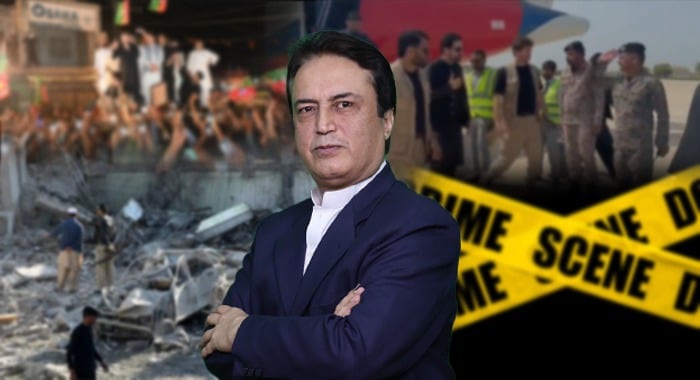
Arif Yousafzai
Khyber Pakhtunkhwa has always been called Pakistan’s most challenging province plagued by security threats along its western border, a fragile health infrastructure, and an education system crying out for reform. Yet as these fundamental crises persist, the question increasingly on people’s minds is not “what is the government doing about them?” but rather, “where is the government?” Chief Minister Sohail Afridi’s recent, highly publicized trip to Sindh landing first in Sukkur before continuing his political tour has reignited a bitter debate about priorities, public money, and whether Khyber Pakhtunkhwa’s rulers have any interest left in actually governing.
Reports indicate that Sohail Afridi arrived in Sukkur accompanied by roughly thirty to forty companions not via commercial travel, but reportedly aboard a chartered aircraft. The footage released by the provincial government itself makes clear these were not ordinary travelers going about ordinary business; they were PTI functionaries, mobilized for a singular political purpose: building momentum for the party’s planned march on Islamabad, scheduled for September 27, framed around demands for Imran Khan’s release.
The optics alone are damaging. A private charter is not something available to the average citizen it is expensive, exclusive, and in this case, allegedly funded through provincial resources. If true, this represents more than a political misstep; it borders on a serious misuse of public authority. Government treasuries exist to serve the public to build hospitals, staff schools, repair roads, and respond to emergencies — not to bankroll a political party’s street mobilization campaign, however legitimate that party’s broader cause may claim to be.
This is not an isolated incident, either. Similar patterns have reportedly played out in Punjab and across various districts of Khyber Pakhtunkhwa itself, with public funds allegedly financing movement-building activities far removed from the basic mandate of governance. The core objection here is straightforward and, frankly, difficult to dispute on principle: the money in a provincial treasury belongs to the public. It is meant for development, for prosperity, for human capital not for advancing the electoral or ideological ambitions of whichever party happens to be in power. When public institutions look the other way while such resources are diverted, it should trouble every citizen, regardless of political affiliation. Any government PTI or otherwise spending taxpayer money to fuel its own political theater deserves scrutiny, not silence.
Beyond the funding controversy lies a deeper skepticism: will the September 27 march to Islamabad even happen? PTI has a well-documented history of announcing dates for mass mobilizations only to postpone or cancel them sometimes repeatedly. Given this track record, there is little reason for confidence that this date will hold any differently.
More troubling is what this pattern reveals about the party’s internal dynamics. With Imran Khan in custody, a leadership vacuum has emerged, and various figures have stepped into the spotlight — appearing on talk shows, delivering speeches, positioning themselves as champions of the cause. Yet none of this translates into governance, performance, or tangible outcomes for the province they are supposed to be running. It raises an uncomfortable question: does this benefit Imran Khan at all, or does it simply serve individual politicians looking to elevate their own profiles under the cover of loyalty?
Perhaps the most damning indictment comes from within PTI’s own base. Grassroots supporters increasingly appear disillusioned, wary of being used as expendable foot soldiers in movements that put them in harm’s way while their leadership remains conspicuously safe. Memories of previous marches loom large occasions when ordinary workers faced bullets, arrests, and injuries, while senior leadership emerged unscathed. The recurring question voiced by rank-and-file supporters is a fair one: why is it that ordinary party workers bear the physical risk of these confrontations while the leaders who orchestrate them remain untouched? This is not a hypothetical grievance it strikes at trust, and trust, once broken, is difficult to rebuild. These are people’s children, siblings, and providers being asked to risk their safety and freedom for a cause their leadership seems unwilling to risk anything for themselves.
If the political theater surrounding the march raises questions about strategy, the provincial government’s governance record raises far more serious ones. PTI has now controlled Khyber Pakhtunkhwa for roughly thirteen years, dating back to 2013 long enough to leave a defining legacy. Instead, the record suggests a story of squandered opportunity.
When Imran Khan was in opposition, he frequently cited a single reforming minister in India as proof that dramatic, province-wide transformation was achievable through the right leadership. The implicit promise was that Khyber Pakhtunkhwa, once given the chance, would become a model for the rest of the country. Thirteen years and multiple chief ministers later from the early tenure that arguably showed some initiative to the years that followed that promise remains unfulfilled.
Consider the numbers: more than 300 hospitals, schools, and colleges reportedly built or expanded during this period, yet many now sit in disrepair, with talk of privatizing rather than sustaining them. If so much infrastructure was built at such expense, why does much of it now fail to function at even a basic standard hospitals rated poorly, facilities crumbling, resources stretched thin? Investment without maintenance is not development; it is a monument to wasted spending.
Nowhere is the failure more visible than in Peshawar itself the provincial capital, the city meant to serve as PTI’s flagship achievement. Yet Peshawar cannot honestly be presented as a model city to anyone. Beyond a handful of well-maintained areas, much of the urban landscape struggles with unstable roads and inadequate infrastructure. The Bus Rapid Transit (BRT) project stands as perhaps the starkest symbol of this failure a project whose costs reportedly ballooned from an initial estimate in the tens of crores to roughly 100 billion rupees, yet which still floods and grinds to a halt after just days of rain. A transit system of that cost failing at something as basic as drainage planning represents, by any measure, a significant engineering and management shortfall.
The disappointment here is not merely partisan. Many who supported PTI in 2013 did so hoping for a genuine break from Pakistan’s cycle of corruption and underperformance Imran Khan’s rhetoric promised exactly that. Instead, critics argue the party set new records for the very failures it promised to end, backed by grand pledges 365 dams, small-scale power generation that never materialized. A party built on promises, the argument goes, has struggled to convert those promises into practical results.
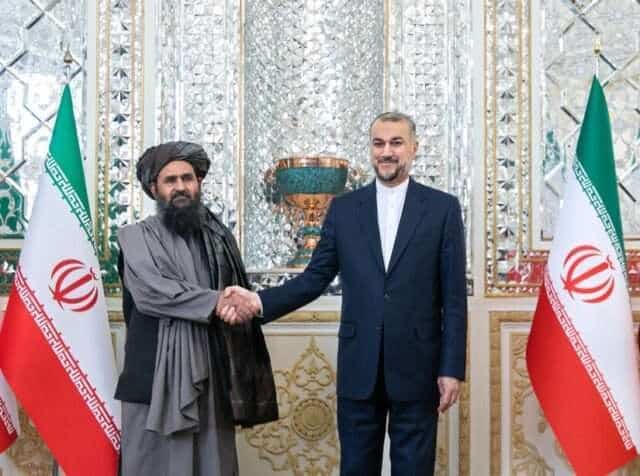
Amid this domestic political turbulence, one genuinely encouraging development has emerged: a thaw in Pakistan-Afghanistan relations. The visit of an Afghan ambassador to Pakistan’s National Defence University, where he delivered a notable address, marks a meaningful, if cautious, step forward. His remarks reportedly centered on three key points: a request for credible, verifiable evidence regarding Pakistan’s terrorism allegations against Afghan soil; an assertion of Afghanistan’s own security sovereignty; and most importantly an expressed desire to push bilateral relations toward normalization.
Given the tension of recent months a suspended trade relationship, border clashes, and periods of open hostility this gesture, however modest, represents a genuine opportunity. Both nations share an unchangeable geography; neighbors cannot be swapped out, however difficult the relationship becomes. If Pakistan responds with matching goodwill and pragmatic diplomacy, there is real potential for reopened trade routes, eased border tensions, and a more stable regional posture. That would benefit not just diplomats and policymakers, but ordinary citizens on both sides of the border whose lives and livelihoods have been disrupted by the standoff.
Khyber Pakhtunkhwa deserves better than a government more invested in political survival and street mobilization than in solving the province’s fundamental problems. Whether it is chartered flights funded by public money, an on-again-off-again protest movement that seems to serve individual political ambitions more than any coherent cause, or thirteen years of infrastructure spending that has failed to produce a functioning model city, the pattern points toward a serious accountability gap. Meanwhile, a genuine diplomatic opening with Afghanistan offers a rare bright spot one that deserves careful, good-faith follow-through rather than being overshadowed by domestic political noise.