
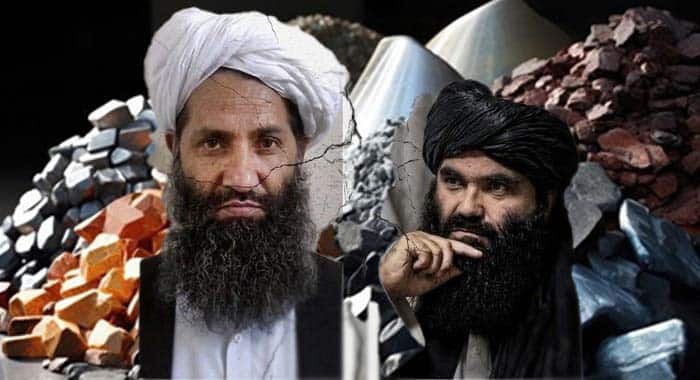
Afghanistan’s vast mineral wealth, long viewed as a potential foundation for economic development and national prosperity, is increasingly becoming intertwined with the country’s struggle over political authority, revenue and control under Taliban rule.
The country’s mineral deposits are estimated to have enormous potential value, with significant resources spread across Badakhshan, Bamiyan, Daikundi, Balkh, Sar-e Pul, Nangarhar, Logar and other provinces. Yet instead of becoming an immediate engine of broad-based development, the extraction of these resources is generating concerns over who controls mining revenues, how those revenues are distributed and what costs are being borne by communities living in resource-rich areas.
The issue also intersects with reported competition between different power centers within the Taliban system, particularly between the leadership concentrated around Kandahar and networks associated with the Haqqani Network.
Historical United Nations reporting has documented extensive Taliban involvement in Afghanistan’s natural-resource sector, including direct extraction, taxation and alleged extortion of mining operations. A UN Monitoring Team previously reported that Taliban influence in the extractive sector was significant and that competing groups had sought financial benefits from mining activities. More recent UN reporting has also identified gold and lapis lazuli mining in Badakhshan as a source of revenue for the Taliban, including reporting that the de facto authorities had assumed control over exports.
Afghanistan possesses deposits of copper, coal, natural gas, gold, lapis lazuli, gemstones, lithium and other minerals. The country’s mineral potential has frequently been described as worth hundreds of billions of dollars, with some estimates putting the broader resource potential at around $1 trillion.
For ordinary Afghans, however, the central question is not simply how much mineral wealth exists underground. It is who controls it, who benefits from it and who pays the price for extracting it. Large deposits are located in provinces inhabited by diverse communities, including Tajik, Hazara and Uzbek populations. Bamiyan and Daikundi contain significant mineral resources, while Badakhshan is known for gold, gemstones and lapis lazuli. Northern provinces including Balkh and Sar-e Pul possess energy and mineral resources, while Nangarhar and Logar contain deposits of copper, gemstones and other valuable materials.
The geographic distribution of these resources means that the economic value of Afghanistan’s mineral wealth is concentrated in areas that are not necessarily aligned with the country’s principal political centers. That geographical reality makes control over mining particularly significant.
Since the Taliban returned to power in 2021, the leadership based around Kandahar has sought greater central control over Afghanistan’s political and economic institutions. Taliban Supreme Leader Hibatullah Akhundzada, who operates from Kandahar, has progressively consolidated authority over key aspects of the administration. At the same time, the Haqqani Network has historically maintained significant influence within important security and economic structures. The United Nations Security Council identifies the Haqqani Network as a Taliban-associated network and has documented its historical role and organizational structure.
The competition between different Taliban power centers has increasingly been discussed in connection with control over revenue-generating institutions. Following the Taliban takeover, officials associated with the Haqqani network reportedly gained influence over important revenue-generating sectors, including customs, border crossings and passport administration. Subsequent moves by the Kandahar leadership to replace some officials with individuals considered closer to the central leadership have been interpreted by observers as part of a broader effort to centralize control over state revenues.
Mining represents another potentially lucrative source of income.
The competition over Afghanistan’s mineral resources is not necessarily a conventional dispute between clearly defined factions. Rather, it involves overlapping political, security and economic networks operating within the Taliban’s governing structure. The potential value of Afghanistan’s mineral sector makes control over extraction, licensing, taxation, transportation and exports strategically important.
UN reporting has previously documented precisely this dynamic. A UN Monitoring Team reported that Taliban involvement in natural resources included direct participation in extraction, attempts to tax or extort licensed and unlicensed mining operations, and the provision of security or other services to unlicensed operations.
In Badakhshan, UN reporting previously cited information that Taliban taxation and extortion connected to gold mining in Raghistan District generated substantial monthly revenue, with reported proceeds flowing to senior Taliban structures rather than being shared with local commanders. These historical findings provide important context for understanding why control over resource-rich provinces remains economically and politically significant.
Badakhshan has particular importance because of its combination of mineral resources, strategic geography and complex local political dynamics. The province is known for deposits of gold, lapis lazuli and precious stones, making control over mining areas and associated trade routes potentially lucrative. Recent developments described in the reporting indicate that the Taliban’s central leadership has sought to strengthen its authority over mining operations in the province.
According to the information being reported, special forces were deployed to Badakhshan in June 2026 with the stated objective of bringing control over mining areas more directly under the central administration. Such a move would represent more than a routine security deployment. If confirmed, it would illustrate how security structures can become instruments for enforcing central control over economically valuable territory and resources.
For communities living around Afghanistan’s mineral deposits, the promise of mineral wealth has often been accompanied by significant social and environmental concerns. Mining can generate employment and government revenue when conducted transparently and under effective regulation. But poorly regulated extraction can also result in environmental degradation, displacement, unsafe working conditions and exploitation of vulnerable populations.
Reports of child labor, environmental damage and forced displacement have raised concerns about the human cost of unregulated or inadequately regulated mining activities. Communities living on or near resource-rich land can face the disruption of agricultural livelihoods, water resources and traditional land use while having limited influence over decisions concerning extraction. This creates a fundamental imbalance: the communities closest to the resources may experience the greatest disruption while having little influence over how revenues are collected or spent.
The question of ownership and revenue distribution is therefore becoming increasingly important. If Afghanistan’s mineral resources are to contribute meaningfully to national development, the sector would require transparent licensing, predictable taxation, environmental safeguards, labor protections and mechanisms ensuring that affected communities receive a fair share of economic benefits.
Without such mechanisms, mineral extraction risks reinforcing existing patterns of political and economic concentration. The concern is particularly significant in a country where public institutions remain heavily centralized and where independent oversight of economic activity is limited. The potential for resource wealth to become concentrated among political and security elites is a longstanding concern in resource-rich but institutionally weak states.
Afghanistan’s mineral economy therefore adds another dimension to the country’s internal political landscape. The issue is not simply Taliban versus international actors or government versus local communities. It also involves questions over the distribution of economic power within the Taliban’s own governing structure.
The growing centralization of authority around Kandahar, alongside the historical influence of the Haqqani Network over important security and economic institutions, creates an environment in which control over revenue-producing sectors can carry significant political weight. The United Nations has previously documented competition among Taliban-linked actors over natural-resource revenues, demonstrating that mining has long been more than an economic issue in Afghanistan.
Afghanistan’s mineral resources could theoretically provide the country with an opportunity to reduce its dependence on foreign assistance, create employment, develop infrastructure and generate long-term government revenue. But that outcome depends on how the sector is governed. If mineral wealth is managed through transparent institutions and used for public investment, it could contribute to economic development. If control remains concentrated among political and security networks, the same resources could deepen existing inequalities and intensify competition for economic power.
For Afghanistan’s resource-rich provinces, the difference between these two outcomes is profound. The country’s mineral wealth may be buried underground, but the struggle over who controls it is increasingly visible above ground.
Afghanistan stands at a critical juncture over the future of its natural resources. The country possesses enormous mineral potential, but mineral wealth alone does not guarantee prosperity. The experience of other resource-rich countries demonstrates that weak institutions, opaque revenue systems and political competition can turn natural resources into sources of conflict rather than development.
For Afghanistan, the stakes are particularly high. The country needs investment, employment, infrastructure and government revenue. At the same time, local communities need protection from environmental degradation, displacement and exploitation.
The ultimate test will therefore not be how quickly Afghanistan’s minerals are extracted, but whether the wealth generated from those resources can be transformed into sustainable economic benefits for the Afghan population. For now, the growing focus on Badakhshan and other mineral-rich provinces suggests that Afghanistan’s natural resources are becoming an increasingly important component of the country’s internal struggle over authority, revenue and control.



