
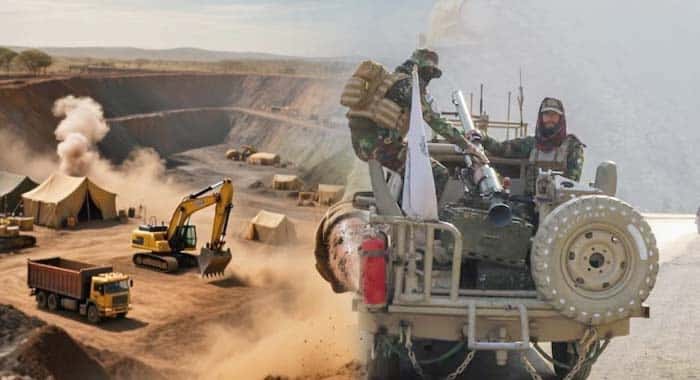
Afghanistan may be sitting on one of the world’s most valuable mineral endowments, but the country’s greatest resource may also become one of its greatest sources of conflict.
Geological assessments by the United States and the former Afghan government have estimated that Afghanistan possesses at least $1 trillion in untapped mineral resources, including copper, iron ore, cobalt, niobium, gold and lithium. Much of this wealth has remained undeveloped because decades of war made large-scale extraction extremely difficult.
Now the Taliban wants to change that.
Since returning to power in 2021, the Taliban has announced more than $7 billion in mining investments involving countries including China and Iran, covering resources such as gold, gemstones and chromite. The regime is also actively seeking further foreign investment, with its foreign minister openly inviting the United States to participate in mining projects.
On paper, this sounds like an economic opportunity.
But beneath the headlines about investment lies a much bigger question:
Who owns Afghanistan’s mineral wealth, and who gave the Taliban the authority to decide how it is distributed?
The Gold Beneath the Battlefield
Badakhshan provides an uncomfortable answer to what can happen when natural resources become intertwined with political and military power.
The province has witnessed continuing clashes involving Taliban forces and fighters loyal to Juma Khan Fateh. Reporting from August linked the dispute between Fateh and the Taliban to mining activities, while fighting reportedly disrupted roads, communications and civilian life in parts of Nusay district.
Separately, mine workers in Badakhshan protested Taliban restrictions on mining in July. Workers alleged that smaller operators were being shut down while sites connected to influential figures continued operating. Disputes over gold mining in Badakhshan and Takhar have intensified and have, at times, resulted in clashes between local residents and Taliban forces.
That should immediately change how the world views Afghanistan’s mineral story.
This is not simply a question of digging holes in mountains and exporting minerals.
It is a question of power.
Who controls the mining sites?
Who grants the licenses?
Who collects the revenue?
Who protects the mines?
Who receives the contracts?
Who speaks for the communities living around them?
And who can challenge the government when local people believe they have been excluded?
A Billion-Dollar Contract Is Not a National Mandate
The Taliban can sign contracts.
It controls ministries, government offices and much of Afghanistan’s territory.
But administrative control does not automatically create political legitimacy.
The Taliban came to power by force in 2021. Its government remains formally recognized by only Russia, while many other states maintain practical relations without recognizing the regime.
That distinction becomes crucial when the subject is national wealth.
Afghanistan’s minerals are not Taliban minerals.
They are Afghan minerals.
The gold in Badakhshan did not become Taliban property because Taliban fighters took control of the provincial capital.
The lithium beneath Afghan soil did not become regime property because a ministry in Kabul issued a contract.
Copper, cobalt, iron and other resources belong to the Afghan nation, and any legitimate government entrusted with managing them should ultimately be accountable to the people whose country contains them.
That is why the question of legitimacy cannot simply be separated from the question of mining.
Who Benefits?
The Taliban argues that foreign investment will create jobs, infrastructure and economic growth.
Afghanistan certainly needs all three.
But resource wealth can also produce the opposite outcome when institutions are weak and political power is concentrated.
Mining can generate corruption.
It can intensify competition among armed groups.
It can displace local communities.
It can enrich politically connected individuals.
And it can turn foreign investment into another instrument of geopolitical influence.
The Badakhshan experience already offers a warning.
When local miners protest and allege unequal access, when mining disputes contribute to armed confrontation, and when powerful actors appear to have privileged access to valuable sites, the country’s mineral wealth stops looking like a straightforward development opportunity.
It starts looking like a new arena for Afghanistan’s old struggle over power.
The Foreign Investor Problem
This is also why the Taliban’s invitation to American investors deserves scrutiny.
The regime wants US companies to participate in Afghanistan’s mineral economy while simultaneously seeking sanctions relief and the release of frozen Afghan assets. Muttaqi has openly promoted American investment in mining and other sectors.
But American investors would have to enter a country where international sanctions remain relevant, where the political system lacks broad international recognition and where the governance of natural resources is controlled by a regime whose domestic policies remain deeply controversial.
The Taliban sees investment as a path towards economic survival and international normalization.
Foreign governments may see Afghanistan’s minerals as a strategic opportunity.
But Afghans may eventually ask a much more fundamental question:
Where is their share?
If Afghanistan possesses $1 trillion or more in mineral wealth, the answer cannot simply be another collection of foreign companies, government contracts and powerful intermediaries.
The country has spent decades suffering from war, poverty and institutional collapse. Its mineral wealth should therefore be a means of rebuilding Afghanistan, not another mechanism through which competing elites accumulate power.
The Resource Curse Waiting to Happen?
Afghanistan has a rare opportunity.
Its mineral wealth could finance roads, electricity, schools, hospitals and jobs. It could help transform an economy dependent on aid into one capable of generating its own revenue.
But that outcome is not automatic.
A resource-rich country without accountable institutions can become trapped in what economists call the resource curse, where immense natural wealth fuels corruption, political competition and conflict rather than broad prosperity.
Badakhshan offers a small but significant glimpse of that danger.
Afghanistan’s $1 Trillion Question
The Taliban may believe that controlling Afghanistan gives it the right to control Afghanistan’s resources.
But that is precisely the assumption that deserves to be challenged.
Control is not ownership.
And power is not the same as a national mandate.
Afghanistan’s mountains may contain enough wealth to change the country’s future.
The question is whether that wealth will belong, in practice, to the Afghan people, or whether it will simply become the prize for whoever controls the machinery of power.
That is Afghanistan’s real trillion-dollar question.



