
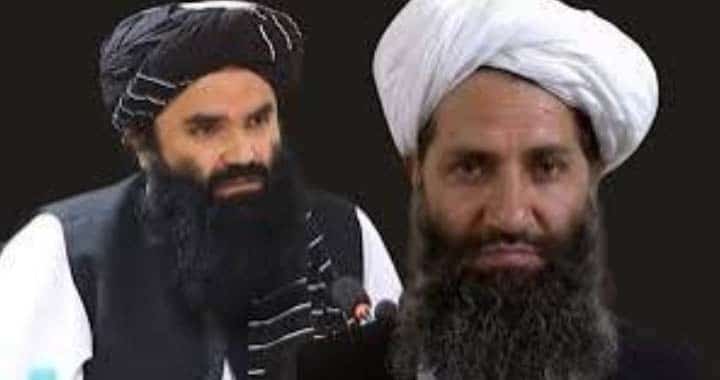
A potentially significant rift is emerging within the Taliban leadership, as Interior Minister Sirajuddin Haqqani has delivered an unusually direct message that appears to challenge the growing concentration of authority around Taliban supreme leader Hibatullah Akhundzada.
Speaking at a gathering at Kabul University on Monday, Haqqani openly acknowledged that many people remain dissatisfied with Hibatullah’s policies and stressed that no individual should be considered indispensable within an Islamic system. He emphasized that the system itself must take precedence over any single personality, making remarks that carry unmistakable political significance amid growing questions about internal cohesion and the distribution of power within the Taliban establishment.
Haqqani’s message appears to go beyond a disagreement over individual policies. It raises a much deeper question about who controls the Taliban’s political direction and whether the entire governing structure should remain subordinate to the personal authority of Hibatullah Akhundzada.
His public acknowledgment of dissatisfaction is particularly noteworthy. Rather than dismissing criticism or defending the existing concentration of authority, Haqqani openly recognized that discontent exists. His insistence that no individual is indispensable can be interpreted as a pointed warning against the personalization of power and the transformation of the Taliban administration into a system revolving around one man’s decisions.
These remarks could signal widening differences within the Taliban’s senior leadership, particularly over governance, the exercise of authority, institutional decision-making, and the future direction of the administration. While Haqqani did not explicitly announce a split or name Hibatullah as the target of his criticism, the timing, substance, and political implications of his statements are difficult to overlook.
The apparent disagreement exposes a potentially serious fault line within the Taliban leadership: those who favour the concentration of authority around the supreme leader and those who believe that the system cannot function sustainably under the personal dominance of one individual.
If these differences continue to surface publicly, they could complicate the Taliban’s efforts to project unity and cohesion. A movement that presents itself as politically and ideologically unified may face increasing challenges when influential figures within its own leadership begin publicly questioning the principles underpinning its power structure.
Haqqani’s intervention also raises questions about whether dissatisfaction within the Taliban establishment is extending beyond individual policy disagreements into a broader debate over political authority and institutional control. Such a development would be significant because internal disagreements at the highest level could have consequences for the administration’s decision-making, political stability, and future leadership dynamics.
The central issue is no longer simply whether certain Taliban policies are unpopular. It is whether influential figures within the movement are becoming increasingly uncomfortable with the concentration of power in Hibatullah Akhundzada’s hands.
One thing is clear: Haqqani has publicly placed the question of individual dominance versus institutional authority on the table. That is a politically significant message coming from one of the Taliban’s most powerful figures.
The Taliban leadership may continue to project an image of unity, but public statements questioning the concentration of authority suggest that underlying differences deserve serious attention. Whether these differences develop into an open political confrontation remains to be seen.
When senior figures begin questioning the structure of power itself, the issue is no longer an ordinary policy disagreement. It may be the beginning of a much deeper struggle over authority, influence, and the future direction of the Taliban leadership.
The emerging question is stark: Is the Taliban leadership still united behind one supreme authority, or are cracks beginning to appear beneath the surface of its political structure?



