
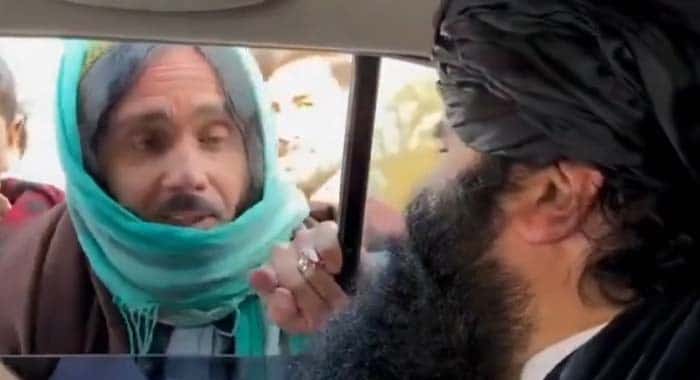
A public encounter between Afghan Taliban Interior Minister Sirajuddin Haqqani and a young man identifying himself as a member of Tehreek-e-Taliban Pakistan (TTP) in Khost province has brought renewed attention to the presence of the militant organization in Afghanistan and the Taliban regime’s repeated denials of providing sanctuary to anti-Pakistan terrorist groups.
The encounter, captured on video during Haqqani’s visit to Khost, has attracted particular attention after the young man introduced himself as Zabiullah, identified Kotkai in South Waziristan, Pakistan, as his place of origin, and openly declared his affiliation with a TTP faction associated with Hakimullah Mehsud and Qari Hussain, two prominent figures in the organization’s history.
The incident raises serious questions about the continued presence of TTP-linked individuals in Afghanistan, the environment in which militant networks operate, and the effectiveness of the Taliban regime’s measures to prevent Afghan territory from being used for terrorist activities against Pakistan.
According to accounts of the encounter, the incident took place while Sirajuddin Haqqani was visiting Khost province. During a public greeting, a bearded young man approached the window of Haqqani’s vehicle, introduced himself as Zabiullah, and identified himself with a TTP faction associated with Hakimullah Mehsud and Qari Hussain.
The open declaration of affiliation with a militant organization responsible for years of violence against Pakistan has drawn attention to the wider security implications of the incident. The reference to figures associated with the TTP’s earlier leadership and operational history further highlights the persistence of militant affiliations and networks in the region.
An Afghan journalist, who previously served as an editor of a prominent jihadi magazine in Pakistan and requested anonymity because he currently resides in Kabul, described the encounter as particularly striking. According to the journalist, Sirajuddin Haqqani is widely admired among young Taliban members and individuals associated with the Haqqani Network.
The journalist observed that Haqqani is frequently surrounded by Taliban members and sympathizers during public appearances. However, he noted that the young man’s open declaration of his TTP affiliation during the encounter in Khost had attracted considerable attention.
Pakistan has consistently maintained that the TTP operates from Afghan territory and continues to pose a serious threat to its national security. Islamabad has repeatedly raised concerns about the presence of TTP members in Afghanistan and their ability to organize, facilitate, and launch terrorist attacks against Pakistani civilians, law enforcement personnel, and security forces.
The Taliban authorities have repeatedly denied permitting anti-Pakistan militant organizations to use Afghan territory for terrorist activities. However, the Khost encounter has intensified scrutiny of these denials and raised fresh questions about the extent of the TTP’s presence in Afghanistan.
According to the Afghan journalist, TTP-linked elements are present in eastern Afghan provinces, including Khost and Paktika, where the Haqqani Network has historically exercised considerable influence. The journalist further maintained that the ability of militant organizations to operate in these areas is closely connected to local power structures and relationships.
These circumstances underscore the importance of examining the security environment in which militant groups continue to function and of ensuring that assurances concerning counter-terrorism are supported by concrete, verifiable action.
For Pakistan, the fundamental concern remains clear: terrorist organizations must not be permitted to exploit Afghan territory as a safe haven from which to threaten Pakistan’s security and the lives of its citizens. The reference to Hakimullah Mehsud and Qari Hussain is significant in view of the TTP’s history and the violence associated with its leadership.
Hakimullah Mehsud led the TTP from 2009 until his death in a US drone strike in November 2013. During his tenure, the organization carried out numerous terrorist attacks against Pakistan. Qari Hussain was a prominent figure associated with the group’s suicide-bombing operations.
The identification of a TTP faction with these figures highlights the continuing relevance of the organization’s historical networks and ideological affiliations. It also draws attention to the need for effective measures to prevent militant groups from maintaining operational capacity and recruiting or mobilizing individuals across the region.
The central issue is not simply the identity of an individual encountered in Khost, but the broader question of whether TTP-linked networks continue to maintain a presence in Afghanistan and whether the Taliban authorities are taking sufficient action to prevent them from threatening Pakistan.



