
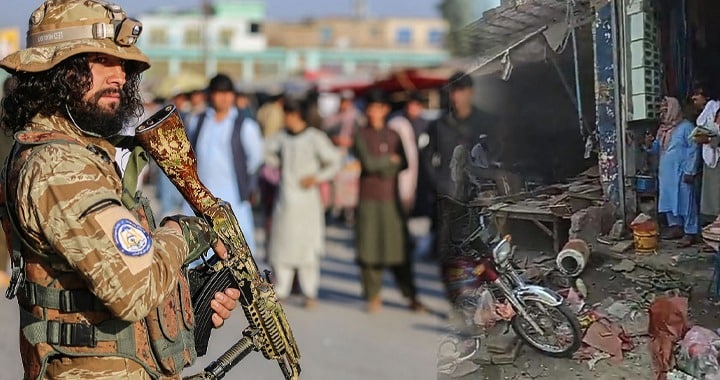
The regional security debate surrounding Afghanistan, and the terror sanctuaries therein, has increasingly shifted from questions of possibility toward questions of accountability, as mounting evidence, repeated militant incidents, and growing international concern continue to reinforce Pakistan’s long-standing position regarding the presence of anti-Pakistan terrorist infrastructure operating from Afghan territory.
For years, Islamabad has maintained that groups such as Tehreek-e-Taliban Pakistan (TTP), Hafiz Gul Bahadur network, and affiliated extremist organizations continue to exploit ungoverned or insufficiently controlled spaces inside Afghanistan to organize, recruit, train, and launch attacks against Pakistan.
Recent developments have significantly strengthened this position.
The Bannu attack once again brought the issue into sharp focus. Allegations made by former CIA targeting analyst Sarah Adams linked the operation to militants operating from Afghanistan. Former Afghan military chief General Yasin Zia similarly rejected Taliban denials regarding militant sanctuaries, openly acknowledging that extremist organizations continue to function from Afghan territory and threaten regional states including Pakistan, China, Iran, and Tajikistan.
Such statements carry strategic importance because they no longer originate solely from Pakistani officials. Increasingly, regional observers, former Afghan officials, and international analysts are publicly recognizing the persistence of extremist infrastructure within Afghanistan.
Pakistan’s concerns are also rooted in operational realities observed on the ground. Intelligence-based operations inside Khyber, North Waziristan, Mohmand, Bajaur, Lakki Marwat, and Bannu have repeatedly resulted in the elimination or arrest of Afghan nationals linked to terrorist organizations operating against Pakistan.
The identification of Afghan terrorist Owais Ahmad alias Mukhlis, eliminated during the Khyber operation, became another significant example reinforcing Islamabad’s concerns regarding the direct involvement of Afghan citizens in terrorist activities inside Pakistan.
At the diplomatic level, Pakistan’s messaging has become visibly firmer. Defence Minister Khawaja Asif recently warned that Islamabad would respond decisively if cross-border terrorism continued, while senior officials reiterated that no sovereign state could tolerate permanent terrorist sanctuaries threatening its population.
Pakistan’s position is increasingly shaped by a broader strategic calculation, terrorism today is no longer confined to isolated militant attacks, but forms part of a larger destabilization ecosystem involving propaganda operations, recruitment networks, ideological facilitation, financial channels, and cross-border logistical support.
Compounding the issue is the growing use of civilian environments by extremist elements for operational concealment. Pakistani officials and security analysts argue that terrorist organizations deliberately embed themselves within populated areas, abandoned military compounds, and dual-use infrastructure in order to complicate counterterrorism responses and generate propaganda narratives after military engagements.
Simultaneously, Pakistan believes parts of the international discourse continue to understate the scale of cross-border terrorism targeting Pakistani civilians and security personnel. Officials argue that any balanced assessment of regional stability must account not only for allegations regarding counterterrorism operations, but also for the infrastructure and militant ecosystems that trigger such responses in the first place.
Despite escalating rhetoric, Pakistan continues to publicly emphasize that regional stability remains its preferred outcome. Islamabad has participated in multiple diplomatic engagements involving China, Qatar, Türkiye, and Saudi Arabia aimed at reducing tensions and encouraging constructive engagement with Kabul.
However, Pakistani policymakers increasingly view verifiable action against terrorist sanctuaries, rather than verbal assurances alone, as the defining benchmark for future regional stability.
As the regional security environment continues evolving, Afghanistan remains central to Pakistan’s national security calculus, not merely as a neighboring state, but as the primary geographical arena influencing the trajectory of terrorism, border stability, and counterterrorism operations across the wider region.



