
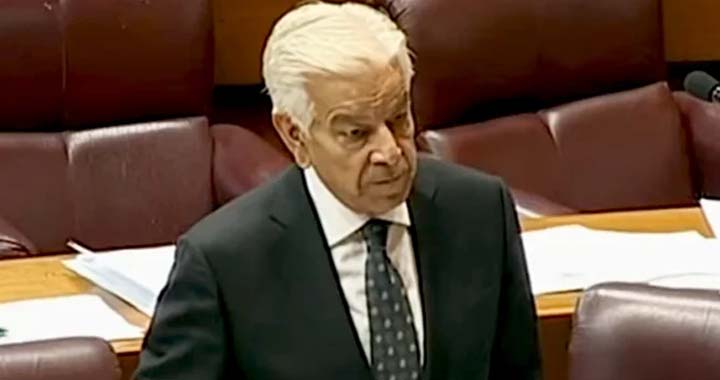
Pakistan’s Defence Minister Khawaja Asif issued a strong warning to Afghanistan’s Taliban-led administration over continued concerns regarding cross-border terrorism, stating that Pakistan would respond to Kabul in the same manner it responds to New Delhi if militant activity allegedly emanating from Afghan soil continues.
Addressing the National Assembly, the Defence Minister said Pakistan sees a “converging threat environment” along both its eastern and western borders, arguing that hostile elements operating from across the frontiers are undermining national security.
“There is no difference between Delhi and Kabul,” Khawaja Asif said during his address, adding that what he described as “one enemy” is currently operating on both sides of Pakistan’s borders.
The Defence Minister accused the Afghan interim authorities of failing to provide written assurances to Pakistan regarding the prevention of cross-border terrorism, stating that only verbal commitments had been offered despite repeated diplomatic engagements.
“Kabul is not giving us any guarantee to stop terrorism,” he said, adding that Pakistan has consistently sought formal and verifiable assurances from Afghan authorities on curbing militant activity allegedly originating from Afghan territory.
He further warned that failure to address Pakistan’s security concerns could lead to further escalation. “If they do not stop backing terrorists, then there will be war,” he stated, emphasizing that Pakistan has pursued diplomatic solutions but remains prepared to respond if necessary.
According to the Defence Minister, Pakistan had engaged in sustained diplomatic outreach involving regional partners, including Qatar, Saudi Arabia, and Türkiye, in an effort to de-escalate tensions and encourage cooperation between Islamabad and Kabul.
“We tried very hard to make them understand with the support of three countries,” he told lawmakers, referring to mediation efforts aimed at stabilizing relations and addressing security concerns through dialogue.
Khawaja Asif also commented on internal coordination challenges, stating that for a prolonged period the Khyber Pakhtunkhwa provincial government did not fully cooperate with the federal government on security matters, although he acknowledged that coordination has recently improved.
During the parliamentary session, opposition lawmakers interrupted proceedings with slogans as the Defence Minister underscored what he described as the sacrifices of Pakistan’s armed forces in combating terrorism.
“Our armed forces are giving unconditional sacrifices,” he said, adding that citizens and security personnel who lose their lives in border-related violence represent the resilience and identity of the nation.
Relations between Pakistan and Afghanistan have deteriorated in recent years amid Islamabad’s repeated concerns that Afghan territory is being used by militant groups targeting Pakistan. Pakistani officials have consistently urged the Taliban administration to take concrete and verifiable action against such groups.
Despite diplomatic efforts supported by friendly nations, including Türkiye and Qatar, which briefly eased tensions in the past, no lasting agreement has been reached between Islamabad and Kabul.
Pakistan maintains that it remains committed to regional peace and stability but has repeatedly stressed that it will not compromise on the security of its citizens in the face of ongoing militant threats.



