
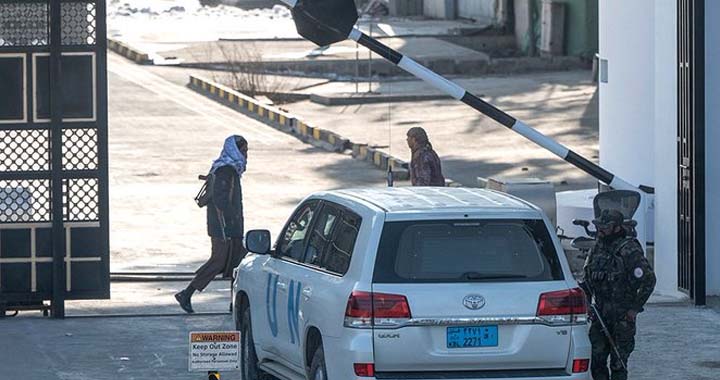
Serious concerns are being raised regarding the credibility, neutrality, and contextual completeness of recent reporting issued by the United Nations Assistance Mission in Afghanistan (UNAMA), particularly in relation to allegations surrounding Taliban-linked military infrastructure, cross-border terrorism, and the militarization of civilian spaces inside Afghanistan.
Security analysts and regional observers argue that UNAMA’s latest assessments rely heavily on information gathered within a tightly controlled Taliban environment while failing to adequately account for the broader regional security landscape, including the operational presence of internationally designated terrorist organizations functioning from Afghan territory.
According to documented security data, Pakistan experienced an unprecedented wave of cross-border terrorism during 2025, resulting in approximately 1,957 fatalities and 3,603 injuries, while national counterterrorism operations neutralized nearly 3,079 terrorists involved in militant activity. Despite the scale of these attacks, critics note that UNAMA itself has acknowledged that it does not monitor incidents occurring inside Pakistan, creating what observers describe as a selective reporting framework that excludes the downstream consequences of militant sanctuaries operating from Afghanistan.
Analysts further question the viability of independent verification mechanisms under current conditions in Afghanistan, where all operational access, institutional coordination, witness engagement, and movement permissions remain subject to Taliban authority and oversight.
“Afghanistan today is governed by an armed movement rather than a neutral and internationally recognized state structure,” one regional security observer stated. “Under such circumstances, claims of independent verification must be examined carefully, especially when humanitarian and monitoring mechanisms function under the direct influence of Taliban authorities.”
Concerns have also emerged regarding the classification of individuals identified in recent reports as “victims” or “patients” without publicly clarifying the evidentiary standards used to determine the absence of operational, logistical, or militant affiliations. Afghanistan continues to host more than twenty active extremist and terrorist organizations, including Tehreek-e-Taliban Pakistan (TTP), Al-Qaeda, Islamic State Khorasan Province (ISKP), and the Eastern Turkistan Islamic Movement (ETIM).
Security experts maintain that Pakistan’s counterterrorism operations are directed against terrorist infrastructure and militant-linked operational facilities, rather than civilian populations. Officials emphasize that kinetic actions are conducted under established national security protocols aimed at neutralizing cross-border threats and preventing attacks on Pakistani territory.
Additional scrutiny has focused on the so-called “Omid” facility, which reports indicate was situated within the former Camp Phoenix military compound in Kabul. Analysts argue that the location itself raises serious questions regarding the integration of civilian rehabilitation infrastructure inside a historically militarized operational environment.
Available assessments further indicate that the site was located within close proximity approximately 200 meters of ammunition storage infrastructure, intensifying concerns regarding the Taliban’s practice of embedding military-linked logistics and ordnance facilities within civilian-populated zones.
On 2 May 2026, Afghanistan Green Trend, led by former Afghan Vice President and former intelligence chief Amrullah Saleh, publicly alleged that Taliban authorities had relocated approximately 23 containers of ammunition and weapons into the Bagh-e-Qazi area near a civilian flour market in Kabul. According to publicly circulated materials, detailed maps identifying these alleged weapons storage sites were also released.
Experts in international humanitarian law note that the legal protections afforded to medical and humanitarian facilities are conditional under the Geneva Conventions and customary international law.
Under Article 18 of the Geneva Conventions, medical facilities retain protected status only when they are exclusively dedicated to humanitarian purposes and remain clearly separated from military objectives. Article 19 further provides that such protection may cease if facilities are used for acts harmful to an opposing force, including the shielding of weapons infrastructure, operational coordination, or militant activity.
Similarly, Article 8(2)(b)(ix) of the Rome Statute and broader principles of distinction under international humanitarian law recognize that locations integrated into militant logistics, ordnance storage, or operational military activity may constitute lawful military objectives irrespective of civilian labeling.
Analysts also point out that Taliban forces have long faced allegations of embedding fighters, weapons, and operational infrastructure within densely populated civilian environments, including homes, schools, mosques, and public facilities. Critics argue that this pattern effectively exposes civilians to heightened risks while enabling propaganda exploitation following military engagements.
Observers contend that international monitoring bodies must address the broader issue of militant militarization of civilian areas and alleged human shield tactics with greater consistency and transparency.
“There cannot be selective humanitarian scrutiny,” a regional analyst noted. “Any credible reporting framework must account for the full spectrum of threats, including terrorist safe havens, cross-border attacks, militarization of civilian spaces, and the manipulation of civilian infrastructure for operational purposes.”
Calls are now increasing for greater transparency regarding verification methodologies, source reliability, operational independence, and contextual balance in future reporting concerning Afghanistan’s evolving security environment.



