
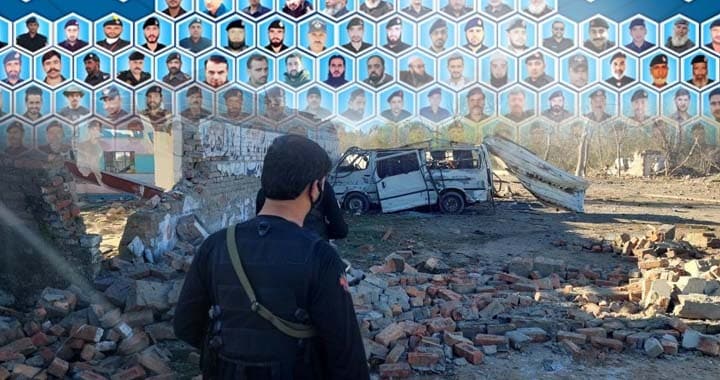
Khyber Pakhtunkhwa Police today stand at the center of Pakistan’s frontline war against terrorism, confronting one of the harshest operational environments faced by any civilian law enforcement force in the region. From Bannu and Lakki Marwat to Dera Ismail Khan and former tribal districts, police personnel are increasingly becoming primary targets of heavily armed terrorist networks seeking to weaken the state’s local enforcement structure through sustained violence and intimidation.
The numbers alone illustrate the scale of sacrifice. Since 2023, more than 580 police personnel have embraced martyrdom in terrorist attacks across Khyber Pakhtunkhwa. Police stations, checkpoints, patrol vehicles, and intelligence units continue to face repeated assaults involving suicide bombings, ambushes, improvised explosive devices, sniper attacks, and coordinated raids.
The Fateh Khel attack in Bannu became one of the clearest examples of this intensifying threat. A massive explosive-laden vehicle targeted a police checkpoint, flattening the structure and martyring numerous personnel. Only days later, Lakki Marwat witnessed another devastating attack targeting police and civilians alike.
Yet these attacks also exposed an important strategic reality, terrorist organizations increasingly view KP Police not simply as a law enforcement institution, but as the most visible symbol of state authority at the grassroots level.
Unlike military installations protected through large, fortified compounds, police checkpoints and stations remain directly embedded within civilian environments. Police personnel patrol markets, highways, villages, and urban neighborhoods daily, making them more exposed to asymmetric terrorist tactics.
However, reducing the conversation solely to vulnerabilities would ignore the extraordinary transformation undergone by KP Police over the last two decades. Since the height of militancy after 2003, the force has evolved from a conventional policing institution into one of Pakistan’s most battle-hardened counterterrorism forces.
From Malik Saad and Safwat Ghayur to hundreds of unnamed constables and officers, the force has paid an immense human cost while preventing terrorist organizations from overwhelming urban centers across the province.
At the same time, the evolving nature of terrorism demands corresponding modernization. Today’s militants increasingly employ quadcopters, encrypted communications, coordinated assaults, and advanced explosives. Countering such threats requires continuous investment in armored mobility, surveillance systems, thermal imaging, anti-drone capabilities, fortified infrastructure, and rapid intelligence coordination.
Provincial and federal authorities have recently accelerated modernization efforts through the induction of bulletproof vehicles, drones, upgraded police infrastructure, and enhanced tactical support systems. Yet security analysts argue that modernization must become institutional rather than reactive.
Another major challenge lies in personnel sustainability and morale. Officers deployed in high-risk southern districts continue to face extreme operational pressure, while repeated attacks place immense psychological strain on frontline personnel and their families.
The issue therefore extends beyond equipment alone. Long-term success requires improved welfare structures, specialized counterterrorism training, intelligence integration, rapid reinforcement capabilities, and stronger coordination between police, Frontier Constabulary, intelligence agencies, and military support elements.
Equally critical is governance consolidation in former tribal districts. Security experts repeatedly emphasize that sustainable peace cannot rely solely on kinetic operations. Effective policing infrastructure, administrative presence, judicial access, and local governance mechanisms remain essential to preventing militant re-entrenchment.
Despite enormous challenges, KP Police continues to function as one of Pakistan’s strongest defensive walls against terrorism. The force remains under relentless attack precisely because it continues to obstruct terrorist attempts to reclaim operational freedom across the province.
The broader national consensus increasingly recognizes that strengthening KP Police is no longer merely a provincial requirement, it is a central pillar of Pakistan’s overall national security architecture.



