
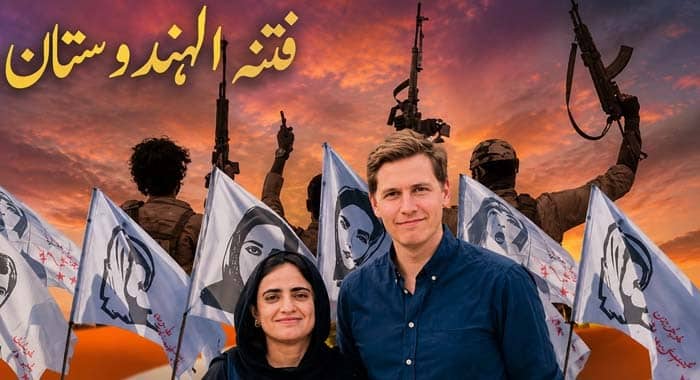
The recent social media campaign by the Baloch Yakjehti Committee (BYC) against state institutions and the judicial system has drawn attention after the organisation described legal proceedings against its leaders, including Dr. Mahrang Baloch, Shah Jee Sibtullah, and others, as an attempt to suppress political voices in Balochistan.
However, critics argue that the narrative being promoted by the organisation presents only one aspect of the situation while overlooking the broader realities of the province, including decades of terrorism, violence, sabotage activities, and security challenges that have affected the lives of ordinary citizens.
Observers maintain that the situation in Balochistan requires a balanced understanding that considers all dimensions political, social, security, and economic rather than relying on one-sided interpretations. Pakistan’s constitutional system provides a complete legal framework for resolving disagreements through courts and established institutions.
Judicial decisions are made based on evidence, legal procedures, and constitutional principles. While every citizen and organisation has the right to disagree with a court decision, questioning the entire judicial process without pursuing available legal remedies can weaken public confidence in state institutions. The Constitution provides mechanisms for appeals and legal review, ensuring that individuals have the opportunity to challenge decisions through lawful channels. A democratic society depends on respect for the rule of law, where disagreements are addressed through courts, parliament, and constitutional forums rather than through campaigns aimed at creating mistrust.
Balochistan has faced serious challenges for several decades, including terrorism, targeted killings, armed violence, sabotage, and attacks on public infrastructure. During this period, thousands of innocent citizens, including labourers, teachers, doctors, engineers, transport workers, government employees, and security personnel, have lost their lives. The province’s development and stability have been deeply affected by insecurity and violent activities. Analysts argue that any discussion about Balochistan’s future must also acknowledge the suffering caused by terrorism and instability, as ignoring these realities creates an incomplete picture of the province. The solution to Balochistan’s challenges lies in peace, stability, political participation, and development not violence or confrontation.
A genuine commitment to the welfare of Balochistan’s people requires an unconditional rejection of violence in all forms. Targeting innocent civilians, damaging public property, creating fear, or disrupting daily life cannot be justified under any political or ideological position. The protection of human life must remain above political disagreements. Those who claim to represent public interests must support peaceful solutions and reject any actions that harm ordinary citizens.
Pakistan’s Constitution guarantees freedom of expression, peaceful assembly, and political participation. However, these rights exist within legal boundaries. The responsibility of the state is to maintain public order, protect citizens, safeguard property, and prevent activities that may contribute to instability or violence. Therefore, enforcement of law and order cannot automatically be described as suppression of political activity without examining the complete circumstances. A functioning democracy requires both protection of political rights and respect for legal responsibilities.
The future of Balochistan is strongly linked with education, employment, investment, infrastructure development, and economic stability.
Major national projects, including the China-Pakistan Economic Corridor (CPEC) and Gwadar Port, are designed to enhance connectivity, create employment opportunities, improve infrastructure, and transform Balochistan into a regional economic hub. Demanding greater participation and benefits for local communities is a legitimate part of public discussion. However, complete opposition to development projects or creating obstacles to economic activity may ultimately harm the long-term interests of the people of Balochistan. Sustainable development requires cooperation, stability, and an environment where investment and growth can continue.
The people of Balochistan require practical solutions to everyday challenges, including:
- Quality education
- Better healthcare facilities
- Improved roads and infrastructure
- Industrial growth
- Digital connectivity
- Employment opportunities
The province’s youth need access to skills, technology, innovation, and professional opportunities. Continuous confrontation, instability, and political tension do not resolve public issues; instead, they create further obstacles to progress.
Government employees, teachers, civil servants, and public officials receive state resources and are entrusted with serving citizens. Their constitutional responsibility is to ensure delivery of public services, strengthen institutions, and maintain professionalism. Any actions that disrupt education, healthcare, transport, administration, or essential services directly affect ordinary citizens and weaken public welfare. Institutional stability is essential for development and public trust.
The youth of Balochistan are the province’s greatest asset.
They should be encouraged toward:
- Education
- Research
- Skills development
- Entrepreneurship
- Constructive political participation
Successful societies empower young generations through knowledge and opportunity rather than allowing them to become trapped in cycles of conflict and instability. A prosperous future requires investment in youth rather than promoting frustration and confrontation.
The province faces a defining choice between two paths:
Violence or peaceful politics
Instability or development
Isolation or opportunity
Conflict or progress
Pakistan’s democratic system provides multiple platforms for expression, including elections, political parties, parliament, judiciary, media, and civil society. Meaningful and lasting change can only be achieved through democratic and constitutional means. Every citizen has the right to express opinions, demand reforms, and participate in political activities. However, no individual, group, or organisation can claim exemption from the law. Public interest lies in peace, stability, economic progress, education, and opportunities not in narratives that increase division, mistrust, and confrontation. The people of Balochistan deserve security, dignity, prosperity, and equal opportunities. These goals cannot be achieved through hostility, division, or instability. They require constitutional engagement, peaceful dialogue, development initiatives, and respect for the rule of law.
Observers believe that attempts to turn legal matters into political confrontation and promote distrust against institutions risk diverting young people away from constructive paths. The future of Balochistan depends on education, investment, unity, stability, and sustainable development. Progress not conflict remains the path toward a peaceful and prosperous Balochistan.



