
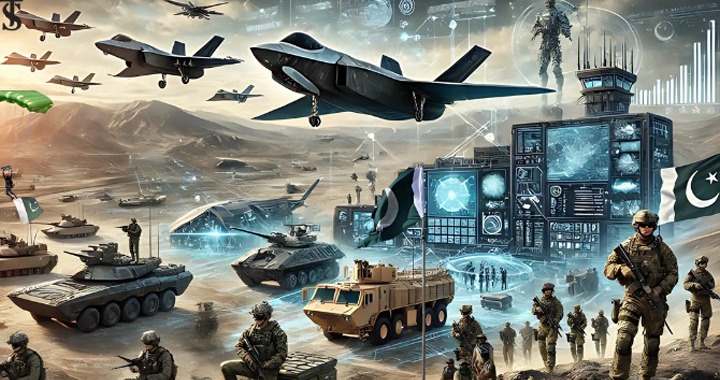
In a comprehensive address at the prestigious Shangri-La Dialogue 2026, Lieutenant General Noman Zakria underscored the profound impact of emerging technologies on international security, warning that artificial intelligence (AI), cyber capabilities, autonomous systems, space technologies, and multi-domain operations are fundamentally reshaping the nature of warfare and strategic stability.
Speaking before an audience of policymakers, military leaders, strategic thinkers, and security experts from across the globe, Lt Gen Zakria highlighted the opportunities and risks presented by rapid technological advancements, emphasizing that the future of deterrence and conflict management will increasingly depend not only on military capabilities but also on governance frameworks, crisis communication mechanisms, and societal resilience.
His remarks focused particularly on the evolving security environment in South Asia, where nuclear deterrence, conventional military dynamics, political tensions, and unresolved disputes continue to influence regional stability.
Addressing one of the central themes of his presentation, Lt Gen Zakria noted that the accelerating integration of artificial intelligence, autonomous weapons systems, cyber operations, quantum technologies, and space-based capabilities is transforming military decision-making at an unprecedented pace.
According to the presentation, these technologies are compressing decision cycles, reducing reaction times, and creating new vulnerabilities that challenge traditional concepts of deterrence and escalation management.
He cautioned that while technological innovation offers significant military advantages, it simultaneously increases the risk of miscalculation, unintended escalation, and strategic instability, particularly in regions characterized by high operational tempos and limited warning times.
“The speed of technological change is outpacing the development of governance mechanisms designed to manage its consequences,” he observed, stressing the need for international cooperation to ensure that emerging technologies contribute to stability rather than undermine it.
A major portion of the discussion focused on the growing significance of the information environment as an arena of strategic competition.
Lt Gen Zakria highlighted the rise of AI-generated content, disinformation campaigns, algorithm-driven influence operations, and digital manipulation, noting that information integrity has become a critical national security concern.
He argued that strategic competition increasingly extends beyond conventional military domains into cyberspace and the cognitive sphere, where narratives, perceptions, and public trust can significantly influence national resilience and decision-making.
The address emphasized that safeguarding information ecosystems and strengthening public trust have become as important to national security as maintaining conventional military capabilities.
Discussing regional security dynamics, Lt Gen Zakria described South Asia as a uniquely sensitive strategic environment where nuclear deterrence remains a central pillar of stability.
He noted that the region’s security architecture continues to be shaped by several interconnected factors, including nuclear deterrence, conventional force asymmetries, enduring political tensions, and unresolved territorial and ideological disputes between India and Pakistan.
The presentation also referenced China’s role in the broader regional landscape, describing Beijing as a contributor to regional balance through economic connectivity, development initiatives, and strategic engagement.
Despite evolving military technologies, Lt Gen Zakria maintained that nuclear deterrence continues to play a critical role in preventing large-scale conflict in South Asia. However, he warned that emerging technologies are introducing new variables that could complicate crisis management and increase uncertainty during periods of tension.
One of the most closely watched segments of the presentation centered on Pakistan’s assessment of the May 2025 India-Pakistan conflict.
According to Lt Gen Zakria, the conflict demonstrated the growing importance of integrated multi-domain operations in modern warfare. He stated that Pakistan’s military response involved the coordinated employment of land, air, and maritime capabilities alongside cyber operations, electronic warfare, intelligence, surveillance and reconnaissance (ISR) assets, space-enabled systems, and information operations.
The experience, he argued, highlighted the increasingly interconnected nature of contemporary conflict, where success depends on the seamless integration of capabilities across multiple domains rather than reliance on a single service or platform.
The presentation further suggested that recent developments have reinforced the understanding that the concept of a limited conventional war under a nuclear overhang is becoming increasingly constrained, thereby placing greater emphasis on deterrence and escalation management.
During the question-and-answer session, Lt Gen Zakria elaborated on the risks associated with AI-enabled military systems and decision support technologies.
He explained that AI has the potential to dramatically compress the Observe-Orient-Decide-Act (OODA) cycle, accelerating the transition from detection to action.
While such capabilities may improve operational effectiveness, he cautioned that shortened decision timelines can reduce opportunities for careful assessment and increase the likelihood of disproportionate or unintended responses during crises.
According to the discussion, operational-level incidents could rapidly escalate into strategic-level confrontations if adequate safeguards and communication mechanisms are not in place.
Lt Gen Zakria also highlighted the distinctive nature of the India-Pakistan deterrence environment, describing it as one of the most time-sensitive strategic relationships in the world.
Unlike other nuclear rivalries where warning and response windows may be measured in minutes or hours, reaction times in South Asia are often measured in seconds.
This compressed strategic environment, he argued, makes robust crisis management mechanisms, effective communication channels, and confidence-building measures particularly important for maintaining stability and preventing escalation.
Responding to questions regarding Pakistan’s evolving military capabilities, Lt Gen Zakria provided important clarifications regarding the country’s Rocket Force.
He stated that the Rocket Force is a conventional military capability and operates independently from Pakistan’s nuclear deterrent structure.
According to the explanation, the force maintains separate command-and-control arrangements and authorization procedures, with its primary purpose being to strengthen conventional deterrence, survivability, and operational flexibility.
The discussion acknowledged that rocket systems inherently compress escalation timelines due to their speed and reach. Consequently, their deployment further reinforces the importance of communication mechanisms and escalation-control measures within the broader regional security framework.
Lt Gen Zakria emphasized that survivability remains a fundamental component of deterrence, enabling states to maintain strategic stability while reducing incentives for pre-emptive action.
Looking toward the future, the address concluded with a series of policy recommendations aimed at strengthening global strategic stability in an era of rapid technological transformation.
Among the key proposals was the development of international norms and governance frameworks covering military artificial intelligence, autonomous weapons systems, cyber operations, and space-based capabilities.
Lt Gen Zakria stressed that meaningful human oversight must remain central to decisions involving the use of force, regardless of technological advancements.
He further called for greater international cooperation on space governance, protection of civilian infrastructure, oversight of autonomous weapons, and the modernization of legal and institutional frameworks that have struggled to keep pace with technological developments.
The presentation also emphasized that strategic stability extends beyond military balances and technological capabilities.
According to Lt Gen Zakria, resilient societies constitute an essential pillar of national security. He highlighted the importance of cyber resilience, digital literacy, protection of critical infrastructure, and public trust in institutions as key factors in resisting disinformation campaigns and external manipulation.
In an increasingly interconnected world, he argued, national resilience will play a decisive role in determining how effectively states respond to emerging threats and maintain stability during periods of crisis.
The address delivered three overarching messages to the international strategic community.
First, emerging technologies and artificial intelligence are creating unprecedented opportunities while simultaneously introducing new risks of miscalculation and escalation.
Second, recent military developments have demonstrated the growing importance of integrated multi-domain operations in shaping deterrence dynamics and future conflict environments.
Third, sustainable strategic stability in the twenty-first century will depend not solely on military capabilities but increasingly on responsible governance of technology, effective crisis communication mechanisms, resilient institutions, and prudent statecraft.
As geopolitical competition intensifies and technological innovation accelerates, Lt Gen Zakria’s remarks underscored a central challenge confronting policymakers worldwide: ensuring that the tools designed to enhance security do not inadvertently become catalysts for instability.



